




deanna witkowski.
jazz in the pews
cohort. 2025-26
project. Jazz in the Pews: Mary Lou Williams, Eddie Bonnemère, and The Community of St. Thomas the Apostle
location. Harlem
medium. research report
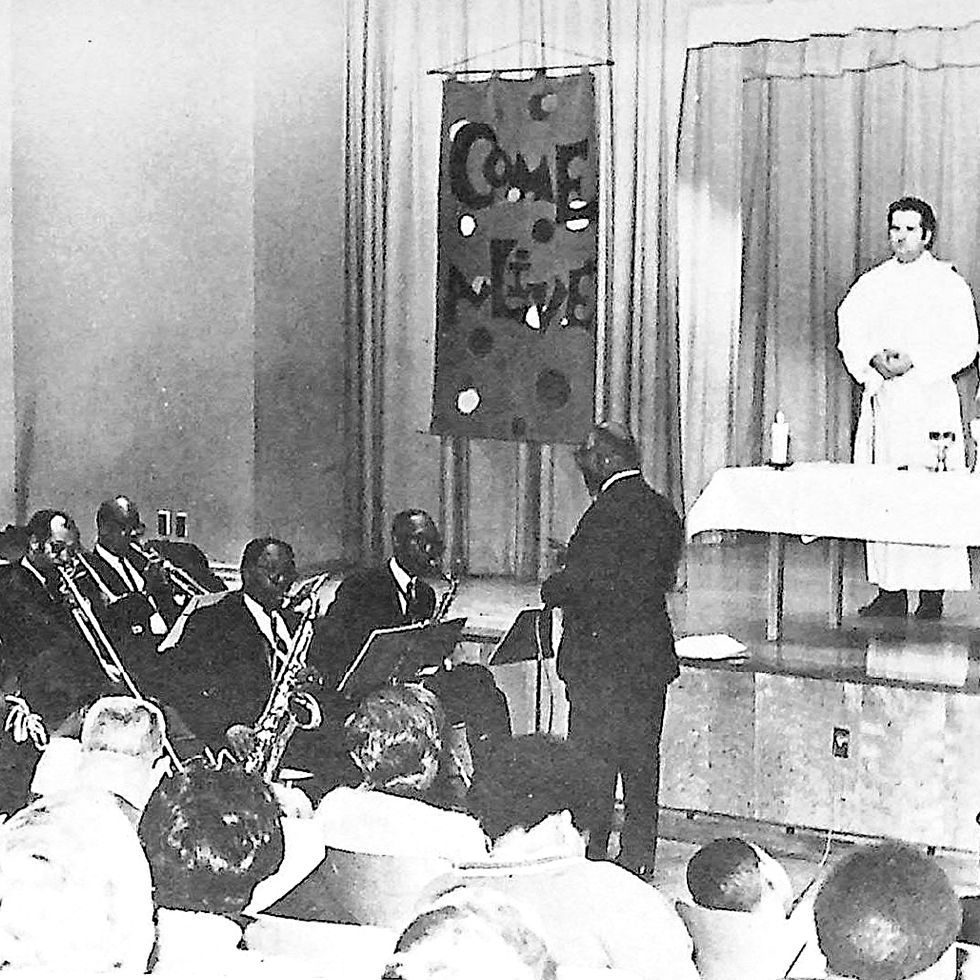
Eddie Bonnemère (middle) leading congregational singing at St. Thomas (1968)
Photo by George A. Alexander in “The Community of St. Thomas the Apostle,” Liturgy 14, vol. 1 (January 1969): 4-14.
In the late 1960s, a unique partnership between two Black Catholic composers and two white Catholic clergy led to the creation of a four-year jazz ministry at a predominantly Black Catholic parish in Harlem, St. Thomas the Apostle Church. Located on West 118th Street less than one block west of Minton’s Playhouse, one of the primary incubators of bebop in the 1940s, the parish began an “experiment in Sunday worship” in the fall of 1967. The initial concept of the experiment was to commission several jazz musicians to write a series of Masses for a full liturgical year beginning with the season of Advent. Three jazz pianists, Billy Taylor, Eddie Bonnemère, and Mary Lou Williams were invited to participate. Ultimately, the latter two accepted the invitation, with Williams composing her Mass for the Lenten Season and Bonnemère composing four Masses beginning with his Advent Mass.

Mary Lou Williams rehearses her third Mass, Mary Lou’s Mass, with students at Elizabeth Seton High School in Pittsburgh. Williams composed and rehearsed her first two Masses in 1967 and 1968-69 while teaching at Seton. | Donald Gielas, “Jazz is really spiritual music,” Pittsburgh Catholic, February 23, 1973, 7.
For St. Thomas, as for many other Catholic churches in the wake of Vatican II, experimentation in musical styles was a necessity. In 1963, Sacrosanctum Concilium (Constitution on the Sacred Liturgy), the first conciliar document to come out of the Second Vatican Council, was promulgated. One of the primary directives of the document encouraged the “full, active participation” of lay people at Mass, especially via communal song to be sung in the vernacular as part of the Church’s shift away from Latin as the sole language for liturgy. On the local level, parishes now sought to find, create, or commission accessible liturgical music that utilized the language of its congregants. While folk Masses became incorporated into Catholic worship during this period, jazz Masses were also created for use in Catholic (as well as in Episcopalian and Lutheran) congregations.
On this 1967 Impulse release, Al Collins satirizes the use of jazz in liturgy while Steve Martin accompanies on organ.
Mary Lou Williams (1910-81) and Eddie Bonnemère (1921-96) were both jazz musicians and Catholics who were involved with liturgical reform. Converting to Catholicism in 1957 after several years of an intentional spiritual search and a hiatus from public performance, Williams experienced a reinvigorated sense of purpose in her music when she began composing religious jazz in 1962. She composed her first jazz Mass for students at Elizabeth Seton High School in Pittsburgh in 1967. For Bonnemère, a lifelong Catholic who had previously played organ for five Masses each Sunday at St. Mark the Evangelist, a Black Catholic parish on 138th Street in Harlem, the idea of combining jazz with liturgy grew out of his graduate composition studies at Hunter College. His first jazz Mass was performed at another Harlem Catholic parish, St. Charles Borromeo, in 1966.
While Williams and Bonnemère had previously composed jazz for communal worship, the type of support that each composer received at St. Thomas afforded them a luxury that few composers experience: the opportunity to try out the same liturgical setting week after week. In effect, St. Thomas was a “workshop” as much as it was an “experiment in Sunday worship.” While Williams had enjoyed earlier workshop-like scenarios in her years of arranging for big-band leader Andy Kirk and during periods of steady nightclub work in which she reworked her trio compositions and arrangements, St. Thomas offered a singular opportunity to refine her newly-created liturgical music on a weekly basis.
For Bonnemère, his four years at St. Thomas kickstarted his career as a sacred jazz composer and presenter. Concurrent with his work at St. Thomas, he became a regular music leader at the still-ongoing jazz vespers series at Saint Peter’s Church in midtown Manhattan. Known as “the jazz church,” this Lutheran church began its jazz ministry in earnest with its installation of the Rev. John Garcia Gensel as “jazz minister to New York City” in 1966. Beginning in 1967, Bonnemère played on a monthly basis at Saint Peter’s, leading the JESU (Jesus Ecumenical Singers United) Choir and his eight-piece band on the first Sunday of each month. Over the course of two decades, Bonnemère was prolific in composing new liturgical music at Saint Peter’s, including ten settings of Lutheran liturgies.
Yet while Saint Peter’s jazz ministry is well-documented, less known is the four-year jazz ministry at St. Thomas that was initiated by Fr. Kevin Kelly in 1967. It was at St. Thomas where Bonnemère honed his song leading skills and workshopped his music on a weekly, rather than monthly, basis. Partnering with Fr. Kelly and liturgist Fr. Robert Ledogar, Bonnemère further developed his philosophy of creating functional, accessible congregational music. He began receiving widespread attention when he led a gathering of 5000 attendees and the St. Thomas Choir in singing his Mass for Every Season at a national liturgical conference in August, 1968.

Back cover of Bonnemère’s 1964 Prestige release, Jazz Orient-ed

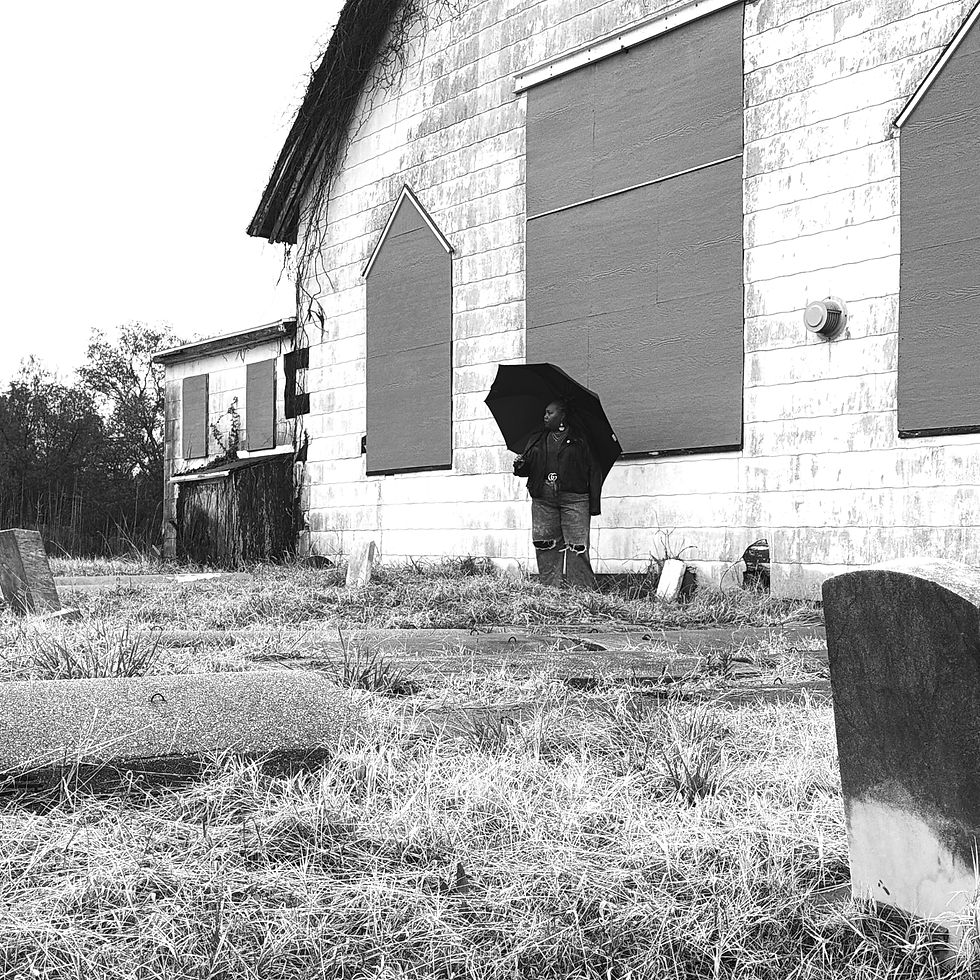
at 118th Street and St. Nicholas Avenue, New York City. St. Thomas was officially closed in 2003. photo by author (2023)
“Jazz in the Pews” offers a snapshot of the jazz ministry at St. Thomas to highlight its critical role in New York liturgical jazz history. This work is especially important because St. Thomas was closed in 2003 and the Archdiocese of New York’s Office of Black Ministry was closed in 2024, both developments that place this history at risk of erasure. Much of my archival findings come from research in Bonnemère’s papers that are housed at the New York Public Library’s Schomburg Center for Research in Black Culture, and I fully expect to learn more about St. Thomas and its jazz ministry as I continue my research.
“Jazz in the Pews” also centers the individual sacred music careers of Mary Lou Williams and Eddie Bonnemère. A digital map-in-progress indicating churches and conferences where Williams and Bonnemère presented their sacred music outside of St. Thomas showcases each composer’s work beyond New York. Because of my musical work as a jazz pianist who has performed Williams’s music for more than twenty years (my 2022 album, Force of Nature, features my arrangements of twelve Williams compositions) and my more recent work as a Williams biographer (Mary Lou Williams: Music for the Soul), I sometimes meet people who share anecdotes of having sung Williams’s sacred music with her at the piano, usually dating from the 1970s. As I learn of more locations where both Williams and Bonnemère performed their sacred music, I will add to these maps. If you have information about Williams or Bonnemère to contribute, please feel free to contact me.
earlier jazz masses by bonnemère and williams.
Prior to each of their tenures at St. Thomas, Williams and Bonnemère had each composed one jazz Mass. Bonnemère’s Missa Hodierna, which premiered in 1966 at another Harlem Catholic parish, St. Charles Borromeo Church, is credited as being the first jazz Mass to be used in an American Catholic liturgy. However, Williams’s initial religious works preceded Missa Hodierna by four years. On November 3, 1962, Williams premiered her “Hymn to St. Martin de Porres” (also titled “Black Christ of the Andes”) with soprano Ethel Fields as part of an annual civil rights Mass at St. Francis Xavier Church on West 14th Street. The date marked the first feast day of de Porres, the newly canonized Afro-Peruvian saint. The piece received its full choral premiere eight days later at Lincoln Center (then Philharmonic Hall). Several months later, Williams recorded the work with the Ray Charles Singers and released “Saint Martin” on her 1963 EP, Jazz for the Soul before including it as the title track of her 1964 religious jazz album, Mary Lou Williams Presents Black Christ of the Andes.[3]
While “Saint Martin” was a religious work with lyrics penned by Williams’s beloved spiritual confessor Fr. Anthony Woods, SJ, Williams rebuffed repeated requests from priests such as Fr. Norman O’Connor, CSP, to compose a jazz Mass. In a June, 1966 letter to her close friend Br. Mario Hancock, SA, an African American Franciscan friar who had originally introduced Williams to the canonization cause for Martin de Porres, she wrote, “Thought it best to drop the mass—Everybody has written a Jazz Mass.”[4]
Even so, in February, 1967, Williams accepted a commission to compose new religious works for a performance at Carnegie Hall sponsored by the New York Jesuits. The performance featured six commissioned composers and was recorded on the two-LP set, Praise the Lord in Many Voices (Avant Garde Records). With assistance from arranger-trombonist Melba Liston, Williams composed three new choral works including her “Our Father,” a setting of the Lord’s Prayer that she would simplify for use in two of her later jazz Masses.

Williams’s twenty-minute Carnegie Hall set begins with an early version of her “history of jazz” performances followed by three new sacred choral pieces arranged by Melba Liston. | Mary Lou Williams, Paul Quinlan, Praise the Lord in Many Voices: A Recorded Performance in Carnegie Hall (Part II), Avant Garde Records AVM-103, 1967, 33 1/3 rpm.
It appears that following the Carnegie Hall concert, Williams had a change of heart regarding composing a Mass. During the spring of 1967, she wrote her first Mass (though untitled, it is known as the Pittsburgh Mass) for her music theory students at Elizabeth Seton High School, an all-girl Catholic school in Pittsburgh run by the Sisters of Charity. On July 26, 1967, the Mass was sung by the Seton students at St. Paul’s Cathedral, located just across the street from where Williams had performed two years prior in a historic piano workshop (other performers included Duke Ellington and Willie “the Lion” Smith) at the Pittsburgh Jazz Festival. Williams was the visionary who had founded the festival with the financial assistance of the Catholic diocese of Pittsburgh in 1964.
Williams’s ongoing visits to her hometown of Pittsburgh played an important role in the evolution of her jazz Masses. She returned to Elizabeth Seton High School in early 1968 and was probably composing her Lenten Mass for St. Thomas during this time.
While Bonnemère’s name may not be a familiar one in jazz or sacred music histories, in the 1940s and 1950s he was a consistent presence in Harlem leading his jazz combos at the Savoy and Apollo ballrooms. He also had a thirty-five-year career as a public school educator, often having his students write poetry that he would set for regional choirs such as the Brooklyn Borough-Wide Chorus. Bonnemère’s liturgical jazz output began with his master’s studies in composition at Hunter College in New York. In 1966, he approached Msgr. Owen Scanlon, pastor at St. Charles Borromeo Church in Harlem, where he served as organist. Bonnemère had recently composed a jazz Mass entitled Missa Hodierna (“Mass for Today” or “Contemporary Mass”) as part of his degree program and wanted to include the work during a Sunday Mass. Although Scanlon later expressed reservations as to whether or not jazz as a genre was appropriate for use in the liturgy, he approved the music for use during a Mass on Mother’s Day. On May 8, 1966 (Williams’s birthday!), Missa Hodierna made history as the first jazz Mass to be used as part of an American Catholic liturgy. Parish leadership wildly underestimated the anticipated number of attendees: while 500 people were expected, 2000 showed up. Even though this enlarged number may, in part, have been due to the fact that it was Mother’s Day, advance press in the New York Amsterdam News shows that the jazz Mass was well-publicized within the greater Harlem community.[5]
Following its 1966 premiere, Missa Hodierna was performed on several different occasions in Protestant gatherings. The Rev. John Garcia Gensel sponsored the work’s second performance on October 25, 1966 at the Broadway United Church of Christ as a benefit for the Lutheran Foundation for Religious Drama. Yet although Missa Hodierna received support among mainline Protestant denominations, it was never used again as part of a Catholic Mass.
beginnings at st. thomas.
While Rev. John Garcia Gensel is perhaps the best-known clergy person to be affiliated with jazz ministry in New York, it was a Catholic priest named Fr. Kevin Kelly who in 1967 founded the jazz ministry at St. Thomas. Kelly had served at St. Charles Borromeo Church from 1957-64 and attended the premiere of Missa Hodierna. In the summer of 1966, he was assigned as assistant pastor at St. Thomas. In an October 1971 interview, Kelly described that when he first arrived, the St. Thomas community felt “dead.”[6] With six masses each weekend and a 300-member congregation consisting primarily of elderly people led by a senior elderly priest, the number of participants at each service was low.
Kelly began his work by procuring a dozen apartments in the surrounding Harlem neighborhood and filling them with seminarians, priests, and nuns from Maryknoll Seminary in Ossining and the nearby Union Theological Seminary. His primary instruction to these new residents was “to get the hell out on the street and act as a neighbor.” His intention was not to proselytize: in fact, he further instructed the men and women religious that if they wished to be of service to their neighbors, they would have to “discover how they could do so without specific programs from the church.”[7] Kelly’s actions occurred during a time of divergent responses to Vatican II and civil rights among clergy, vowed religious, and laypersons in the Catholic church. As official church statements condemning racism, beginning with the 1958 pastoral letter, “Discrimination and Christian Conscience,” were disseminated, scores of seminarians, nuns, and priests now saw their vocations in terms of living in inner-city neighborhoods and fighting for civil rights, even while many Catholics struggled with or simply rejected Church teaching on race.[8, 9]
Kelly also implemented major changes inside the church building, knocking out the communion rail “for theological reasons,” as many parishes did in response to Vatican II.[10] Seeking to revitalize the music, he collaborated with Fr. Robert Ledogar, a Maryknoll Seminary professor of liturgy and a key figure in post-Vatican II liturgical reform. Both Williams’s and Bonnemère’s archives include letters from Ledogar inviting each composer to participate in the St. Thomas “experiment in Sunday worship” by writing a new Mass setting, with Bonnemère also being invited to serve as music director for the year-long project.[11] In a letter to Williams, Ledogar indicated that he had “already enlisted the advice and active help of Eddie Bonnemère and Billy Taylor in getting something started.”[12] Taylor had been invited to compose a Christmas Mass but decided quite late—during the beginning of Advent—that he would be unable to compose the work in time, leaving Bonnemère to quickly create this second Mass setting in the series.[13] However, Taylor’s 1963 composition, “I Wish I Knew How it Would Feel to Be Free,” originally recorded as an instrumental by Taylor’s trio before he and Dick Dallas added lyrics that Nina Simone recorded on her 1967 album, Silk and Soul, not only became a civil rights anthem but also a frequent recessional hymn at St. Thomas.
In addition to commissioning composers, the larger idea of the project was for the new Mass settings to eventually be used by additional churches in the newly-formed Harlem Vicariate, which included seven Harlem Catholic churches: St. Charles Borromeo, St. Thomas the Apostle, St. Aloysius, Resurrection, St. Mark the Evangelist, St. Joseph of the Holy Family, and All Saints.[14]
Soon after Bonnemère accepted the commission to write an Advent Mass, Ledogar sent Bonnemère an advance draft of The Place of Music in Eucharistic Celebrations (PMEC) in October, 1967. The document was the first to come out of the Music Advisory Board of the United States Bishops’ Commission on the Liturgical Apostolate. Ledogar was a board committee member and had helped craft this early liturgical renewal document directed towards parish musicians. PMEC identified a “theology of celebration” underlying congregational song and applied these principles to the place of music in the Mass.
While Bonnemère often penned his own text, Ledogar also wrote text (credited as “word adaptations” on Bonnemère’s scores) for the bulk of Bonnemère’s four Mass settings and Williams’s Lenten Mass. In this brief post-Vatican II period prior to the promulgation of the Novus Ordo (the New Mass Ordinary) by Pope Paul VI in 1969, there was a great deal of latitude in terms of text that was approved to be sung or recited by the congregation. Ledogar’s letters suggest three possible scripture texts for Bonnemère to set: the Entrance Hymn with text from Isaiah 35; the Gradual, with text from Psalm 84; and the Communion Song, with text from Isaiah 7. However, he invited Bonnemère to “play around with these words and we can talk over the variations.”[15] This latitude to “play around,” rather than sending prescribed, unchangeable text, is indicative of the degree of experimentation, both musical and textual, in this brief time period.
In an October 24, 1967 letter, Ledogar sent two texts that Bonnemère had requested: the Anamnesis and the Gospel of Luke passage recounting the Annunciation. This letter was written two days after the “New English Canon,” or setting of the Eucharistic prayer, began to be used in American Catholic churches. The translation marked the first completed work of the International Committee on English in the Liturgy (ICEL), which had been formed in 1964 by ten episcopal conferences in English-language countries. Ledogar stated that he was enclosing a copy of the new Canon so that Bonnemère could “see just how the anamnesis and Amen will fit in.”[16]
Rather than being restrictive, Ledogar’s suggestions to Bonnemère, and later to Williams, offered parameters—albeit, fluid ones—in which to work. Similar to how a jazz musician navigates a musical structure, be it a chord progression or song form, in which to improvise, Ledogar provided text for Bonnemère to either adhere to or to adapt, but not to ignore, as he composed his Masses.
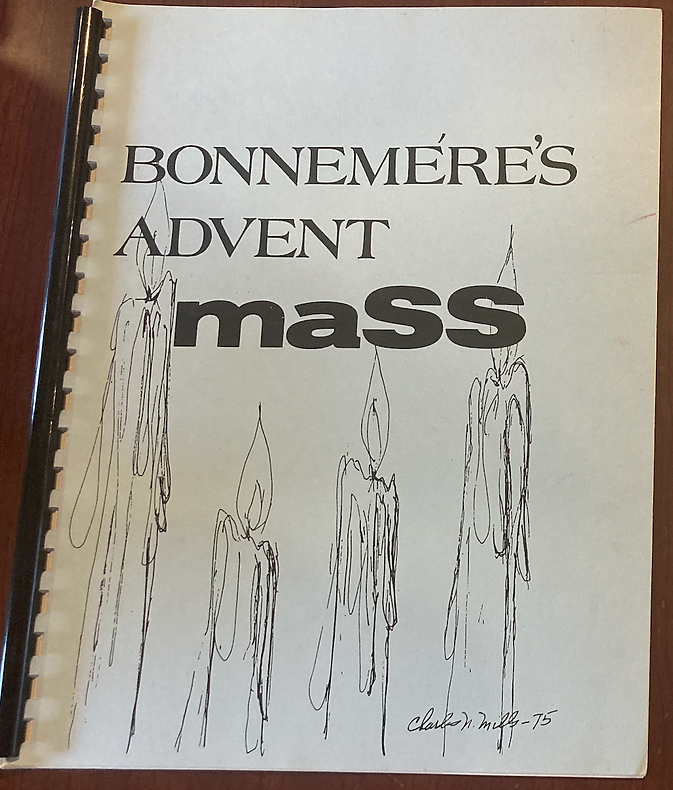
Cover of Bonnemère’s handwritten Advent Mass score (from the author’s personal collection) includes the entrance hymn, “Be Strong.” The hymn sets a a text paraphrase from Ledogar based on Isaiah 34 (“Tell those who are frightened/Be strong/Do not be afraid/Our God will come/Will come to save us”).
advent mass.
In the fall of 1967, Bonnemère became music director for the 11 a.m. Mass at St. Thomas the Apostle. On December 3, his Advent Mass was sung as part of the liturgy for the first time. The instrumentation included nine instrumentalists (trumpet, saxophones, bass trombone, and rhythm section) and eight teenaged singers who comprised the youth choir. Bonnemère refused to audition singers as he wanted to show that the music was “functional” and accessible to anyone, regardless of musical training. In weekly parish bulletins, Fr. Kelly explained the purpose behind the jazz Masses and urged the congregation to arrive thirty minutes early each Sunday to practice their sung parts. The congregation participated not only by singing but by contributing financially: the weekly cost to pay instrumentalists was $300, and parishioners regularly gave a total of $700 each week.[17]
It is unclear from Bonnemère’s archive as to whether or not he composed another complete Mass setting for the weeks between his Christmas Mass and the premiere of Williams’s Lenten Mass at St. Thomas in March. However, he did begin introducing his music at multiple weekend liturgies, rather than only at the Sunday 11 a.m. Mass. At his Mass for the Easter Season premiere on Easter Sunday, April 14, 1968, 700 people were in attendance.[18] Yet, it is important to note that the jazz ministry gained further notoriety over the course of five Sundays beginning on March 3, 1968, when Mary Lou Williams premiered her Mass for the Lenten Season.
On March 28, 1968, Mary Lou Williams brought two recordings of her religious music (“Saint Martin de Porres” in a different take than the one included on her 1964 album, and her “Our Father” from Praise the Lord in Many Voices) for airplay and discussion on WRVR’s Just Jazz with host Max Cole.
“More Jazz with Max Cole; 374; Interview with Mary Lou Williams,” 1968-03-23, The Riverside Church, American Archive of Public Broadcasting (GBH and the Library of Congress), Boston, MA and Washington, DC, accessed July 11, 2026,
http://americanarchive.org/catalog/cpb-aacip-528-086348hj0z.
mass for the lenten season.
In the fall of 1967, Mary Lou Williams was proactively seeking paid composing opportunities. One such opportunity arrived in the form of an unexpected invitation from Fr. Bob Ledgoar. In an undated letter, Ledogar asked for Williams’s input, stating that he welcomed “the chance to get your thoughts and advice on the use of contemporary music in Catholic worship” and asked to arrange a meeting to discuss the subject. He also invited Williams to compose a Mass to be used during the season of Lent at St. Thomas. Williams readily accepted the challenge. In a Christmas Day, 1967 letter to Br. Mario Hancock, she wrote that a priest “gave a Lenten Mass to write—well I’m at it again!!”[19]
As he did during the composing process with Bonnemère, Ledogar sent suggestions of texts to Williams and emphasized the necessity of creating music “that can be taught to them [the congregation] in a few months without them having to read music.”[20] He also invited Williams to visit during Bonnemère’s Advent Mass Sunday liturgies. Whether or not she visited St. Thomas, Williams likely composed her Lenten Mass during a second teaching stint at Elizabeth Seton High School in Pittsburgh. A March 1, 1968 Pittsburgh Catholic article entitled “Brookline girls to go to Harlem” lists the names of six students from Seton who will join Williams at St. Thomas “in presenting the first in a series of her jazz Masses during the six Sundays of Lent.”[21] (Due to inclement weather, the Seton students were unable to make the trip to New York).
Although the congregation did not use printed sheet music, Williams created handwritten scores for her instrumentalists (guitar, bass, drums, with Williams on organ), vocal soloist Honi Gordon, and the St. Thomas youth choir. The full score was probably used three times after its initial run, both times in early 1969: at the North American College in Rome as an after-Mass concert on February 2, 1969; again during the season of Lent in 1969 at St. Thomas; and throughout the 1972 Lenten season at Queen of Angels Church in Newark, New Jersey.[22] Evidence that the piece was recycled in the second year of the St. Thomas jazz ministry—but that Bonnemère, and not Williams, played the Mass setting—comes from a March 23, 1969 letter from Ledogar to Williams in which he states, “It is true that your music sounds different when played by Eddie [Bonnemère]—but the kids are also jealous because they aren’t in the choir anymore.”[23]
Published responses to Williams’s new Mass included glowing comments from activist and founder of the Catholic Worker, Dorothy Day. Day described her experience participating in Mass on the third Sunday of Lent, writing: “I have just come from a glorious celebration, the eleven o’clock Mass at St. Thomas the Apostle Church . . . One came away feeling as though one had truly celebrated Mass, offering worship, adoration, glory to God, not to speak of penitence. . . This was a musical event; and I do not think there has been anything to compare with it in any of the so-called folk masses being sung in colleges and churches around the country.[24]
Williams’s final Lenten Mass performance occurred on Palm Sunday, April 7, 1968, three days after the assassination of Dr. Martin Luther King Jr. In the two days between the evening of April 4 and the morning of April 7, Williams wrote two new pieces for Dr. King: “Tell Him Not to Talk Too Long,” which sets a portion of King’s February 4, 1968 sermon at Ebenezer Baptist Church in Atlanta; and “I Have a Dream,” based on a portion of King’s speech at the March on Washington for Jobs and Freedom in 1963. The new pieces were sung on April 7 by the St. Thomas youth choir just prior to the final hymn, “We Shall Overcome.” Williams’s addition of these two pieces created another theme rather than only a Mass for Lent: the piece became a memorial Mass for Dr. King. For two later performances, in February 1969 at the Pontifical Latin American College in Rome, and in July 1968 at the annual Pax conference at the Catholic Worker farm in Tivoli, New York, Mass for the Lenten Season was advertised as such. An ad in the June 1968 issue of the Catholic Worker listing the names of speakers includes “Mary Lou Williams, world-famous jazz composer and pianist in her newest composition: In memoriam- Martin Luther King/‘Tell Him Not to Talk Too Long.”’[25]
While audio of Williams performing her Mass for the Lenten Season is not publicly available, versions of the two additional songs for Dr. King appear on the Smithsonian Folkways 2005 reissue of Mary Lou’s Mass. These recordings came from an April 1969 broadcast on Vatican Radio with Williams accompanying the North American College choir of seminarians on organ as part of an interview with host Marjorie Weeks.
2022 U.S. concert premiere of Mary Lou Williams’s Mass for the Lenten Season (piece begins at 12:30). The performance also includes Williams’s two pieces for Dr. Martin Luther King Jr. that she incorporated into the Mass on April 7, 1968.
Three years after her tenure at St. Thomas, Williams taught her Mass to the congregation and youth choir at Queen of Angels Church in Newark, New Jersey during the season of Lent in 1972. It appears that this is the last time the work was performed during her lifetime, and the piece has rarely been performed in either concert or liturgical settings since the early 1970s. In 2007, pianist Aaron Diehl performed the Mass at St. Joseph of the Holy Family Church in Harlem.[26] The piece did not receive its American concert (as opposed to liturgy) premiere until March 26, 2022, when it was performed by the Stonewall Chorale in collaboration with the Deanna Witkowski Trio at Holy Apostles Church in New York.
mass for the easter season.
During Lent 1968, while Williams’s Mass for the Lenten Season was sung at St. Thomas, Bonnemère composed his first setting of a Lutheran liturgy, Missa Laetare. The work was premiered on March 17, 1968 at Saint Peter’s Church with the Lutheran Seminary Choir of Philadelphia under the direction of Robert Bornemann, and was later recorded for Fortress Press. Missa Laetare includes what became one of Bonnemère’s most well-known songs, “Help Me, Jesus.”
Bonnemère was becoming known for his ecumenical outlook. Song sheets and bulletins from St. Thomas and Saint Peter’s show that he often mixed and matched his compositions in the portions of the Mass Proper (the changing parts of the Mass, such as the entrance hymn or recessional hymn). In other words, Bonnemère took songs he had written for Lutheran settings like “Help Me, Jesus” and programmed them at St. Thomas; and took the entrance hymn from his Advent Mass, “Be Strong,” and programmed it at Saint Peter’s.
Bonnemère’s Mass for the Easter Season was premiered on Easter Sunday, April 14, 1968 at St. Thomas. Like his Advent Mass and Williams’s Mass for the Lenten Season, no commercial recording was made of the work. Unlike his Advent Mass and his later Mass for Every Season, it appears that he did not use the Easter Mass in other settings beyond St. Thomas, and his archives do not have much information regarding the work.
mass for every season.
Even though many expressed enthusiasm for the jazz ministry, some resistance from parishioners and senior leadership intensified in the spring of 1968 when Kelly arranged to hold the jazz Masses in the St. Thomas school auditorium on West 121st Street due to a minor fire in the church. With limited seating, weekly offerings did not always cover the cost of musicians, who now occasionally donated their time. Among some of the congregants, there was an “attitude that such music was legitimate as long as it paid for itself.”[27] Bonnemère and Kelly began to feel pressure from the senior pastor, who wanted to end the jazz services. Nevertheless, the ministry was about to receive national attention.
Bonnemère’s Mass for Every Season premiered on Trinity Sunday, June 9, 1968. Kelly had recently joined the board of directors of the Liturgical Conference, a then 7,000-member organization with Benedictine roots that sponsored a national “liturgical week” annually from 1940-1968. Likely due to Kelly’s influence, at the Liturgical Week held from August 19-21, 1968, in Washington, D.C., Bonnemère and the St. Thomas Choir led an assembly of 5,000 during the closing Mass in singing Mass for Every Season. Kelly also publicized the jazz ministry in print. In a one-page article outlining the “spirit and philosophy” of “The Community of St. Thomas” distributed to conference attendees, Kelly outlined the basic principles underlying the community jazz ministry, writing that participants’ “willingness to be involved as human beings” is what gives the community “what many have singled out as an outstanding, indefinable spirit.”[28] Regarding music, he further explained: “Instead of being inspired by an orchestra or held spellbound by a choir, almost unconsciously the people themselves, in discovering that they really can join in the service, have made it come alive.”[29] In the second section, he emphasized “the willingness to spend time preparing the worship, the scene, the materials, the various roles of persons. . . and the determination not to take anything for granted.”[30]
In preparation for leading his Mass for Every Season in the closing Mass on the final day of the Liturgical Week, Bonnemère taught sections of the Mass after each general session. Fr. Clarence Joseph Rivers, the “father of Black Catholic liturgy” who had premiered “God is Love,” his hymn from An American Mass Program at the 1964 Liturgical Week, served as the master of ceremonies. A National Catholic News Service press release reported that Fr. Rivers “pointed out the ease with which the audience had learned the somewhat difficult rhythm,” saying, “And they say ‘our people couldn’t learn [Bonnemère’s music], it’s much too hard.’”[31]
Bonnemère’s Liturgical Week debut was just the beginning of his presentations at national and regional liturgical gatherings. In 1971, as the chair of the newly formed National Office of Black Catholics’ Department of Culture and Worship, Fr. Rivers invited Bonnemère to be a featured liturgical composer at the organization’s first liturgical conference.[32] Bonnemère’s papers include dozens of brochures from liturgical workshops where he was featured in New York, New Jersey, Pennsylvania, and Ohio.
It is ironic that Bonnemère had submitted a resignation letter to Fr. Kelly on August 13, 1968, just days shy of the beginning of the Liturgical Week. Although Mass for Every Season became Bonnemère’s final jazz Mass composed for St. Thomas, he stayed on as music director of the jazz ministry for three more years. In a 1969 WRVR interview, Bonnemère confirmed that Mass for Every Season was subsequently sung during the second year of the jazz ministry.
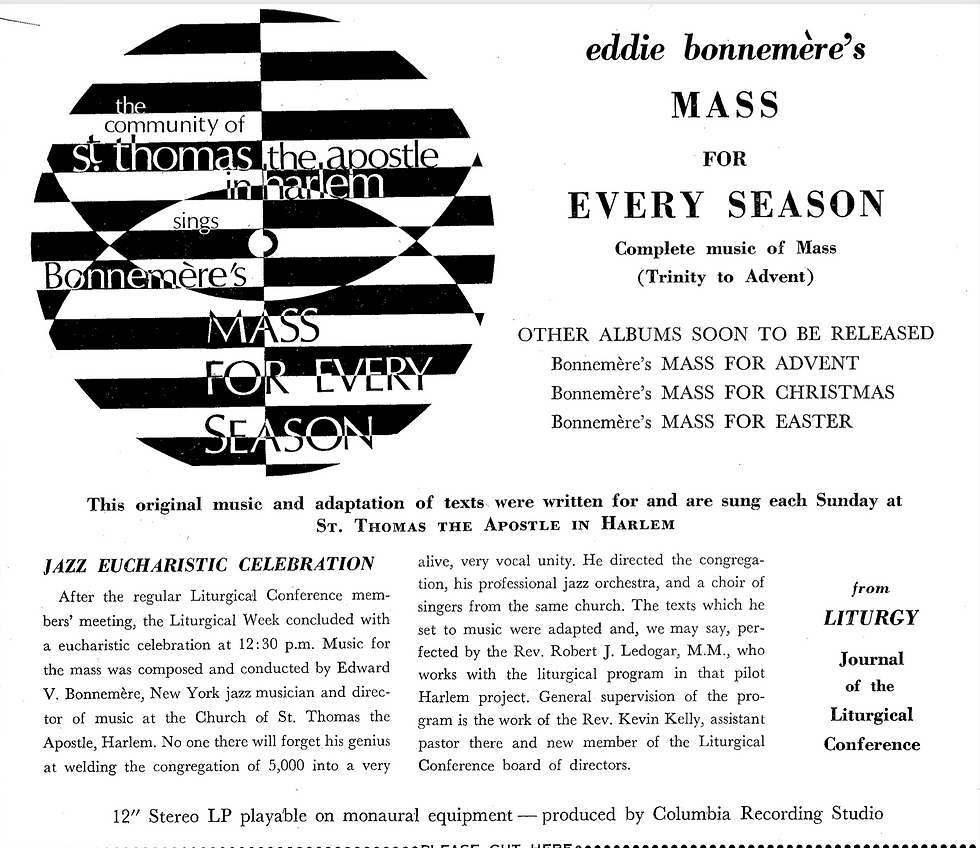
for the recording of Bonnemère’s Mass for Every Season as it appeared in the January 1969 issue of Liturgy. Although the advertisement mentions additional Masses, none of these were recorded. “The Community of St. Thomas the Apostle,” Liturgy 14, vol. 1 (January 1969): 4-14.
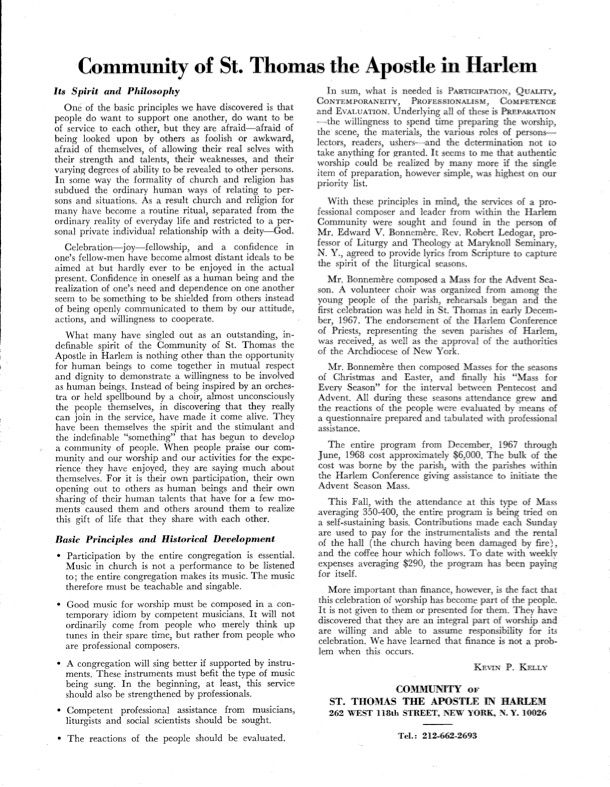
underpinning the St. Thomas jazz ministry was distributed to attendees at the 1969 Liturgical Week in Washington, D.C. Used with permission from Laurence Bonnemère.
The Community of St. Thomas the Apostle in Harlem Sings Bonnemère’s Mass for Every Season was released in 1969. The vinyl release included a single-line musical score insert.
Bonnemère discusses his music at St. Thomas as well as his recordings of Missa Laetare and Mass for Every Season in this July 19, 1969 WRVR interview with host Max Cole.
“More Jazz with Max Cole; 374; Interview with Mary Lou Williams,” 1968-03-23, The Riverside Church, American Archive of Public Broadcasting (GBH and the Library of Congress), Boston, MA and Washington, DC, accessed July 11, 2026,
http://americanarchive.org/catalog/cpb-aacip-528-086348hj0z.
the community of st. thomas the apostle.
The first year of the St. Thomas jazz ministry had received financial support from other parishes within the Harlem Vicariate. Beginning in the fall of 1968, the “Community of St. Thomas the Apostle,” comprised of the congregants who attended the Sunday morning jazz Mass, became self-sustaining. Reusing the musical settings from the 1967-68 liturgical year, Bonnemère got rid of the choir and relied on his song leading and instrumentalists to lead the congregational singing.[33]

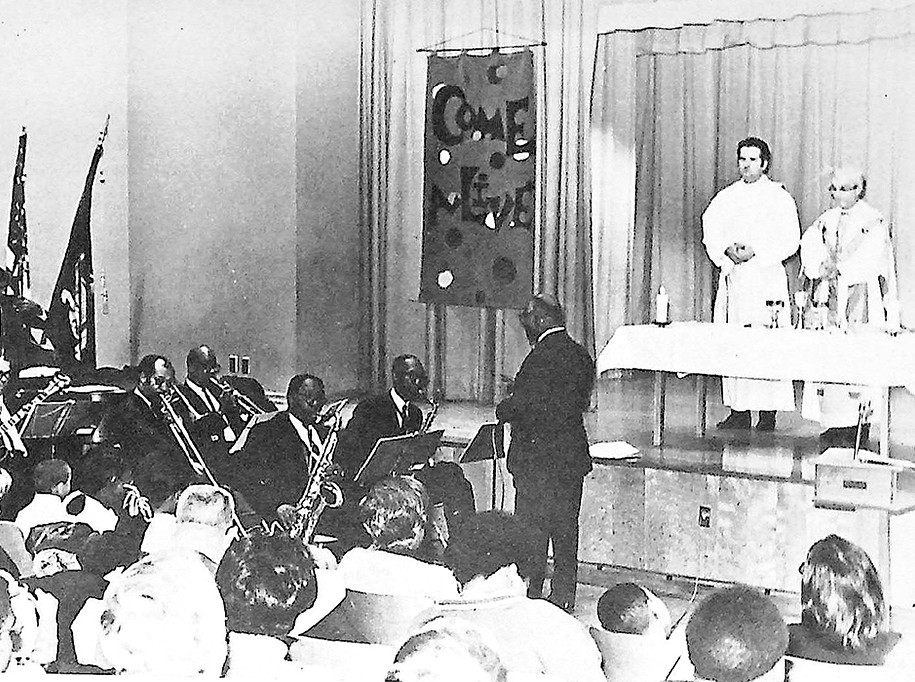
Bonnemère leading his band of instrumentalists at St. Thomas in 1968
Photo by George A. Alexander in “The Community of St. Thomas the Apostle,” Liturgy 14, vol. 1 (January 1969): 4-14.
Following the success of the Liturgical Week, Bonnemère and Kelly were aware that both the music and the intense degree of community involvement at St. Thomas were receiving attention from other churches. Bonnemère’s papers include dozens of letters from Liturgical Week attendees, many of them church music directors, requesting the sheet music for his Masses. In January 1969, Fr. Kelly borrowed funds to produce a recording of Mass for Every Season with a fifteen-voice volunteer choir and a nine-piece band (alto and tenor sax/flute, trumpet, bass trombone, electric guitar, piano, bass, drums, and Bonnemère at the organ). Self-released by The Community of St. Thomas the Apostle, the album included a pamphlet on the jazz ministry as well as a single-line music score. Corresponding sheet music was also made available in octavo style for $1 per score.
A January 1969 article in Liturgy, the journal of the Liturgical Conference, describes a Sunday morning visit to St. Thomas. The unnamed writer of the article notes that part of the reason that the service feels so alive is that the members are not completely dependent on the priest: instead, they are involved in every aspect of the ministry, not only in congregational singing but also in planning the content of each week’s liturgy.[34] Describing the congregational singing, the writer confesses that their initial reaction was one of disappointment that the music was not “concert-like in quality.” This first impression quickly changes, however, as they note that everyone present is heartily singing, commenting, “The singing at the St. Thomas Mass is...glorious...and fun, and exhilarating, and melancholy, and full of hope. Mr. Bonnemère’s talents as a composer and song leader defy enumeration... His own understanding and appreciation of liturgy (self-acquired through study and interest) is the indispensable element in the program.”[35] A quote from Fr. Kelly addresses the element of “imperfection” in communal worship that the reporter experiences: “Often people who come to one of our masses from outside are expecting something flawless, and that isn’t the way life is. Beauty, song, music, artistry—yes. But with these always the element of imperfection, the element of not knowing exactly how it’s going to work out.”[36]
The reporter mentions a weekly newsletter that lists other ministries run by members, including adult education classes (offering courses in English, reading, math, and office skills) and a “Saturday Music and Recreation Center” that serves 240 young people.[37] Bonnemère’s papers include some of these weekly community newsletters that were distributed at each week’s liturgy. These mimeographed newsletters addressed to the “permanent members” of the Community of St. Thomas detail how individual participation was carried out. Two newsletters from October 12 and October 19, 1969 describe various essential tasks that Kelly asks “permanent members” to fulfill in order for the jazz ministry to function. These include the usual preparing and serving at coffee hour as well as setting up the school auditorium space for worship and “preparing the readings and themes of our celebrations.” This latter directive is made plain in the further statement, “We intend to involve all who wish to be permanent members of the community in the planning and celebration of our worship together.”[38] For a Catholic church following a lectionary-based calendar of scripture readings, this latter job was new and experimental. This intentional involvement conferred value on the designation of what it meant to be a “permanent member” of the Community of St. Thomas the Apostle, a term that appears repeatedly in newsletters. In the fall of 1969, three Sunday newsletters (September 28, October 5, and October 12) included invitations for anyone who desired to become a permanent member to join. This is similar to the idea of church membership in some Protestant denominations where one can “join” a congregation as a new member simply by accepting an invitation to do so.[39] At the Community of St. Thomas, however, which was itself a community within a larger congregation (St. Thomas the Apostle Church), becoming a permanent member meant making a substantial, conscious investment of time and energy. The October 19, 1969 newsletter states, “For we also agreed that if we couldn’t share the celebration with every permanent member—we would stop our community worship.” In actuality, the term “sharing” meant “planning.” The same newsletter estimates that forty people were needed to plan and carry out each week’s liturgy. This number represents a high percentage as the following week’s newsletter states that there are approximately “fifty permanent members.”[40]
As of October 18, 1969, the fifty members were divided into three groups, with each group planning one Sunday. The enormity of this task, however, was not always met with the necessary participation: the same newsletter states that only six members were on board for two Sundays that month. Kelly acknowledges, “It will take time—maybe the whole year to have groups of people work together in preparing their worship.”[41] Kelly also relays Bonnemère’s concern that Sunday morning congregants may be perceiving themselves as an audience in a performer-focused event. He writes, “Mr. Bonnemère has provided not only the music but his own insights into Liturgy and worship. . . His worry is that many perhaps attend just to hear an orchestra and a different beat music [sic] without understanding what is required of a person who worships.”[42]
A newsletter from the final year of the jazz ministry’s existence in 1971 lists nine “temporary goals” that outline the purpose of the community. Goal number one emphasizes a primary pastoral concern: that the community members experience God not only in the eucharistic celebration but in each other:
-
That a true sense of caring and concern for all the members of our group be established. This means:
-
that we get to know each other more than by name only
-
that...we might...show the same care and concern for our neighbor
-
that our Eucharist express the unity and differences of our group and the Presence of God in it [43]
Goal number six states “that the destiny of the group be determined by the members themselves,” which was already apparent in the degree to which members created weekly liturgies, adult education programs, and community outreach. Goals seven and nine include the element of “risk-taking” that Kelly frequently emphasizes as well as an awareness of the Community serving as a model for other parishes:
-
that the group as a whole and each individual member be willing to take risks
-
to provide a way within the Catholic Church that can serve the religious needs of Catholics and others that cannot be served as well in the traditional parish structures [44]
Although many of these goals were realized, in 1971 the permanent members decided that the responsibility involved in planning each weekly liturgy was too taxing. Rather than choose to follow a different model, the community made a decision to “disband with the understanding that it could revive itself at a moment’s notice, provided it would do so as a community endeavor.”[45] This alternative model where the members were indispensable to the shape of each week’s liturgy illustrated the seriousness of which the members took the Vatican II directive of full participation, even if it meant that without this level of commitment, the jazz ministry would cease to exist. Future research needs to be done to determine if the permanent members of the jazz ministry continued attending other weekend Masses at St. Thomas and if the larger parish music repertoire changed as a result of the four-year program.
Deanna Witkowski discusses Eddie Bonnemère and his liturgical jazz work in this January 2026 podcast
coda.
Although the Community of St. Thomas the Apostle was predominantly a Black Catholic parish and Ledogar’s initial invitation letters were extended to African American jazz musicians with connections to Harlem, there was not a conscious decision on Bonnemère’s part to identify his work as Black music. Bonnemère’s ecumenical outlook corresponded with earlier Catholic movements that embraced “interracialism,” rather than the growing voices espousing a specifically Black consciousness in the arts and liturgy.[46] His frequent comments describing his music as “functional” and accessible illustrated his intention of having his music reach a wide demographic that transcended racial, class, or religious background.
Even so, it is ironic that after leaving St. Thomas—a predominantly Black Catholic community—and becoming more associated with Saint Peter’s—a predominantly white Lutheran community—until his death in 1996, Bonnemère became more articulate regarding what constituted African American Catholic music. In 1986, Bonnemère wrote to Bishop James P. Lyke during the compiling of the first African American Catholic hymnal, Lead Me, Guide Me, expressing concern regarding representation. Bonnemère was aware of the diverse backgrounds of Catholics in the pews even as he created music that was “catholic” with a small “c”: that is, ecumenical in nature. He also recognized that including diversity in musical styles, especially music with Latin American and African origins, was not only more inclusive but also a way of welcoming a wider swath of people to church. Due in no small part to Bonnemère’s own music, which covered a range of global styles, the New York Times reported in 1968 that the “series of experimental liturgies” at St. Thomas were drawing “Catholics—both black and white—from throughout the city.”[47]
Jazz historical narratives are often taught in a vacuum by stringing together recordings of who played with who on which album. Similarly, it would be remiss to tell the history of new forms of Black Catholic music from the late 1960s through the early 1980s by focusing on hymnals such as Lead Me, Guide Me or even archival documents from annual liturgical conferences. By focusing instead on localized histories of communities outside of “regular jazz venues,” especially in the context of religion, we find, as Vaughn Booker termed them, “race representatives” such as Williams and Bonnemère who transformed the ways that local communities worshiped, listened, and supported jazz musicians.[48] Both of these composers changed the worshiping life of individual parishes in each appearance that they made, affecting new generations of people in the pews who experienced how a jazz composer could shape and deepen ritual liturgical words and actions. If local Sunday worship is the space in which churchgoers sing together on a weekly basis, the history of American Catholic music and African American musicians’ contributions to this history must center individual composers, like Williams and Bonnemère, and communities like that of St. Thomas the Apostle Church in Harlem.
Deanna Witkowski celebrates the legacy of Mary Lou Williams in this three-minute video recorded at Fordham University in 2020.
maps.
All images included on this page are provided for educational purposes.
notes.
[1] “More Jazz with Max Cole; Eddie Bonnemere,” 1969-07-19, The Riverside Church, American Archive of Public Broadcasting (GBH and the Library of Congress), Boston, MA and Washington, DC, accessed July 3, 2026, http://americanarchive.org/catalog/cpb-aacip-528-8p5v699f1k.
[2] Mary Lou Williams Collection (Newark, New Jersey: Institute of Jazz Studies at Rutgers University), MC 60, Brother Mario Hancock, Subseries 3D: Correspondence with Religious, Box 19, Folder 14: June 29,1966 letter.
[3] Not to be confused with vocalists who worked with the legendary singer-pianist Ray Charles, the Ray Charles Singers regularly sang for Perry Como’s television and radio broadcasts.
[4] Mary Lou Williams Collection (Newark, New Jersey: Institute of Jazz Studies at Rutgers University), MC 60, Brother Mario Hancock, Subseries 3D: Correspondence with Religious, Box 19, Folder 14: June 29,1966 letter.
[5] “’Missa Hodierna,” New Mass by Jazz Musician to be Heard,” New York Amsterdam News, May 7, 1966, 32.
[6, 7] Fr. Kevin Kelly, as quoted in Lorn E. Brown and Thomas Wood Holcombe, “Jazz, Liturgy, and Community” (master’s thesis, Union Theological Seminary School of Sacred Music, 1972), 16, Eddie Bonnemère papers, Sc MG 356, Box 6, Folder 10, Schomburg Center for Research in Black Culture.
[8] “Discrimination and Christian Conscience,” Pastoral Letters of the United States Catholic Bishops, 1941-1961 (National Conference of Catholic Bishops, United States Catholic Conference).
[9] John T. McGreevy, Parish Boundaries: The Catholic Encounter with Race in the Twentieth-Century Urban North (Chicago: University of Chicago Press, 1996), 170.
[10] Fr. Kevin Kelly, as quoted in Lorn E. Brown and Thomas Wood Holcombe, “Jazz, Liturgy, and Community,” 17.
[11] In an October 1967 letter to Williams, Ledogar writes, “I have been invited by the Catholic parishes of Harlem to assist them in working out some experiments in Sunday worship of a more contemporary style.” Mary Lou Williams Collection, MC 60, Fr. Bob Ledogar, Subseries 3D: Correspondence with Religious, Box 20, Folder 8.
[12] Mary Lou Williams Collection, MC 60, Fr. Bob Ledogar, Subseries 3D: Correspondence with Religious, Box 20, Folder 8.
[13] Lorn E. Brown and Thomas Wood Holcombe, “Jazz, Liturgy, and Community,” 20.
[14] Ledogar correspondence to Williams, Eddie Bonnemere papers, Schomburg Center for Research in Black Culture, New York Public Library, Box 2, Folder 8. Bonnemère’s papers do not contain any programs that indicate that other Harlem churches used the works.
[15] Fr. Robert J. Ledogar correspondence, Eddie Bonnemère papers, Sc MG 356, Box 2, Schomburg Center for Research in Black Culture.
[16] Fr. Robert J. Ledogar correspondence, Eddie Bonnemère papers, Sc MG 356, Box 2, Schomburg Center for Research in Black Culture
[17] St. Thomas the Apostle newsletters, Eddie Bonnemère Papers, Sc MG 356, Schomburg Center for Research in Black Culture.
[18] Lorn E. Brown and Thomas Wood Holcombe, “Jazz, Liturgy, and Community,” 21.
[19, 20] Mary Lou Williams Collection, MC 60, Fr. Bob Ledogar, Subseries 3D: Correspondence with Religious, Box 20, Folder 8; undated letter.
[21] “Brookline girls to go to Harlem,” Pittsburgh Catholic, March 1, 1968.
[22] Williams’s Lenten Mass was also sung at a Catholic Worker conference in Tivoli, New York, in the summer of 1968. As Williams did not have a choir or instrumental ensemble accompanying her at this performance, the full score would not have been used on this occasion.
[23] Mary Lou Williams Collection, MC 60, Fr. Bob Ledogar, Subseries 3D: Correspondence with Religious, Box 20, Folder 8; March 23, 1969 letter.
[24] Dorothy Day, “On Pilgrimage,” Catholic Worker 34, no 3 (March 1968): 1.
[25] Catholic Worker 35, no. 5 (June 1968): 8.
[26, 27] Text correspondence with Aaron Diehl, February 20, 2024. Diehl also recorded the work with Damien Sneed in 2011 with production by Fr. Peter O’Brien, SJ. The recording has not been released probably due to the fact that Fr. O’Brien died in 2015 and was at the helm of the project.
[28] Kevin P. Kelly, “Community of St. Thomas the Apostle in Harlem,” 1968. Personal collection of Gilda Bonnemère.
[29, 30] Kevin P. Kelly, “Community of St. Thomas the Apostle in Harlem,” 1968. Personal collection of Gilda Bonnèmere.
[31] Anne Collins, “Liturgical Conference Ends Annual Meeting with Four Resolutions,” National Catholic News Service, August 23, 1968, 25.
[32] Invitation from National Office of Black Catholics to Bonnemère, Eddie Bonnemère papers, Sc MG 356, Box 2, Schomburg Center for Research in Black Culture.
[33] In an author-conducted interview with musician Ira Shankman, who played piano on Bonnemère’s recording of Mass for Every Season, Shankman explained that he also played piano at weekly Masses at St. Thomas (and later at monthly jazz vespers at Saint Peter’s) for Bonnemère. Shankman recalled that on the Sundays when he played, Bonnemère only played piano when he wanted to take an instrumental solo. This important piece of information illustrates that Bonnemère was usually leading congregational singing without the restrictions of conducting or leading from the piano.
[34, 35, 36, 37] As the article credits its photographer, George A. Alexander, it is possible that Alexander was also the writer. However, no writer is credited. “The Community of St. Thomas the Apostle,” Liturgy 14, vol. 1 (January 1969): 4-14.
[38, 39, 40, 41, 42, 43, 44, 45] Brown and Holcombe, “Jazz, Liturgy, and Community,” 25, 26, 27, 27, 28, 28, 22
[46] See, for example, Matthew J. Cressler, Authentically Black and Truly Catholic: The Rise of Black Catholicism during the Great Migration (New York: NYU Press, 2017), chapter 4.
[47] Edward B. Fiske, “A Visit to Archbishop Cooke’s Domain,” New York Times, November 13, 1968, Section SM, p. 50.
[48] Vaughn A. Booker, Lift Every Voice and Swing: Black Musicians and Religious Culture in the Jazz Century (New York: NYU Press, 2020).
cite this project.
Projects featured on this site are the intellectual property of the Fellows who created them and may not be reproduced without their permission.
Please cite the creator if you use their work in support of your own.
Citation: Witkowski, Deanna. “Jazz in the Pews: Mary Lou Williams, Eddie Bonnemère, and The Community of St. Thomas the Apostle." SPIRIT HOUSE: A Crossroads Project. July 2026. Date Accessed. https://www.crossroads-spirithouse.org/witkowski
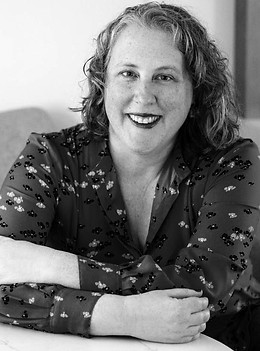
Pianist, composer, and scholar Deanna Witkowski moves with remarkable ease between Brazilian, jazz, classical, and sacred music. As a sought-after Williams expert, she has taught for Jazz at Lincoln Center, presented at the Kennedy Center, Loyola University Chicago, and Fordham University, and performed Williams’ compositions as a featured guest with the Pittsburgh Symphony Orchestra. In 2024, Witkowski completed her PhD in jazz studies at the University of Pittsburgh and is currently writing her second book, Jazz in the Pews: Experiments in Sunday Worship in the 1960s. Experience her music and scholarship at deannajazz.com
_edited.jpg)