




justine bakker.
experimenting with de laurence
cohort. 2025-26
project. Experimenting with De Laurence: Black Occult Practice in the 20th Century
location. Chicago
medium. exhibit
.png)
Secret Occult Order of the Ancient Magi by L. W. Laurence (1920) | public domain
In the early decades of the twentieth century, Black esoteric religion was everywhere. By “Black esoteric religion,” I mean forms of spirituality that revolved around claims to hidden, higher or special knowledge and were at odds with dominant interpretations of religion and science. In Harlem, followers of Father Divine’s Peace Mission Movement hosted huge Holy Communion banquets, where they celebrated him as “God in a body.” A few streets over, Black Herman performed his unique blend of stage magic and occult magic. Famous for his “buried alive” act, he was also known as a faith healer and once stood trial for “practicing medicine without a license.” Another Harlem-resident, Robert T. Browne, wrote a metaphysical treatise called The Mystery of Space (1919), a mix of mathematical theory, theosophy, and mysticism. In Chicago, members of the Moorish Science Temple of America paraded through the streets. Donning a fez, they celebrated their identity as “Moorish American.” In small spiritualist circles in New Orleans, mediums held seances to consult with those who had passed away. Drug stores and hoodoo supply stores like Valmor Products Company sold the wide variety of roots, herbs, powders, and charms that spiritual workers used to realize good luck and healing and to settle disputes. Meanwhile, on the pages of major Black newspapers like the New York Amsterdam News and Chicago Defender, spiritual entrepreneurs advertised their expertise in crystal gazing, palm reading, and clairvoyance, speakers announced live lectures and radio shows about Hindu magic, spiritualism, and a host of other esoteric topics, and bookstores advertised occult books—books that teach or invoke hidden or supernatural knowledge, covering topics such as astrology, alchemy, magic, and divination—alongside “race literature” and the Bible (see image above). Elijah Muhammad, leader of the Nation of Islam, had a weekly column in another Black newspaper, The Pittsburgh Courier, in which he revealed the heretofore secret history and future of America.

Chicago Defender, August 24, 1918. Page 12 (display ad 47, no title |public domain
Despite their ubiquitous presence in Black life, Black esoteric imaginations, discourses, practices, and movements remain, as Matthew Harris and JT Roane wrote in 2021, “much neglected.” There are different reasons for this, including the continuing numerical dominance and cultural power of the “Black Church” and a justified concern over reinforcing the destructive racialized pairing of blackness and irrationality. The latter was also a concern in the early twentieth century: the editor-in-chief of the Chicago Defender, to name one example, lamented the fact that his newspaper had to publish advertisements of psychic readers and spiritual healers to be able to finance the enterprise. As recently argued by scholar of religion Margarita Simon-Guillory—who, as one of the editors of the groundbreaking volume Esotericism in African American Religious Experience (2015), did much to bring Black esoteric religion to the attention of scholars—the newspaper produced a “bifurcated” account of Black religion that, informed by respectability politics, pitted mainline Protestant Christianity against forms of belief considered “strange, weird, and barbaric” (2024, 63).
This project contributes to the important work of Simon-Guillory, Harris, Roane and others who have problematized, challenged, and complicated the one-sided interpretations of Black religion in public and academic domains. It does so by homing on in something most of these esotericists—irrespective of their religious background and spiritual commitment—shared: a keen interest in occult books. The most famous occult book at the time was The Sixth and Seventh Books of Moses, an eighteenth-century German book that includes seals, tables, talismans, spells, and symbols for invoking spirits as well as instructions for magical usages of the Biblical psalms.

Library of Congress
First popularized in North America by the Pennsylvania Dutch, it was published in 1910 by De Laurence, Scott, and Co., a Chicago-based publishing and mail order company. It was this edition that circulated far and wide in Black esoteric circles. Founded by white occultist, hypnotist, and publisher Lauron William de Laurence (1868-1936), the company’s books and accompanying occult products like talismans, charms, candles, incense, oils, and crystal balls, also found enthusiastic response in the Caribbean and West Africa (Polk 1999). This is why historian of magic Owen Davies refers to De Laurence as a “transatlantic sensation” and “America’s most influential occultist” in his definitive Grimoires: A History of Magic Books (2009, 198, 216).

Picture of De Laurence in 1911 edition of the catalogue of De Laurence, Scott, and Co.
Courtesy American Medical Association Archives
That De Laurence’s books were enthusiastically read, adopted, adapted, and appropriated by Black religious practitioners is a well-known fact. Yet, we still know little about how De Laurence’s texts and products circulated in Black communities in the first half of the twentieth century. How and where did people encounter these books? Archival evidence points to several sites, such as newspaper advertisements, flyers, and brochures. Other sites may include Black colleges and universities and places of worship, when people visited a palm reader, fortune teller, or psychic, or through fraternal organizations, literary circles, book fairs, and reading clubs. People may have also simply encountered these books when they visited friends and family, when they came upon a book cart, peddler, or sidewalk book vendor on the street, or in fiction, for example Claude McKay’s Home to Harlem (1928) or the work of Zora Neale Hurston.
A second set of questions pertains: how and when did people obtain these books? Did they acquire them through mail order? Buy them from street vendors? In bookstores, drug stores, pharmacies, religious stores, candle shops, or stores specifically dedicated to selling occult products? From spiritual merchants operating from their private homes? Did they borrow them through informal, itinerant, public, school, or university libraries? A third set of questions revolves around how, precisely, people use these books: how did they adopt, adapt, and appropriate the practices and ideas? Who intensively engaged these books, and who used them (only) for display? What kind of social, literary, and ritual practices developed around reading and working with these books? A fourth set of questions pertains to regulation: to what extent were these books outlawed, demonized, and ridiculed—and by whom? What ideologies shaped efforts at demonization and criminalization?
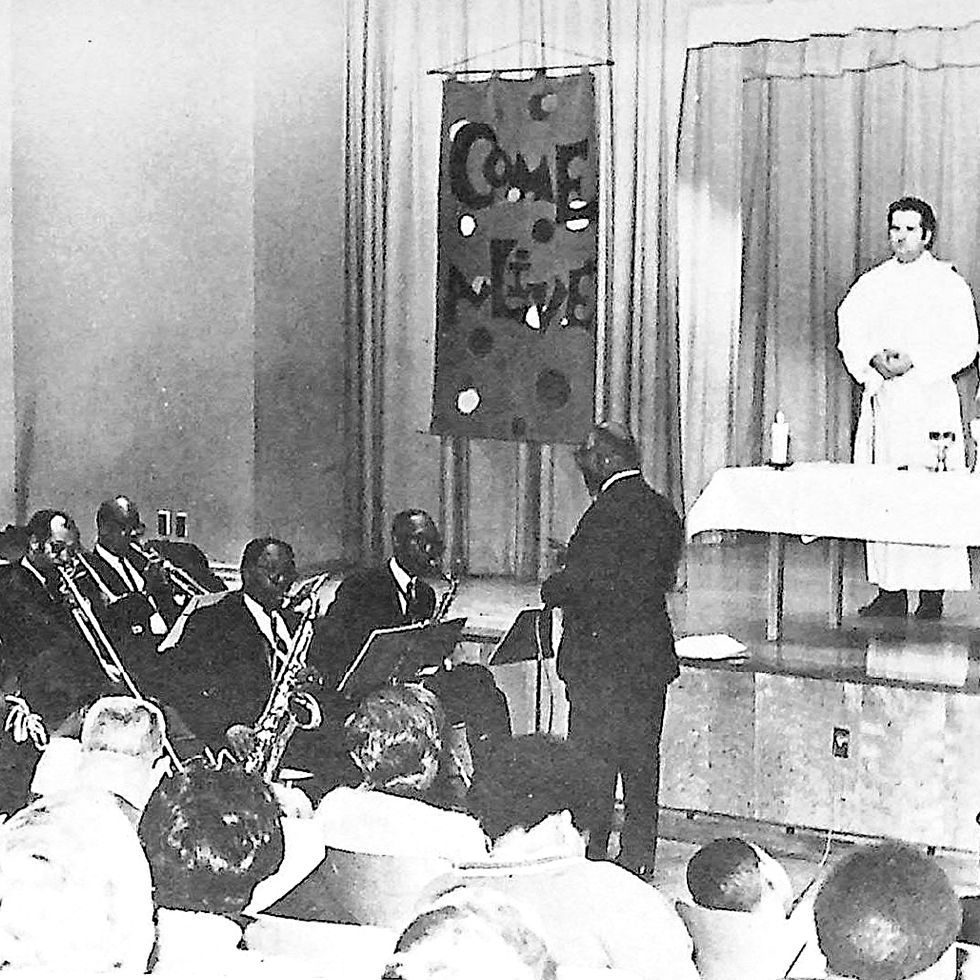
And if we know little about how, when, and where his books circulated precisely, we know even less about the extent to which De Laurence himself may have travelled in Black (religious) communities. Newfound evidence, which I present as part of the StoryMap exhibition, puts De Laurence on stage with the aforementioned Father Divine in New York City in 1932. This would suggest that De Laurence also engaged with the “black gods of the metropolis” (Fauset 1944) beyond selling his books. It further suggests a relationship between Father Divine and De Laurence that goes beyond a shared interest in New Thought belief in the immanence of God, power of positive thinking, and the realization of the kingdom of God on Earth. This raises important questions about influence, interaction, and exchange: if De Laurence was indeed on stage with Father Divine, what was the extent of this relationship? Could it be possible, for example, that De Laurence joined one of Divine’s famous Holy Communion Banquets? And, with whom else did he engage? What was the nature of these relationships and how may they have shaped his thinking, views, and politics—and vice versa? These are difficult questions to answer definitively, but asking these, I hope, already reorients our focus away from unilateral influence (from De Laurence’s books to Black religious practitioners) to multidirectional exchange, relations, interactions, and networks.
This project has been developed with these questions in mind. Using maps, newspaper articles, letters, and government records, I seek to trace and elucidate moments that suggest or indicate De Laurence’s presence in or engagement with Black American communities. This narrative proceeds in three parts, which, moving from De Laurence’s well-documented efforts to sell the occult to his presence on stage with Father Divine in Chester Dance Palace, become increasingly more speculative. De Laurence and his books show up in the archives time and again, but the evidence is frequently scarce, scattered, and thin. It is difficult to draw big or definitive conclusions about De Laurence’s involvement in Black esoteric religion. The tentative hypotheses and suggestions we can arrive at are, moreover, complicated and frequently uneasy. They are also much needed, however: homing in on De Laurence and his books allows us new insight into the production and circulation of esoteric practices and discourses in African American religious communities during the Great Migration. Specifically, following De Laurence allows us a particular entry point to map and study the infrastructure of (book)stores, dancehalls, and newspapers that shaped Black esoteric religion in the twentieth century.
further reading.
Davies, Owen. Grimoires: A History of Magic Books. Oxford University Press, 2009.
Harris, Matthew, and J.T. Roane. “Out There: Perspectives on the Study of Black Metaphysical Religion.” The Immanent Frame, March 25, 2022.
Fauset, Arthur Huff. Black Gods of the Metropolis: Negro Cults of the Urban North. University of Pennsylvania Press, 2002 [1944].
Finley, Stephen, Margarita Simon Guillory, and Hugh Page Jr, eds. Esotericism in African American Religious Experience: “There Is a Mystery”... Brill, 2014.
Guillory, Margarita Simon. Africana Religion in the Digital Age. Routledge, 2024.
Polk, Patrick A. “‘Other Books, Other Powers’: The 6th and 7th Books of Moses in Afro-Atlantic Folk Belief.” Southern Folklore 56, no. 2 (1999): 115–33.
cite this project.
Projects featured on this site are the intellectual property of the Fellows who created them and may not be reproduced without their permission.
Please cite the creator if you use their work in support of your own.
Citation: Bakker, Justine. “Experimenting with De Laurence: Black Occult Practice in the 20th Century." SPIRIT HOUSE: A Crossroads Project. July 2026. Date Accessed. https://www.crossroads-spirithouse.org/bakker

Justine M. Bakker is Assistant Professor of Comparative Religious Studies at Radboud University Nijmegen (the Netherlands). She holds a PhD in Religion from Rice University (Houston, TX), where she specialized in African American religious history and Black studies. She studies alternative, esoteric, and heterodox forms of Black religion and the intersection between race and esotericism. The Journal of the American Academy of Religion, Religion, Aries, and Correspondences have recently published her research. Together with David Kline, she edited the volume Words Made Flesh: Sylvia Wynter and Religion, which will be published by Fordham University Press in spring 2025.
_edited.jpg)