




hess love.
eroding gods
cohort. 2025-26
project. Eroding Gods: Shifts in AfroChesapeake Spirituality Due to Climate Change
location. Maryland
medium. autoethnography

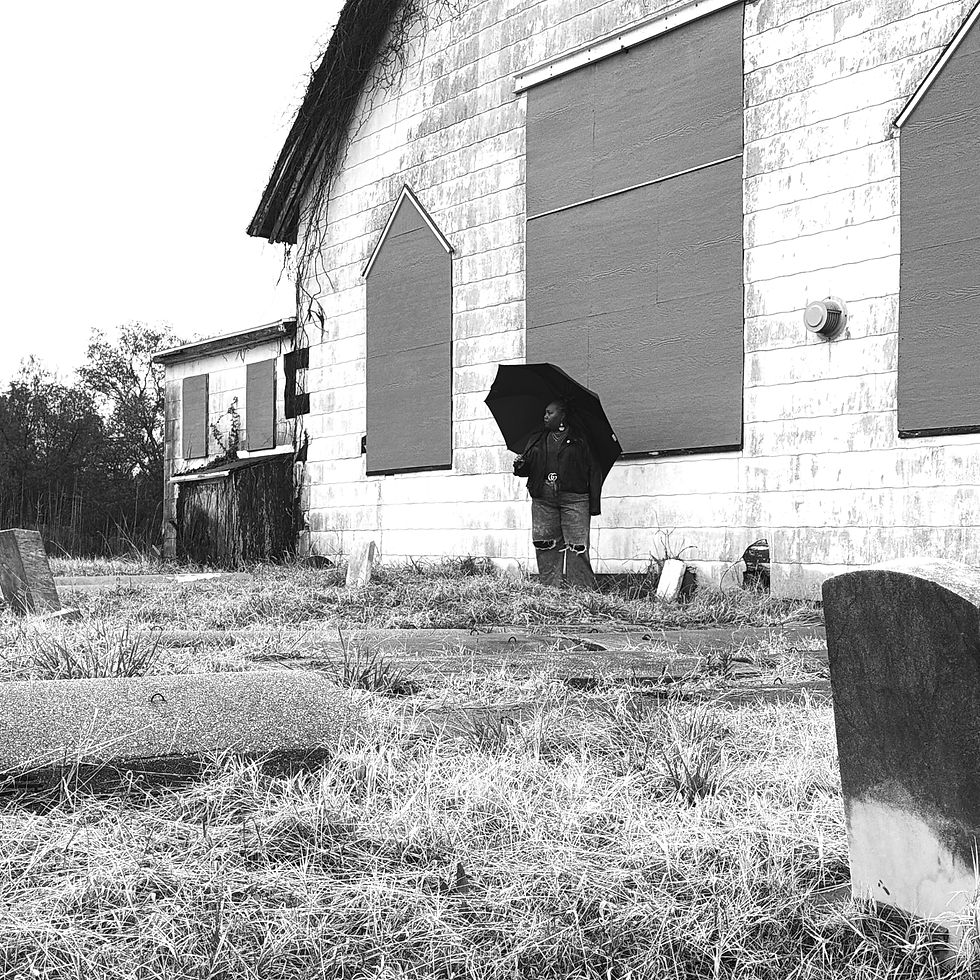
Samantha Master at St. John's Methodist Episcopal Church on Deal Island, MD | photo by the author
how it started.
There is land cradled between the Atlantic Ocean and the Chesapeake Bay, it is there where time moves slower, where devotion is not bound to heaven but woven into the soil, the water, and the breath of all who dwell there. The Eastern Shore of Maryland–birthplace of Harriet Tubman and Frederick Douglass–is sacred and finite. On that land AfroChesapeake spirituality flourishes at the intersection of Hoodoo and Black Christianity. Today, the Black settlements that coexist with coastlines, wetlands, woodlands, and grasslands that anchor these practices are disappearing. Rituals are disrupted due to the receding ability to congregate at sacred sites and spaces of memory. The land is being eroded by the twin forces of climate change and human greed through relentless overdevelopment.
Above is the language of the proposal that I submitted to The Crossroads Project, with the dreams of this story stirring in my mind. Below I tell you where that journey has taken me.
how it is.
Let this kind of God touch your skin. Rustles from the human-height plant life holding its own under the muggy cold rain said this to me. The clouds echoed that sentiment while Sam testified at Deal Island. We came to record a woman and a church, and the sky came too, falling on the mics and the camera and the umbrellas, refusing to wait outside the frame. I had four devices running so we would lose nothing, and the rain ran right through all four, insisting on its place in the record. I understood then what this project would ask of me. The land would speak (as I knew it would), and my work would be to make space in the archive and let it in. The doors to the Earth are open.
There is a way of doing oral history that wants the room sterile and the speaker to be sealed off from weather and kin and kith. That’s boring. When it comes to legibility I am difficult and wild, so of course I want the reverse: I want life. I want you to hear the rain and the birdsong. I want you to hear the water swishing under the wind and the cousin walking in with a plate. The environments are alive. They are dynamic. They are god’s work. They are divine. The lives of all beings in creation run on call and response, and a question earns a symbiotic chorus answering back. So when you witness these people, I want you to know what it sounds like to be witnessed in place, at home. There is a name for this Black sense of place, the way a people and their more-than-human kith make space and meaning against a man-made geography engineered to unmake them. The testimony is a subjugated knowledge, a lived experience standing as its own criterion of meaning. What the recorder gathers is an epistemology, these people of the AfroChesapeake are knowers, and the land knows alongside them. This work refuses the sterility that would strip the weather out to extract DNA, which only ever told a fraction of the story anyway.
start with sam, since the rain started with her.
Her people are the Cottmans of Deal Island, two sets of them (the ones with two T's). Her ancestors raised John Wesley Church one generation out of slavery, after a man named George Wallace bought his family free and built a refuge for the newly freed on the water's edge. The church stands boarded now and it floods. It floods so hard the road turns impassable, so the people leave and keeping leaving while carrying the traditions off with them. Samantha Master came home to Deal Island to visit a year ago, she pulled a phone number out of a binder she had kept since high school, and called her cousin Chanel to say ‘yes.’ Yes, she would help save the history of the church.
On Deal Island the saltwater does its slow violence on the dead. It eats the concrete vaults until they crack open. Sam has heard of coffins drifting down the street in the floodwater, of vaults standing empty because the bodies washed away. She reads this as the ancestors trying to get out of the ground. She wonders if the eaten shoreline is them reclaiming what was taken, if the storms and the high seas are them singing a song of their rage, refusing to go quietly into the night. She loves the idea of their return, the idea that ‘they’ will root up what we put down. In her mind the water answers by taking up more room. Sam keeps her faith in two hands, she rides with the brown Rabbi Jesus the long way, and she honors Yemaya in the sea and Oshun in the river (deities of Orisha centered traditions that mostly hail from the Yoruba people). She calls herself a recovering Christian, deeply Black and divinely made, and she wants the future generations to inherit something they can feel, the tangible magic of the mundane and ordinary life on the Chesapeake: the crabs and the oysters, the clover running wild across lawns, and the muskrat Harriet trapped. Sam fears a future where a story is all that survives, and she wants the living things to outlast the telling.
AfroChesapeake culture, like many within the African Diaspora, can be read as conjure, a pharmacopeia where the same substance heals and harms by turns. Sam's water is exactly that medicine, the baptismal cure and the corrosive flood in one body, the pharmakon of the shore. When she hears the ancestors raging in the high seas, she refuses the genre of Sylvia Wynter’s “Man” (and it’s geographies) that counted these people as property. The dead insist on a humanity that is god-given, nevermind what the ledger denied them. Their rage is a counter-cosmology, a counter-cartography, in service of the earth that rules everything as a god creation, and the Man-made demigod of the plantation can’t beat that.

St. John's Methodist Episcopal Church (Deal Island) photo by author

St. John's Methodist Episcopal Church (Deal Island) photo by author
To access more historical data and environmental context for this site, please open the video in a new tab and expand the YouTube description box.
next yolanda and the birds.
While we didn’t identify which songs came from which species, their music ran through her whole hour at Mount Zion, filling the camera’s memory card with chirps in between her memories. There was one small one circling that we kept trying to photograph without spooking it. Yolanda Acree, she wears her dead on her chest, the names of five women in one glance: Jennie, Nealie, Sarah, Ada, Victorine, and her grandmother Lois among them, making six names to be called. Her people are here, she says, though their spirits live elsewhere. The ground keeps the remains and the back roads keep the rest. She wants to become a tree when she goes, in place of a grave.
Yolanda found Hoodoo late, near thirty-six, after a churchgoing childhood she attended for the candy and the company. Her line is clean, good-good church folk, and Yolanda is remaking that good. She would rather connect to the people she knew in life than to a John Paul Jesus who at no point spoke to her. Then human ancestors come to her in dreams, and she acknowledges land is a living ancestor. She reads the changing earth as a transition rather than a death, a turning toward whatever age comes next, and she feels it mirrored by a human upheaval arriving. Yolanda leans towards the spirits, finding them in the wind and the rain. They are speaking, her open question is whether we are listening.
Her erosion is slow and total. Her cemeteries sit away from water, so they may outlast the tide. Still, the whole peninsula of the Eastern Shore is sinking, water on each side, and the threat wears other faces too. Solar panels and housing developments eat the farmland (and the farmland’s monoculture ate both Indigenous to here (Nanticoke, Choptank) and African descendent (ethnogenesis of AfroChesapeake) ways of stewarding the land), and the data centers are coming—or at the very least trying to. The trees that gave shade to the living who visit the dead have been cut, so the old folks may quietly stop coming for fear of overheating. Yolanda stays because her grandfather passed two days before her flight home from Veracruz, and she refuses to miss another transition in the flesh. Her prayer for this place is: let the spirit of this place survive into the generations, even where the ground goes under. She hands us a Black geography, the land read as a living ancestor and so as a map the surveyor's grid was and is not able to account for. Her sinking peninsula is a “plantation future,” the long afterlife of the ground that was worked and the people who were worked on it. Yet it is a future beholden to a god creation.

Caroline County photo by the author

Caroline County photo by the author
To access more historical data and environmental context for this site, please open the video in a new tab and expand the YouTube description box.
then darius and the wind.
At Still Pond it came up windy, and you could hear something inside it, the way Deal Island had been breathing between raindrops and Mount Zion had been birds. His ground is free ground. Butler Town runs back to 1820, when his fifth great grandfather James Butler owned thirteen acres. James had bought his freedom for one dollar in 1812, and he deeded the land to his heirs when he died. Darius Johnson sets that fact against the most known names of the shore: Douglass and Tubman. Decades before they would soon be leaving the Eastern Shore, James Butler was keeping acreage on it.
His erosion is theft, slow then quick, quiet then loud. In the 1850s sheriff sales targeted Butler Town to clear land for a railroad that came through elsewhere in the end. James Lamb Bowers, who was tarred and feathered with Harriet Tillerson for sheltering runaways, turned around and took the Butler heirs' land inside the same decade he witnessed James Butler's will. The present version reflects the lifeline of that inside-out practice: when a family parcel goes for ten or fifteen grand at tax sale, and up goes a 300,000 dollar rancher, sold to someone from elsewhere who carries other values.
Darius left the church building in the seventh grade and kept the faith in the landscape. That’s a familiar story around these parts. The land takes him past time and past the drama of people, down to the core of what faith is for him. Kent County has become quiet, a place of return, of homecomings and the cedar headstone you drive back to see, while the living leave and the dead keep them tethered. His deepest spiritual hour came while he was instrumental in building affordable housing a half mile down the road for his own cousins. One day he woke at three in the morning, the witching hour, and anchored himself in James Butler, who gave land to his family two centuries back. In the dark, dark morning Darius decided to carry the same labor forward. He recalls that in the summer the early dark was filled with fireflies, a million of them in the growing pitch black. Today he struggles to recall the last one he saw. What Darius traces is a “matrix of domination,” a single architecture of power reaching across two centuries from the sheriff's sale to the tax sale. The railroad and the rancher are within the same lineage of this dispossession, the conversion of what has been made Black ground into someone else's capital, and the place of return he names is a Black sense of place persisting inside that loss, a homing instinct that dispossession cannot extinguish fully.

Kent County photo by author

Kent County photo by author
To access more historical data and environmental context for this site, please open the video in a new tab and expand the YouTube description box.
then queen and david cornish, sr., father and daughter, and the river itself.
The Choptank (River) was an escape route once, a road out that witnessed people freeing themselves. As a tributary of the Chesapeake Bay, it is now part of the thing that is eating Dorchester County. We met at Gerry Boyle Park at Great Marsh in Cambridge. Before it was turned into a park, it used to be a communal and baptismal ground with many more wading spaces into the river than exist there today. David fell out on that beach as a boy, passed clean out looking at the waves, and woke to the water letting him know it carries powerful things. He keeps his distance now. He wades less and less. Once he watched Queen almost drown as a child in a city pool. They came up by grace, and now his refrain to Queen, that whenever they wade, is “life jacket, life jacket!” David knows that the Water, whether static or dynamic, begets both life and death.
David tells the long tale of Big Lizz, the enslaved healer who was decapitated while hiding her master's gold in a swamp during the Civil War. A century later priests went back into Blackwater for that gold and landed in the state hospital. The bulldozers Reagan sent stopped cold and rust there yet, because a scrapping shore will leave them be. Then Queen turns the story up with the necessary inquisitions of a young, yet ancient, Hoodoo practitioner: “does anyone go back to release her spirit?” Going for the gold is its own violence against a woman who chose none of it, outside of protecting it on both sides of life. Those two did not know about my work at Big Lizz’s swamp burial ground prior to this project. Lizz emerging in this interview is my reminder to start working with her and that place again, yet in my experience on the DeCoursey Bridge, I wonder if she wants to be released from that swamp at all.
The faith of father and daughter braids fullest at this river. David studies all truth, in the earth and the wind, his foundation set in true Holiness. His God commands the rain and the fire. Queen uses the Bible as reference and remixes songs into prayer, and they study Hoodoo as a religious knowledge system that shifts by region and water and migrates the way the WPA slave narratives were of a migrated people. Between them they name a living. In the Holiness churches the people practiced Hoodoo unknown to themselves, passed down generation to generation, the African retention living inside the Christianity, and the entheogenic conjuration that can only be fully understood by the land and the bones that it holds. Still, the erosion here arrives not all at once. By 2100 half of Dorchester County goes under water, the baptism beach is gone in a single generation, cut off and rocked over. No photographs survive, so memory carries the whole of it. Not far from Bayly road Silent City Cemetery belongs to a solar power company that can lay cement over unmarked graves whenever it chooses. It owns the land, and as Queen says it, “it owns those bodies.” In 2026 concerns over the second ward of Cambridge getting bought up for a tourist town lay thick in the air.
David and Queen leave you with river law. The Eastern Shore will tell you to come or tell you to stay away, and it will rock you to sleep or set you on pins. Once you cross the Chesapeake Bay Bridge and touchdown on Maryland’s Eastern Shore, time loosens its grip and you slow down with no say in it. And unless these waters recognize you, you have no business in them. To say the water must recognize you is to say that the human is a ceremony, it is a relation both earned and performed, rather than a status the census grants. Yet, near those same waters David prayed for a daughter and got Queen, the prize after all the years, the one who carries the Cornish line in their forehead. The continuation of promises, like the ones his father Bishop Clarence Cornish Sr. offered when he healed “the crippled and the blind,” and came home to Cambridge in life and in death. The wind howls and offers its own testimony, the Choptank holds life on both sides.

at Gerry Boyle Park on the Choptank River in Dorchester County photo by the author

at Gerry Boyle Park on the Choptank River in Dorchester County photo by the author
To access more historical data and environmental context for this site, please open the video in a new tab and expand the YouTube description box.
here comes renna and the sun.
It beamed down inescapable while she moved easy through the heat, a daughter of conjure women under a sky that answered to her name. Malone's Church is freedom ground. We (Renna and I) speculate that this clearing in the woods must’ve been a hush harbor before the church building laid its first brick, because how else did it know where to build so fast? Jeremiah Malone was enslaved, and as a free man he owned thirty-some acres and deeded the church for ten dollars on one condition: the name would stay Malone forever. Vincent Green escaped in 1827 and came back from Baltimore to lead this church. This place is where descendants of the church say Harriet and John Tubman met, where Minty walked and was known by name. A few of John Tubman's people lie buried here. Renna says you feel it the moment you step on the ground, a sense of protection, a sense of ease, and her one prayer is that everyone who steps there feels freedom, and that the freedom seekers be known all over. The singing and praying band carried coded messages inside the camp meeting, the clapping and the song telling where to meet and the mothers of that church knew the work of local ecosocial knowledge to be transcendent of both the mundane and the supernatural, the work to claiming a freedom that you were to be born with. They knew how to cast and kept the bark teas for healing. After a lifetime of healing and moving things around they came back to the church and lie buried in its yard. The conjure and the cross share the same ground here, the same people. Renna’s great grandmother, born in 1887, rose each morning to testify of the kingdom she expected to reach, in words that spoke fire. The committee once talked of burning Malone's down, the way they burned the schoolhouse, and something in Renna rose up and said this one stays. It stands as a testimony to their faith and their strength. The sea level rise had taken the foundation down to a brick or two on the back side, and the rain came through the roof, and still it stands. Back and front lit by sunbeams, the light reveals that Renna carries grief she has yet to process, a cousin shot dead in his car, a great aunt who walked out into the cold woods alone then died. She set her own plot close among her people. In preparation for a transition that is decades away, she is passing the work down to a granddaughter of eight, with the expectation of each woman lifting the church higher than the last.
Renna does the labor of Black study at its prototypical praxis, reading the archive for its silences and building a counter-archive. The buried Bible that was found in the cornerstone of Malone’s church, the phone number Sam kept a decade in a binder, these are the record making methods of a discipline the academy could learn to lend more credit towards. And the women carrying this work, each handing it down to the next, are the agents of knowledge a Black feminist tradition taught us to not only recognize, but to expand, to continuously elevate from the ground-up. The plantation tried to select the archive, if not erase the record entirely, and a grandmother's testimony upon rising every morning is the ghosts and the gaps answering back.

Malone Methodist Episcopal Church (Dorchester County) photo by the author

Malone Methodist Episcopal Church (Dorchester County) photo by the author
To access more historical data and environmental context for this site, please open the video in a new tab and expand the YouTube description box.
afterwards, i found myself in san domingo. place with the dust tracked roads, and elders who sing their memories and desires in chorus.
The elders sat around a table in the old Rosenwald schoolhouse, four classrooms built on Booker T. Washington's plan. The windows sit so the light falls over your left shoulder, and the light catches the memories of men who were once boys who polished the pine floors with linseed oil and slid across them on Friday afternoons. They keep the school exactly as it was, down to the rough boards the Historical Trust forbid them to let them sand. The aluminum siding that hid the building for decades had quietly protected the original fabric underneath.
San Domingo was a whole world, free families back to the 1820 census. James Brown was born in 1792, and Henry Quinton poled a flatboat down Barren Creek the way I pole a paddleboard now. The place fed and built itself, and fixed nearly anything that broke. It had its own store and gas station, its own vault maker and well drillers. Fraser Brown caulked boats with Frederick Douglass's old trade and taught the boys to drill wells. The mailman knew your name and where you stayed, so a letter reached you with your name alone. And San Domingo is thinning like all the rest. The camp meetings shrank from a month long ritual down to a single weekend, and then they stopped. The ringshout once turned counterclockwise while a man beat the cracker bed is but a distant bodily memory now. Six hundred families in its heyday have become a skeleton crew of maybe two hundred fifty so the elders archive what they can, the schoolhouse and the papers, and they ask the young who will pick up the care, keeping, and telling of this place. They need a griot, one elder says, and they suspect they have become ones they’ve “been waiting for.” San Domingo gives this work its collective form, offering a genre of the human the plantation tried to foreclose, an otherwise built of hand-drilled wells and counterclockwise ring shouts. Call this livingness, or name it as insistence, insistence of Black life that keeps making place and meaning where Man’s map dreamed to predict ruin. The schoolhouse that keeps being kept exactly as it was is protective work, the past made present to transform the now.
Six visits, six elements, and a single argument assembles itself across them: the weather is a witness here, a co-author with dirt and wind and current and sun, and it answers every question we ask. The dead refuse to stay put, and the ground refuses to keep them safe. The vaults crack open at Deal Island, and a solar company deeds the graves at Silent City. The church and the hoodoo are patch-worked into one mighty quilt, and the Orisha of another religion wait in the sea water, and the spell casting mothers are buried in the churchyard. This place is haunted with memories and living, and the elements wear on those things too. The erosion is one wound wearing four faces, the saltwater and the wind, the tax sale and the forgetting. These are the eroding gods, this place made holy by the people and the people made holy by the place, and the tide and the developer comes for them together.
As much as I want to tie this in a clean bow for you, as much as I want to reach for every word my schooling sold me and lay it at your feet so you feel what I felt, this land refuses such translation. You can read me from now until “the day that eight times eight times eight is four,” and know less than one morning standing thigh deep in the water these people pray in would teach you. We make the record so the spirit outlives the drowning of the place. And we make it knowing the record can carry the names and the dates, while the thing itself waits for your skin. So come while the coming is good. We are elders in wait, the elders carry the rituals, and the elders are mortal, and the knowledge leaves with us when we go. Come before the water rises over the door and the bulldozer makes way for Ryan Homes and Royal Farms, in the places where prayers and healing once were proclaimed around the trees, crowding in the leaves like fruit before finding the way up to God. Stand on the ground until the shiver runs up from the dust of the ancestors’ spines into yours. And when you reach the eastern shore of the Chesapeake Bay, let the life here run warm across your hand and recognize you. Let this kind of god touch your skin.
To access more historical data and environmental context for this site, please open the video in a new tab and expand the YouTube description box.
further reading.
BOOKS
Chireau, Yvonne P. Black Magic: Religion and the African American Conjuring Tradition. Berkeley: University of California Press, 2003.
Collins, Patricia Hill. Black Feminist Thought: Knowledge, Consciousness, and the Politics of Empowerment. 2nd ed. New York: Routledge, 2000.
Gumbs, Alexis Pauline. Undrowned: Black Feminist Lessons from Marine Mammals. Chico, CA: AK Press, 2020.
Harris, Melanie L. Ecowomanism: African American Women and Earth-Honoring Faiths. Maryknoll, NY: Orbis Books, 2017.
Hurston, Zora Neale. Mules and Men. Philadelphia: J. B. Lippincott, 1935.
McKittrick, Katherine. Dear Science and Other Stories. Durham, NC: Duke University Press, 2021.
McKittrick, Katherine. Demonic Grounds: Black Women and the Cartographies of Struggle. Minneapolis: University of Minnesota Press, 2006.
McKittrick, Katherine, ed. Sylvia Wynter: On Being Human as Praxis. Durham, NC: Duke University Press, 2015.
Miles, Tiya. All That She Carried: The Journey of Ashley's Sack, a Black Family Keepsake. New York: Random House, 2021.
Raboteau, Albert J. Slave Religion: The "Invisible Institution" in the Antebellum South. New York: Oxford University Press, 1978.
Sharpe, Christina. In the Wake: On Blackness and Being. Durham, NC: Duke University Press, 2016.
Smith, Theophus H. Conjuring Culture: Biblical Formations of Black America. New York: Oxford University Press, 1994.
ESSAYS
Hartman, Saidiya. "Venus in Two Acts." Small Axe 12, no. 2 (2008): 1 14.
McKittrick, Katherine. "Plantation Futures." Small Axe 17, no. 3 (2013): 1 15.
Wynter, Sylvia. "Unsettling the Coloniality of Being/Power/Truth/Freedom: Towards the Human, After Man, Its Overrepresentation -- An Argument." CR: The New Centennial Review 3, no. 3 (2003): 257 337.
cite this project.
Projects featured on this site are the intellectual property of the Fellows who created them and may not be reproduced without their permission.
Please cite the creator if you use their work in support of your own.
Citation: Love, Hess. “Eroding Gods: Shifts in AfroChesapeake Spirituality Due to Climate Change." SPIRIT HOUSE: A Crossroads Project. August 2026. Date Accessed. https://www.crossroads-spirithouse.org/love
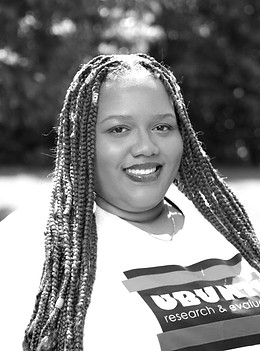
Hess Love is a poet, ethnographer, Hoodoo historian, naturalist, and environmental educator focused on Maryland’s African American folk traditions and the Chesapeake Bay. Founder of the Chesapeake Conjure Society and an MFA candidate in Creative Writing, they study under Arthur Flowers in Literary Hoodoo. Hess’s work documents Hoodoo as a living practice rooted in Black geographies, descendant stories, and Chesapeake landscapes.
A Sundress Best of the Net nominee, Hess has received support from Roots Wounds Words, Martha’s Vineyard Institute of Creative Writing, Tin House, Bread Loaf Environmental Writers Conference, Voices of Our Nation (VONA), Scribente Maternum, the American Folklore Society, the Maryland State Arts Council, and the Obsidian Foundation. They serve as Curator of Black American Religion and Spirituality for The African American Folklorist Magazine. In Maryland, Hess also works with descendant communities at archaeological and historical sites, advocating for cultural care and responsible repatriation to honor AfroChesapeake heritage.
_edited.jpg)