
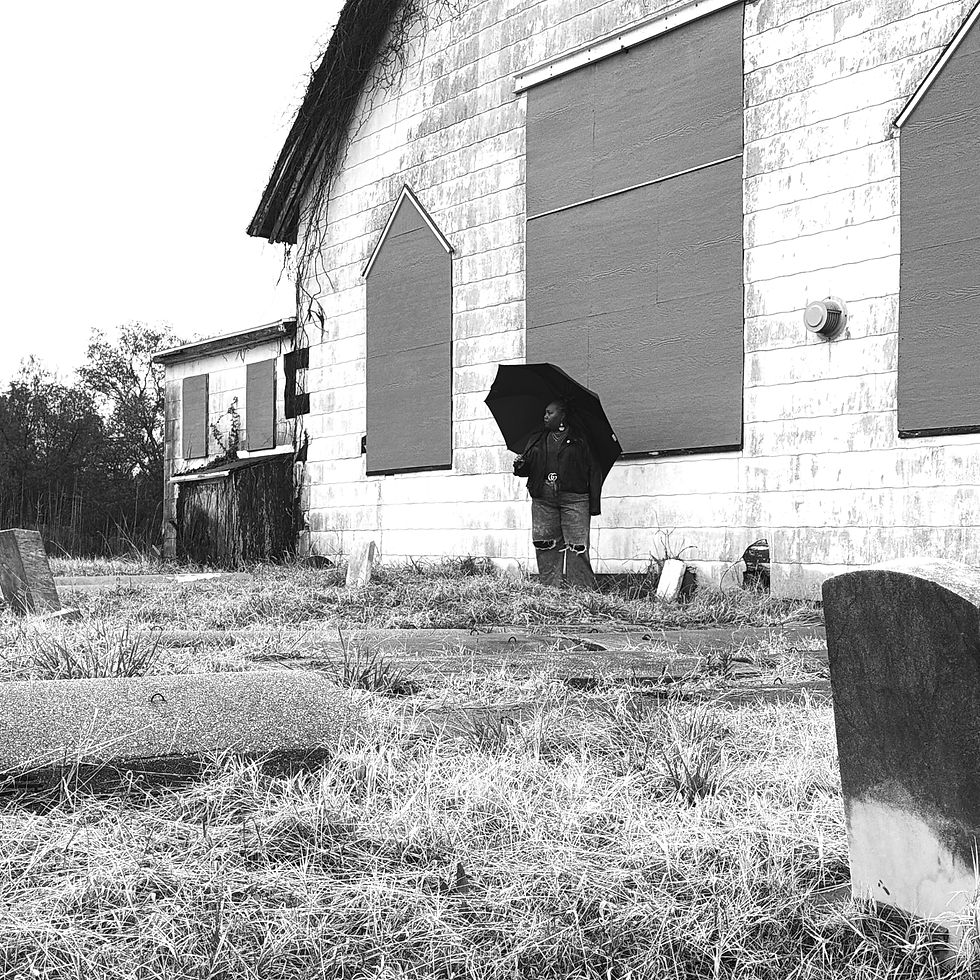


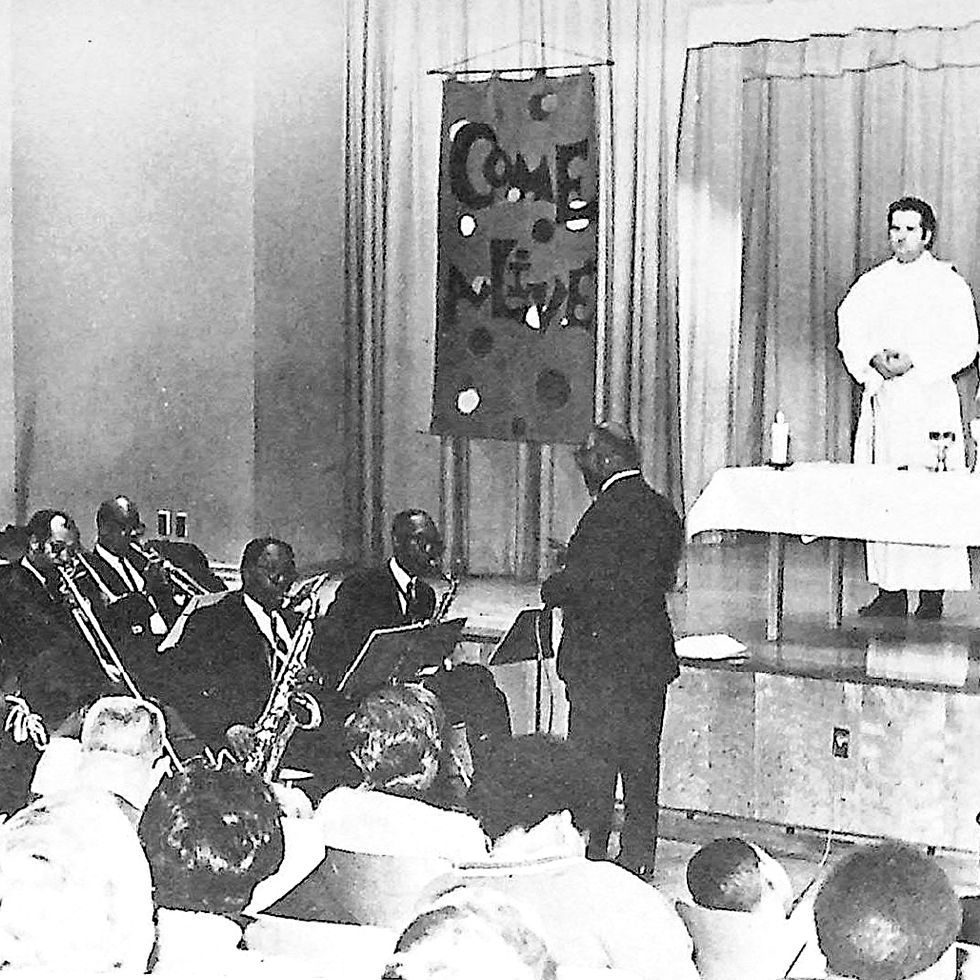


kb dennis-meade and khytie brown.
crossing the kalûnga line
cohort. 2024-25
project. Crossing the Kalǔnga Line: A Cinematic Biography of a Revival Scientist
location. Jamaica
medium. exhibit
The dead are not dead. They are in the water that runs. They are in the water that sleeps. Within the boundlessness of kalûnga, the porous watery boundary that divides existence into the land of the living and that of the dead, water and the grave are conjoined. So too are the living and the dead insevereable. At this porous boundary, the living and their dead (inversely, the dead and their living) are perpetually reaching, touching, whispering, dreaming, propitiating, offering, demanding, pressing, eating, drinking, reverberating. They embody the characteristic closeness of Diop’s crowd and Ochoa’s ambiance, which likens the dead in the Kongo-Cuban spiritual practice of Palo to an ambient mass, a multitude, “immanently turning out versions of itself [...] until the multitude that accumulates overtakes and saturates” (Ochoa 2010, 11). Our film, Crossing the Kalûnga Line, emerges from this ambiance, which crossed the threshold from cosmic dreaming to testing, while simultaneously reaching across the divide between lived religion, art, and scholarship.
Crossing the Kalûnga Line is a lyrical documentary film that blends impressionistic, expository, and reflexive documentary styles not only to tell, but also evoke, a deeply human story of death, memory, community, conflict, kinship, and love, as experienced by Black practitioners of Revival Zion religion. Revival Zion is an understudied Kongo-heritage religion that is indigenous to Jamaica. Yet, the religion and its practitioners must constantly navigate deep-seated Afrophobia—fear and suspicion of things that are African—as it is conflated with antisocial colonial renderings of Obeah as African sorcery. Amidst these tensions, Revivalism is still an enduring aspect of the Jamaican religiocultural landscape. Often depicted as an old and dying practice of those in rural areas, contemporary research is challenging this notion by focusing on the extant face of the religion through the study of transnational movement, gender and sexuality, social media practices, and aesthetics. The film aims to add to this work and spark larger conversations about the role of Revivalism in Caribbean future-making. The film foregrounds Black Caribbean religious cosmologies and the voices and leadership of those typically relegated to the margins of traditional scholarly accounts.
The film enters the world of Revivalism through Bishop Charles Marrah, a Revivalist and Obeah scientist/“science man,” with an established ministry in Rock Hall, a rural town on the border of St. Catherine and Kingston, who transitioned in November 2023. The film centers the family and community on the living side of the kalûnga divide, as they mourn the bishop, articulate their vision for his legacy, while seeking his assistance in their endeavors in the mundane realm, in order to sustain life in the face of hardship as practitioners of a marginalized religion.
On an overcast day, August 19, 2025, the film team piled into our hired minibus after completing last-minute preparations for the first, and arguably most significant day of filming ⸺the kumina ritual. Kumina, like Revival Zion, is part of the Kongo complex of Jamaican religions. The African Caribbean Institute of Jamaica/Jamaica Memory Bank, with whom the film team consulted, describes kumina as a musico-religious practice whose central purpose is to facilitate communication “with the ancestors of the Congo people of Africa and their descendants in Jamaica” (“ACIJ/JMB Fact Sheet – Kumina,” 2022). Kalûnga defies space-time and metaphysical boundaries, as well as the intended disconnection of transatlantic slavery’s human trafficking enterprise.
Kumina, and Revivalists, indeed, hold that the dead are not under the earth but groan, run, feed, dance and sing with their living kin who request their presence. How does one cordially request the presence of the dead? Through sounds, vibrations, dancing, singing, sacrificial animals, and copious handles of white rum. Drumbeats played by master drummers summon spirits to enter and possess the Kumina dancers, and even participants, in what is known as Myal. The drums do not only summon spirits, but are themselves often loaded with spirits, thus, the heads of the drums are saturated with white rum during the ceremony, so that the spirits can drink. The ACIJ explains that
On death, the personal spirit of a person possessed by ancestral spirits during Kumina rituals can join other ancestral spirits who are able to return to earth. Ancestral spirits can also be called upon to aid the living. Kumina ceremonies are held for specific purposes, mainly death in a family (wakes, entombments, and memorials). They are also performed to celebrate births; weddings; thanksgivings, for healing, and to remove the wrong kind of spirit from a person. Kumina dances can also be performed at public sessions or in private ceremonies.
“ACIJ/JMB Fact Sheet – Kumina,” 2022
Our team arrived at the bottom of a steep hill in Rock Hall at 3 pm, eager to pay our respects, alongside family and community members, at Bishop Marrah’s kumina and to learn about Bishop Marrah’s life and work from the people who knew him best. We had to abandon our minibus, as it could not make the climb. We packed up our camera and sound equipment, donned our raincoats and umbrellas, with our offerings of white rum, and tackled the steep and winding hill, whose peak disappeared under thick, gray nimbostratus clouds. Before we even made it up the hill, as luck, or the spirits would have it, we met a welder and his wife, the Lewises, at the foot of the hill, who were enthusiastic to ask questions and to share their stories of Marrah’s impact on their lives in terms of his healing ministry and facility with various interpersonal and social afflictions. As we neared the bishop’s balmyard (name for the healing compounds of multiple kinds of Afro-Jamaican religion practitioners), we began to hear the voices of seasoned singers backed by the Bandu and Cas drums. Their rhythms seemed to play hide and seek between the trees and bushes. They were not alone. Throughout my decade of ethnographic research with Revivalists (Khytie), it seemed no kumina was complete without the staccato of at least one disgruntled community member, who (somehow always out of eyesight) would make their displeasure at “wickedness,” “devil work,” and “obeah workers and buyers” known. It was no different this day, as out of sight, seemingly hidden away downslope in a ravine, a woman cursed us for about fifteen minutes, lamenting that she couldn’t believe that we “came all the way from foreign to buy obeah, what a shame! Blood of Jesus pon unu!” “Bad blessings” lined our path, and we continued our trod until we were finally greeted by a gate made of corrugated zinc and wood, and a rustic handwritten sign on a green wooden plank, secured by tree limbs, that read “CM Holy Trinity Peace Church Living Christ Ltd.”


“Everybody always love him because of the person that he is... He never discriminated, nothing.”
Levene Marrah
In between feasting, drumming, and dancing, we interviewed several members of Bishop Marrah’s family. Their storytelling and candor offer multiple intersecting approaches, questions, tensions, and feelings about spiritual power and ethics, legacy, intimacies, health, divination, and social stratification. Levene Marrah’s characterization of her father as someone “everybody always love” because “he never discriminated,” is in stark contrast to the vexation of the “Woman in the Ravine” from earlier. Levene’s sentiment speaks not only to Bishop Marrah’s embrace of all people but also highlights some of the deep and ongoing tensions between Revivalism and Protestant Christians in Jamaica, a truly sordid entanglement. Behind her sentiment is the understanding that Revivalism and obeah are marginalized traditions that are heavily discriminated against within Jamaican culture. The latter, obeah, is a criminalized healing and protection practice with a long history of colonial-inspired Afrophobia that persists until today. “He never discriminated…” foregrounds the tensions between Marrah’s approach to religion and spirituality, which lends itself to egalitarianism and an embrace of multiple spiritual modalities, as our final film will show, and how the converse is not afforded to practitioners of African-heritage traditions in Jamaica.


In sifting through the material remnants and relationships Marrah left behind, Crossing the Kalûnga Line narrates an intimate story about Jamaican Revivalism in three parts: Part I: At the Shoreline, Part II: Wading in the Water, and Part III: Into the Deep. Each part, which can be considered a lyrical movement, asks us to sit with both existential and theoretical questions related to living/doing/studying Black religion. These questions include:
-
“What is 'good' religion and 'bad' religion?”
-
“How do we approach archival and ethnographic silences?”
-
“Where do we let the dead speak?”
-
“How do we free Africana epistemologies from the shackles of Western logocentrism?
-
“What are the limits of spiritual power?”
Building on the research expertise of Drs. Khytie K. Brown and KB Dennis-Meade, ethnographers and scholars of Africana religion, Crossing the Kalûnga Line aims to expand representations of Revival Zion by documenting the contemporary textures, rhythms, lived realities, and meaning-making practices of everyday urban Revivalists. Centering Revival’s Kongo heritage, the film is animated by kalûnga, and was created at the behest of one, and many, who have already relinquished form and matter, to take on the quality of copresences (Beliso-De Jesús 2015); namely, Bishop Charles Marrah, the familial ancestor of Dr. Dennis-Meade, and folklorist, novelist, and anthropologist, Zora Neale Hurston, our scholarly ancestor who traversed similar landscapes across the African diaspora insistent on documenting the richness, complexity, and power of Black religion and folklore. In the 1930s, Hurston published Tell My Horse: Voodoo and Life in Haiti and Jamaica (1938), a comparative study of Africana religious practices. Tell My Horse is an experimental oeuvre that obscures the boundaries between researcher/initiate, participant/observer, anthropological text/travelogue. While most acclaimed for her novels and ethnographic writings, Hurston is less often credited as a pioneer of ethnographic cinema. However, during her research in the US South in the 1920s—a time when Black life and culture were deemed unworthy of serious study—she documented fifteen reels of footage that are now recognized as the first professional ethnographic recordings made by an African American woman. Scholars argue that by embracing filmmaking, Hurston granted her research subjects greater autonomy and disrupted the power hierarchies inherent in conventional single-authored ethnographic texts.
Following Hurston’s example, the film is inspired by Hurston’s visual storytelling about Black religious life and offers a multimodal, team-based, experimental narrative that exceeds the boundaries of conventional single-authored ethnographic texts, which are often inaccessible to the very communities with whom we collaborate. Alongside the Kongo conception of kalûnga, the film communes with the Afro-Caribbean concept of tidalectics, coined by Kamau Brathwaite (1973), that calls for a Caribbean epistemology that is oceanic and water-based, instead of terrestrial, and is anchored in ebbs and flows instead of fixity. As such, rather than being exclusively didactic, it will employ rhythmic editing that lends itself to experiencing the flows, non-linear and even deliberately fragmented narratives that invite multiple interpretations and highlight the tensions, shadows, and reflections of the film’s subjects.
The final version of the film is still in the works; however, we offer the initial trailer in its RAW format as the camera sees it before color grading, a visual exhibition that moves you through Preparation, Portraits, Places, and Portals, and a Spotify playlist that evokes some of the rhythms of the space, place, conflicts, and practices we sought to capture.
Those who are dead are never gone:
They are there in the thickening shadow.
The dead are not under the earth:
They are in the tree that rustles,
They are in the wood that groans,
They are in the water that runs,
They are in the water that sleeps,
They are in the hut, they are in the crowd,
The dead are not dead.
Birago Diop, from "Sighs"
works cited.
“ACIJ/JMB Fact Sheet Kumina.” https://acij-ioj.org.jm/wp-content/uploads/2022/03/FACT-SHEET-1-KUMINA.pdf
March 2022
Beliso-De Jesús, Aisha. Electric Santería : Racial and Sexual Assemblages of Transnational Religion / Aisha Beliso-De Jesús. Pilot project. eBook available to selected US libraries only. New York, NY: Columbia University Press, 2015. Web.
Brathwaite, Edward Kamau. The Arrivants: A New World Trilogy. London: Oxford UP, 1973.
Diop, Birago.“Sighs”
Ochoa, Todd Ramón. Society of the Dead : Quita Manaquita and Palo Praise in Cuba / Todd Ramón Ochoa. 1st ed. Berkeley: University of California Press, 2010. Web.
cite this project.
Projects featured on this site are the intellectual property of the Fellows who created them and may not be reproduced without their permission.
Please cite the creator if you use their work in support of your own.
Citation: KB Meade and Khytie Brown. “Crossing the Kalûnga Line: A Cinematic Biography of a Revival Scientist." SPIRIT HOUSE: A Crossroads Project. August 2025. Date Accessed. https://www.crossroads-spirithouse.org/dennis-meade-brown.

Dr. Dennis-Meade is a scholar of Africana Religions and Caribbean Studies. She is Assistant Professor of Religious Studies and Black Studies at Northwestern University. Her work centers the intersection of political and cultural histories that inform processes of meaning-making within religious communities in the English-speaking Caribbean. Her research areas include the study of the modern African diaspora, religious cultures and politics in the Caribbean, ethnographic methods, and the digital humanities. Her research areas include the study of the modern African diaspora, religious cultures and politics in the Caribbean, ethnographic methods, and the digital humanities. Dr. Dennis-Meade’s current book manuscript explores the role of religion in the history of social change in Jamaica from the late 19th century to the present through the lens of place and space. The project centers the voices and experiences of her interlocutors living within an inner-city community in Kingston, Jamaica. Through ethnographic fieldwork and archival research, her study analyzes the importance of religion in shaping community identity and belonging. Her findings prompt scholars in the fields of Religious Studies and Black Studies to attend to the impact of antiblackness, globalization, colonialism, and violence on African diasporic religious communities and practices.

Khytie Brown is Assistant Professor in the Department of Religious Studies at University of Texas-Austin. She is an ethnographer and scholar of African diaspora religions and African and African American studies. Her research broadly examines the intersections of religion, race, gender and sexual alterity, criminality, material culture, sensory epistemologies and social media practices among African diasporic religious practitioners in the Caribbean, Latin America and North America. In particular, her work focuses on Revival Zion religion, an understudied African-heritage, indigenized form of Christianity originating in Jamaica. She is currently working on her book manuscript, Afro-Queer Journeys: Spiritual Intimacies and Rituals of Becoming in Revival Zion Religion. The book examines Revival Zion religion as an indigenous Kongo-heritage religion, addressing transnational movements and migrations, colonial legacies of afrophobia and homophobia, and sensory hierarchies of difference in the making of marginalized religions in the Caribbean and Latin America, while foregrounding practitioners’ somatic practices as subversive world-building responses. Khytie holds a Ph.D. in African and African American studies from Harvard University with disciplinary foci in religion and anthropology.
_edited.jpg)