


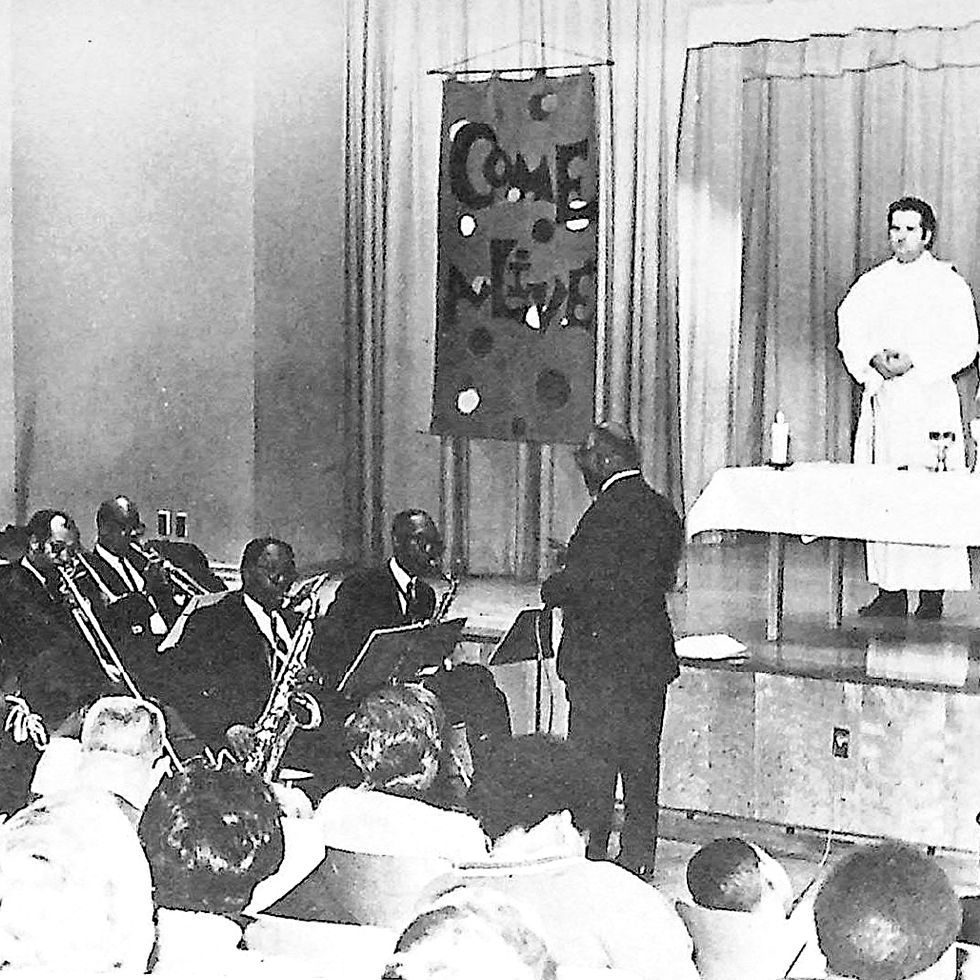


yvonne chireau.
holy heroes
cohort. 2025-26
project. Holy Heroes: Comics, Cartoons, and Black Religion
location. unbounded
medium. exhibit

Artist: Samuel Milai | The Pittsburgh Courier (30 June 1945)
"Cool, but I just don’t see what religion has to do with comic books.”
My friend and I are standing in the center pavilion at the San Diego Convention Center, home to Comic-Con, one of the largest comics and animation conventions in the world. “But this is religion!” I insist. I am dazzled by the rush and flow of color and light, entranced by the mashup of formats and styles, books, graphic novels, cards, movies, the materiality of the objects and artifacts within a secular faith that binds observers and devotees in a mutual desire to see their icons and be seen by each other, like some pop culture Darshan. As a religionist it was impossible for me not to observe that a public ritual was taking place.
At Comic-Con, everything revolves around the dynamics of visibility by promoting, and buying, and selling, pursuing the gaze. Reimagining flat two-dimensional texts and their pictures by enlivening them, bringing them to life with characters and elaborate performance art is a form of religious action; this is the fabulous collective theatre known as cosplay.
But that was not what I was there to do that day. I was there to present an academic talk on Black religions and comics. I was most excited to take part in the Spiritual Themes in Comics discussion that was sponsored by the Christian Comic Arts Society, an African-American led organization, which has hosted panels and kept tables at Comic Con International for over thirty years. Scholarship on Black religion typically defaults to writings about the Black church, so it makes sense that most religion and comics media featured the works of Christian-identified
creators. To my surprise, the group was less interested in Black Christianity but wanted to learn about African diasporic religions - the traditions such as Santeria and Haitian Vodou, and the erroneously signified Voodoo - and other Africana faiths at the margins of white American Christian culture, like Hoodoo, but which nonetheless were represented in the history of comic books. My guess was correct, that religious pluralism and spiritual diversity has been visible all along in the comics world, but it has not been recognized as such. The panel was successful. I made new friends and met new conversation partners. Most of all, the venue provided new possibilities for sharing the richness of Black religious life using a visual medium that has often been neglected and overlooked as viable documentary source material for telling stories of race, religion and representation.

Hugo Canuto is a Brazilian visual artist from Salvador, Bahia, whose work adapts Afro-Brazilian and Yoruba religious narratives into the visual language of superhero comics, like this 2016 re-creation of Jack Kirby’s cover for The Avengers #4.
The Holy Heroes website was created in response to a gap in memory and scholarship with respect to the Black religious presence in comics and cartoon media. I wanted to curate a collection of images within an exhibit format using examples to show how the medium was blended and hybridized, notwithstanding period and context, in religion themed images that were intended to entertain, inform, persuade/evangelize, or some combination of these. The display includes scans of newspaper strips, comic books, illustrations in advertisements, political cartoons, and other ephemera like tracts and cover art. The site shows a variety of scenes of organized religious life in Black communities, as well as advertising and promotional materials from outside of these communities, that includes biographical and historical personalities, and fictionalized caricatures, fantastically superpowered icons and holy heroes.
These comics, I think, tell us what was valued by insiders in Black religious communities in different periods, and what was useful and of interest; but the site also details images of ridicule and irreverence by those outside of traditional faith groups. The work that they accomplish is representational. And it is also aesthetic. African American subjects have appeared for more than a century in comics, cartoons, newspapers, tracts, advertisements, and related print media. The site tracks a combination of period and medium and setting. By bringing them together, this project makes visible the range of racial and religious representation that has been obscured by narrow accounts of African American religion and by the separation of comics studies from religious history. The digital format allows visitors to compare images across time, traditions, publishers, and visual modes, to see how Black sacred life was commemorated, instructed, commercialized, and reimagined.
I am a religionist; like others in my field of study, I work in an interdisciplinary arena. Comics studies deals with issues of race and representation but doesn't put religion at the center. I wanted to bring my interest and respect for African American religious history into conversation around a body of material that has remained dispersed and largely unexamined. African American studies uses visual documentary materials and historical sources and puts culture at the center. Race, either race as Blackness, or race as whiteness - has been a constant, visible element in comic books since their inception in the late 1930s. Racial coding in the comics is pervasive in what Benson and Singsen have called the "white racial frame" of US comic book production, which has resulted in the reproduction of racial caricatures, stereotypes and exclusion. For most of their history, comic books have reflected the cultural assumptions and values of the society, and the periods in which they were produced. The medium shapes the message, and it incorporates audiences across different literacy levels and demographics. Holy Heroes brings different sources materials together and argues that their form matters. Comics circulate religious images through accessible, popular visual media across broad audiences and for different purposes. Even when creators have sought to challenge racism, their efforts have frequently been constrained by the ideological limits of the world they inhabit. These patterns are seldom isolated; they are entangled with other forms of bias, including sexism and homophobia, which further complicate the effort to tell more inclusive stories. This framing has directly resulted in the scarcity and uneven misrepresentation of Black religious identities in genre comics of the twentieth century.
Holy Heroes is a digital curated exhibition of the Black religious presence in comics, cartoons, and related print media. It brings together histories of race, religion, in visual media in a rare collection. The project from more than ten years worth of material, has also brought me into conversation with a network of fans and artists who also delight in comics and cartoons, understanding their potential as public humanities resources, or simply for sharing and unusual ephemera that are rarely found in the archives. The materials for this project are normally scattered across libraries, newspapers, comic collections, church archives, and the apparatus of commercial publishing history. They cannot be seen when they remain isolated.

Future iterations of the web site will include religion themed film animation. Using parody and racial hyperbole, these cartoons mimicked Black vernacular practices and its styles of folk Christianity to appropriate African American devotional performances for technicolor venues. The success of Depression-era cartooning owed much to the resonance of caricatures that were inherited from nineteenth-century illustration, Blackface minstrelsy and vaudeville entertainment which supplied key performance modes.
The material is animated by a question that runs through them all—what does Black religion look like when drawn in this way? How have comic books, cartoons, and related comics media represented Black religious life?
While much of the research is still provisional, the site makes use of an archive of sources that are largely unavailable as a unitary body of evidence of Black religious history. For one, I wanted to preserve a wider visual record. In this collection, for instance, African American Islam shows up consistently - a cartoon image by the Moorish Science Temple from a teaching booklet in the early twentieth century, the Nation of Islam's mid-century presence in syndicated comics from Muhammad Speaks Newspaper, and later popular cultural formations of Black Muslim identity, such as the fictional showdown between Superman and Muhammad Ali in a DC comic book special from 1978. Some of the images come from religious institutions, religious media, and their sectarian publishers. Others appear in Black newspapers and Black-owned publishing houses or were independently created by comics trailblazers who carried a tradition of visual storytelling, those whom the comics historian Ken Quattro has called “invisible men,” talented African American writers and illustrators who worked behind the scenes, often without credit and sometimes in segregated workplaces, while creating comics that were expressly informed by Black perspectives. Finally, some of these images will always be recalled by devoted followers of comics as favorites from a time past, their characters living forever even as the identities of their originators remain absent from popular histories.
about holy heroes.
HOLY HEROES is a digital curated exhibition that chronicles Black religious presence in comics, cartoons, and related print media. It brings together the histories of race, religion, and visual media through images from comics, cartoons, and comic books. The site opens a window onto African American religions as they have been rendered in print media. Visitors can browse curated timelines and explore the visual record of Black sacred life in comics media.
Comics and cartoons have long served as an important visual record of Black religious life, preserving, circulating, and contesting ideas about Black sacred authority, religious identity, and racial representation across twentieth- and twenty-first-century popular media. These images, from newspaper strips, comic books, political cartoons, illustrated advertisements, book covers, and religious tracts, are available in library collections. Here they are gathered into a coherent online exhibit of Black religious representation.
Some of the images come from religious institutions and religious media or their publishers. Some come from Black newspapers or Black-owned publishing. Some come from commercial entertainment companies. Some are independently made.
The exhibit asks:
How have comic books, cartoons, and related comics media represented Black religious life? Their variety is animated by a question that runs through them all—what does Black religion look like when drawn in cartoons and comics?
Why Black comics and religion?
Comics studies have developed important approaches to race, representation, and popular visual culture, but religion has rarely been treated as a central category of analysis. African American religious history places Black religion at the center of inquiry and has long used visual materials as documentary sources, yet comics and cartoons have not received sustained attention as a visual record of Black sacred life. Holy Heroes addresses this gap by gathering and interpreting images through which Black religious people, practices, institutions, and sacred worlds have appeared in popular print media.
Comics and cartoons deserve scholarly attention as sources for the study of Black religion.
Their visual form, popular circulation, and accessibility across age groups, literacy levels, and social settings made them an important medium through which religious images and ideas entered public culture.
Religionists work in an interdisciplinary field. Comics studies deals with representation but doesn't put religion at the center. African American religious history uses visual materials for its documentary sources and puts Black religion at the center. The result I am reaching for is a record that remains unexamined as a curated collection: comics and cartoons. The medium shapes the message, and it incorporates audiences across different literacy levels and demographics. My project brings diverse materials together and argues that their form matters. Comics circulate religious images through accessible, popular visual media across broad audiences and for different purposes.
Scholarship on Black religion in America typically defaults to "the Black church." But in this archive, African American Islam shows up consistently - from cartoon images of the Moorish Science Temple in the early twentieth century or the Nation of Islam's mid-century presence in syndicated comics from Muhammad Speaks newspaper to later formations of Black Muslim presence in comic books. Religious pluralism and diversity has been visible all along, but it has not been recognized as such.
The display includes newspaper strips, comic books, cartoon illustrations in advertisements, political cartoons, tracts, and other illustrated ephemera like book covers and brochures. It includes images and scenes of organized religious life and communities, promotional materials, biographical comics with historical personalities, and holy heroes - superpowered icons and fictional caricatures. These images show us what is valued by insiders and outsiders to Black religious communities. They detail images of reverence and ridicule. The work that they accomplish is representational, and it is also aesthetic.
Form, description, style, line, and layout can determine what is shown to be reverent and authoritative on the page.
The platform functions as a scholarly resource and a public archive. Readers can encounter the Black sacred in constructed images of faith and imagination that respond to African American religious histories. This living archive invites visitors to view comics as historical evidence and as sacred narrative. They are visual records of struggle, imagination, and faith rendered through line, color, and form.
comics, cartoons, and african diasporic religions.
Diasporic religions—African derived Orisa traditions, Obeah, and Haitian Vodou—have been represented through the cartoon and comics form as far back as the 19th century. Negative perceptions entered into these mass media portrayals at an early point. Later, in the US, these religions were viewed as exotic and strange, with foreign gods, foreign practices, and hailing from foreign places.
I use the phrase “graphic Voodoo” to refer to the ongoing characterization of Africana religions as insurgent and racialized, overdetermined by associations with sorcery, and presumed to be violent and dangerous. Graphic Voodoo became a signifier for spiritual alterity that marked black ‘otherness’ with resonant elements drawn from two historical sources: Indigenous African spiritual traditions and Haitian Vodou. As a metonym for Africana religions, Voodoo became a stand-in for race and religion in many widely-circulating comic books in the US, especially those of the action-adventure and horror genres. Voodoo came to denote Black religions, from Africa, the Caribbean, and the US, such as Hoodoo and Conjure.
The aesthetics of Voodoo, as established in action-adventure jungle comics and zombie themed comics coded Black Africana spiritualities as uncivilized and strangely powerful. Outlandish pictures of black religious authorities in roles as Voodoo priests and witch doctors - half-naked, with grass skirts, feathered headdresses, ornamental necklaces, bones, and fetishes - registered the stereotype of the timeless ‘Native.’
While nineteenth-century political cartoons and illustrated journals had employed denigrating visuals in portrayals of indigenous people, Africana religions in twentieth century comics were refracted through a prism of broadly pejorative tropes. Weighed against western standards and Anglo-Christian exceptionalism, Africans were viewed as abject denizens of the “dark continent,” degenerate, lacking moral virtue, “without God, law, religion, or commonwealth.” Defamation of African peoples in written and visual discourses would be used to rationalize the West’s role in the slave trade, colonialism, and its postulations of scientific theories of white racial superiority. These accepted images of Africa and Africans filtered into the comics. Voodoo was an imagined but powerful idea: a religion that enacted immorality and corruption, threatened vengeance and retribution toward its enemies, validating white paternalism and American-Christian virtue as a means of social control.

"Marie Laveua." Artist: Samuel Millai.
About Marie Laveau
During the mid 1940s, African Americans learned about Black diasporic religions through cartoon imagery. Marie Laveau was born a freedwoman in New Orleans around 1801, of parentage that joined African, French, and Native American ancestries. She was baptized at St. Louis Cathedral and remained a practicing Catholic all her life, said to have attended daily Mass and to have held the confidence of the Capuchin pastor Père Antoine. By midcentury she led an Africana religion that would come to be known as New Orleans Voodoo, presiding over gatherings at her St. Ann Street cottage and celebrating the annual St. John's Eve rites on the shores of Lake Pontchartrain. Laveau’s faith tradition was an ancestral practice that had been carried to Louisiana in the memories of enslaved Senegambian, Fon, and Kongo peoples and replenished by the Saint-Domingue refugees who poured into the city after the Haitian Revolution. Some say that there were two Marie Laveaux, with her daughter and namesake adopting her physical identity and practice after her death, bequeathing to the historical character a kind of earthly immortality. Today, many consider her to be a witch, a Voodoo queen, a ghost, or a local saint modeled in the style of other unofficial Catholic goddesses. She most certainly embodies the trope of the Conjure woman, the quintessential black folk heroine who elides neatly drawn divisions between morality and (supernatural) power, particularly in her role as an occult agent, first as a slave, then later, as an American subaltern. The Conjure woman inhabits the visual figurations of the actual vocations of African American women in history from slavery to the present, including Hoodoo and root workers, spiritualists, herbalists, seer/diviners, healers, and priestesses. The freedom with which comics and cartoon illustrators have interpreted the form of Marie Laveau offers a compelling testimony to her resilience as an inspiring social actor.
About the artist
Ahmed Samuel Milai created religion-themed educational content in titles like Your History, J.A. Rodgers’ popular Black “race” series in the 1950s. Milai, a prolific African American cartoonist at the Pittsburgh Courier newspaper, drew an early comic strip series beginning in 1937, with various illustrations of Black religious content, on through the early 1960s. His comics are collected at the Billy Ireland library at OSU.
comics, cartoons, and islam.
The default assumption about Black religion in the US is often just "the Black church" - meaning Protestant Christianity - when the reality is much more diverse. Black Islam has deep roots in African American history - from early 20th century movements like the Moorish Science Temple, to the Nation of Islam's massive cultural and political influence, to orthodox Sunni communities, to the Five Percenters who had a vital impact on hip-hop culture. These weren't fringe movements, I argue, but they shaped Black identity, politics, and culture. This is clear as we see how comics and cartoons engaged with African American Islam, whether in mainstream media's problematic depictions of the NOI, or Black newspaper cartoonists representing Islamic identity, or the significance of figures like Malcolm X, who appeared in different graphic biographies.

from Muhummad Speaks (1965-1969). Artist: Eugene Majied
About the Nation of Islam
Although American culture is predominantly Christian, religions such as Islam have deep roots in Black communities, which have always been spiritually pluralistic. Eugene Majied/Eugene XXX was a prolific illustrator for black newspapers such as the Chicago Defender and Muhummad Speaks in the 1960s and 70s. His incisive style of political cartooning conveyed the theological principles of economic self-reliance and racial pride that characterized religion and theology in the Nation of Islam.
In pursuit of racial uplift and the ideal of black nation, members of the Nation were required to dress conservatively, reject common vices, and refuse non-natural appearances and bodily modifications (i.e: tattoos, chemically processed hair, wearing makeup, etc.) The Nation’s principles around self-presentation and self-preservation appealed greatly to Black Americans, with the Nation’s membership in the 1960s estimating to be close to 100,000 and newspaper circulation (Muhammad Speaks) reaching 600,000 copies in its first issuing year (1960).
The NOI’s inclusion in this exhibition is incredibly important, as the Nation holds a significant place in representation of Black Muslims in America, particularly in the context of the Civil Rights Movement and major cultural shifts in the wake of the Great Migration. Although not formally accepted as a sect of Islam (due to their deviation from the Five Pillars, rituals, and religious mythology/history), the Nation of Islam holds a significant place in the practice and representation of Islamic practice within Black America. The organization’s leaders were notable cultural and political influences in late modern and early postmodern America, often considered key figures in the Black and American historical canons.
About Muhammad Speaks
The NOI maintained multiple newspapers and media streams. The majority of the comics provided come from Muhammad Speaks, created by Elijah Muhammad in 1960. An overwhelming success, during its run Muhammad Speaks spread the messages of the Nation, highlighted stories of success within the community, and most significantly served as a place for discourse on anti-Black state-sanctioned violence in the United States. The publication became one of the most read newspapers in Black American history, ending its run in 1975 with the death of Elijah Muhammad.
About the artist
Born as Eugene Franklin Rivers on February 4th, 1926 in South Carolina, Eugene Majied was a prominent cartoonist and artist for Muhammad Speaks. Majied studied art at an early age, desiring to be a painter and taking courses at the Museum of Fine Arts, Boston. After serving in World Ward II, Majied returned to the United States, moved to Chicago, and became a janitor whilst pursuing art as a personal venture. After encouragement from his wife, Majied began to illustrate for Chicago-based Black newspapers, such as the Chicago Defender. Majied converted to the Nation and began to work closely with the leadership at the Chicago headquarters, including Elijah Muhammad, where he became a lead cartoonist for Muhammad Speaks.
Majied’s comics were distinct and compelling in their ability to engage with social, cultural, and political commentary. Notably, Muhammad Ali’s decision to join the NOI was prompted by encountering one of Majied’s comics. Majied’s signature varied, appearing as Eugene X, Eugene XX, Eugene XXX, Frank Lee, and Lee. Later in life, Majied returned to South Carolina to illustrate for the Greenville News. He passed away in 2005.
comics, cartoons, and christianity.
American comics and cartoons have historically privileged white Christianity and representations of the Christian religion, and Christianity has shaped storylines, character designs, and visual tropes across all visual media. American newspaper strips, cartoons, and comic books imagined race and religion together from within a specific white-racialized perspective. This dominant worldview typically pushed depictions of Black Christian religiosity to the margins, with some notable exceptions. The co-constituency of race and religion in American comic strips, cartoons, and comic books has always been imbricated with the cultural attitudes and social dynamics of the day. In mainstream visual media, African American subjects were present, but their visibility was often punctuated by the devaluation of Black personhood.
The Black press in the twentieth century, recognizing an urgent need, aimed to provide alternative depictions that counteracted the reductive and demeaning imagery of Black Christianity that was seen in the white majority press. Comic strips thus became a potent medium for illustrating the diverse facets of Black life, including its vibrant religious practices, religious institutions, community leaders, and other notable figures.
In the twentieth century, an array of comics enriched the pages of the Black press, marking a historically significant era when Black protagonists and characters gained visibility. The work of Black cartoonists circulated in syndicated cartoons distributed to African American newspapers. This period also saw Black cartoonists and comics illustrators making inroads, a rare presence in White-majority owned newspapers and publishing companies.
African American artists were the first to portray the Black preacher as a figure with whom their readers shared personal connection and cultural identity. Nurtured within the walls of the venerable African American church, African American religious leaders served as pastors, healers, prophets, and ministers, holding unique positions of authority, often as de facto leaders. This influential role was acknowledged by W.E.B. Du Bois, who called the Black minister "the most unique personality developed by the Negro on American soil."
African American comics creators and illustrators rendered Black Christian preachers with familiarity and respect. In their comics and cartoon images the preacher figure was imagined as a beloved icon, even in instances where he or she was made the target of self-deprecating “inside” humor.
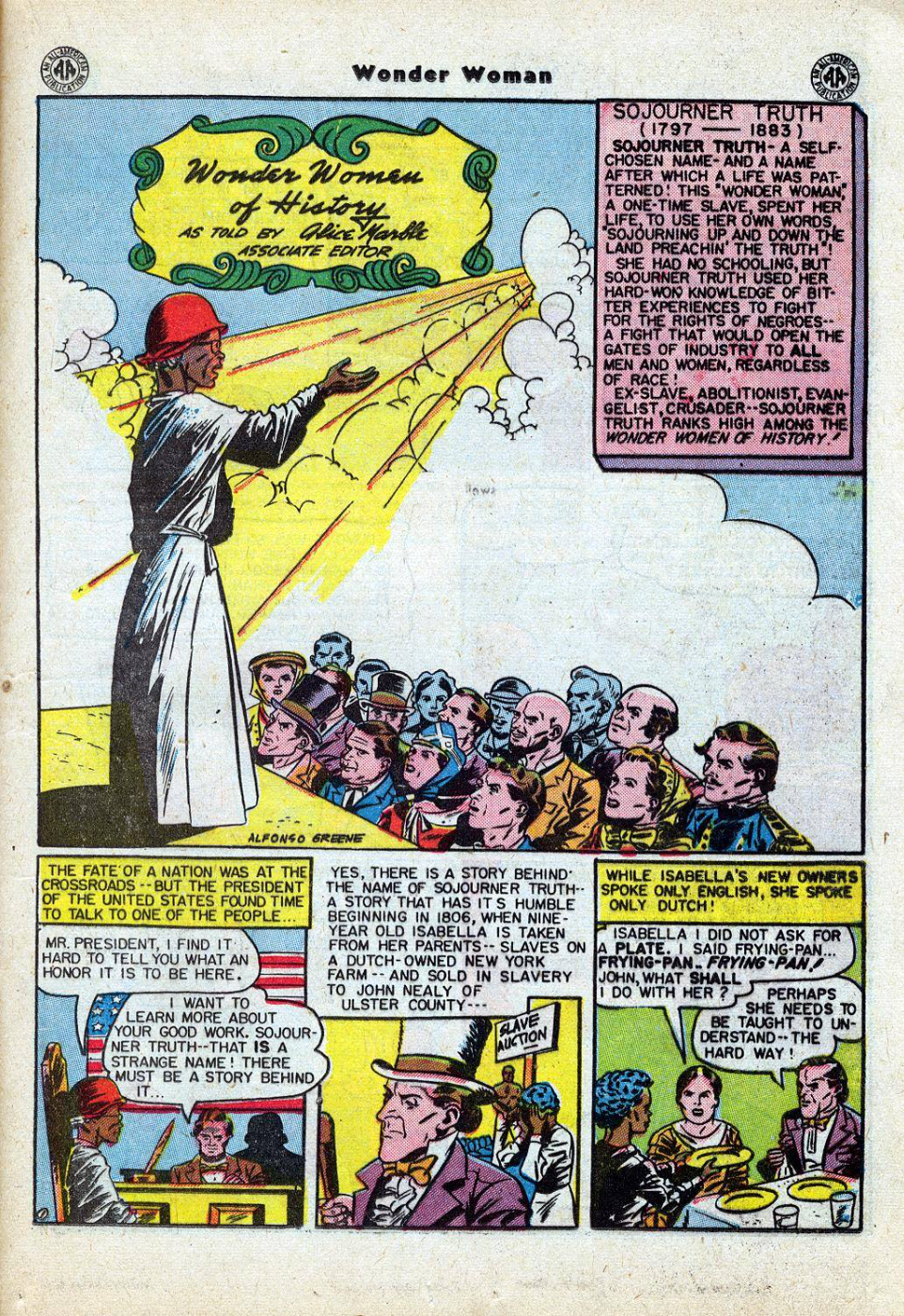
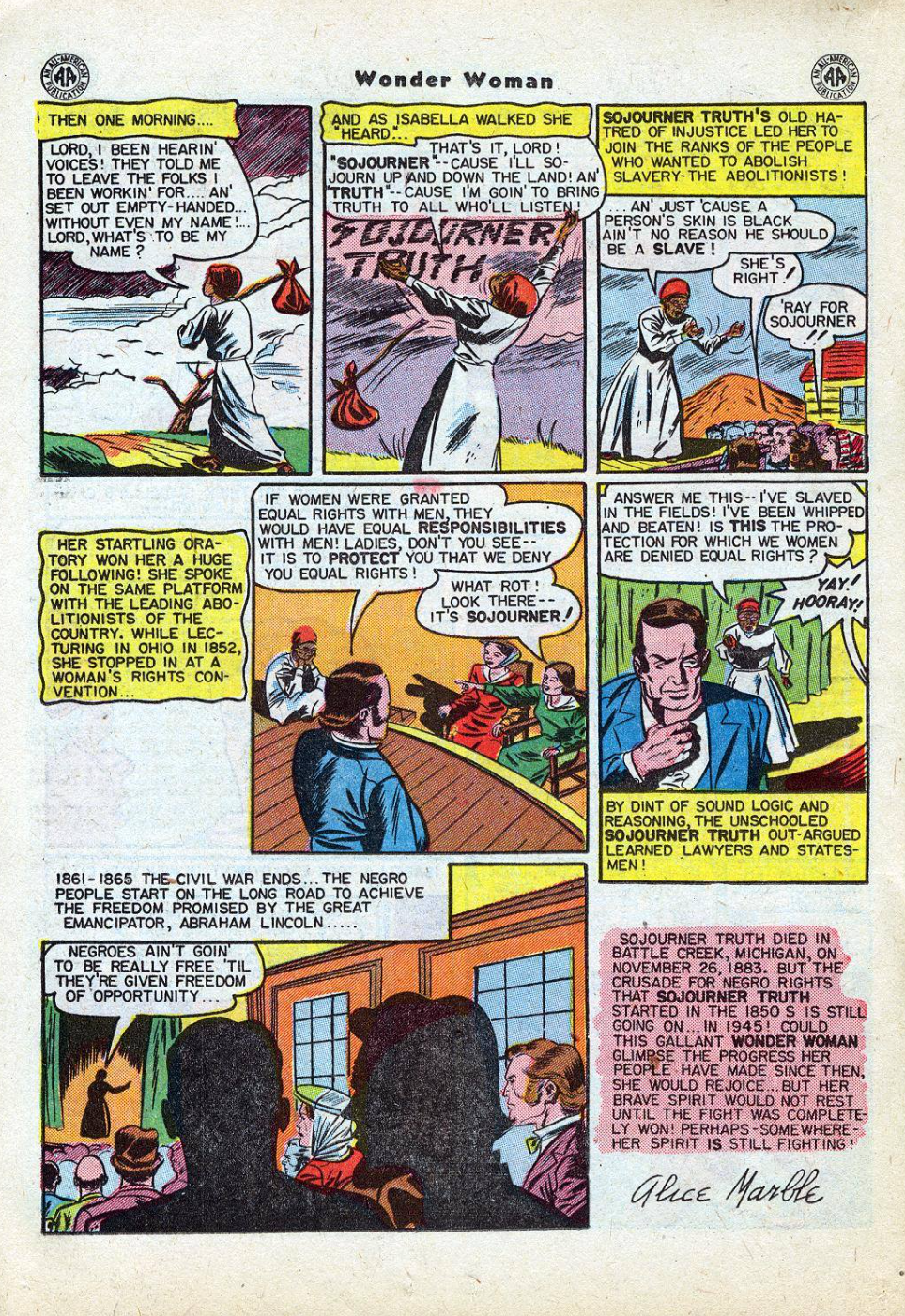


About the images
This collaboration between a Black artist and white feminist writer to depict the Black abolitionist and evangelist Sojourner Truth represents a kind of cross-racial partnership that was rare in 1945. The story appears in a mainstream superhero comic, making a radical Black religious-political figure accessible to white audiences, but filtered through the cultural and institutional gatekeeping of the day.

Fred Carter, Jesus Praying in the Garden, 1978, ink and pencil, 7 3/8 × 7 5/16 inches. Courtesy of Urban Ministries, Inc.
About the artist and the image
Fred Carter was an uncredited artist for Jack Chick Publications until 1980. He created tracts and cartoons for the fundamentalist and evangelical Christian market. While many of the Jack Chick publications adhered to Blaxploitation period-specific aesthetic styles in their presentation of African American people, Carter’s art was recognizable for its dramatic, somatically muscular, and visceral realistic style.
Though uncredited for much of his career, Carter created Jack Chick comics from roughly 1972 to 1980. An ordained minister and talented painter, he authored some of the most recognizable content directed at Black audiences in the Jack Chick catalog, including Soul Story and Burn, Baby, Burn. Visual studies scholar David Morgan notes that Carter's illustrations acknowledged African American identity by incorporating race and religious faith, "celebrating Blackness without apology." Carter, who passed away in 2022, is considered one of the most widely seen African American comics illustrators of the 20th century.
In 1974 Carter produced the first interracial comic book superhero team action comic series, The Crusaders. In 2000, he produced the Children of Color Bible with original oil paintings, including one of the first images of Jesus Christ incarnated in a Black body.
For some artists, the choice to portray Jesus as a Black man was not unthinkable. It was not about provocation but about historical clarity. To many African Americans, illustrating Christ in their image was a way to remove him from the justifications of the slaveholder’s Bible, to see him not as a distant, unmarked figure but as someone whose life reflected the realities of oppression and state violence. A Christ who belonged to the persecuted, not the powerful. For these Christians, the Black Jesus was not an abstraction but a direct claim. His face and body was shaped by the same histories of forced labor, survival, and resistance. To depict was to recognize the lived experience of those who had endured under systems that saw them as expendable. It was not just an image but a reassertion of who Christ was and who he stood with, a reminder that his suffering was not separate from theirs.
The figure of Christ as presented in the comics provides a stark example of how comic books have reflected the religious and racial cultures out of which they arose. Despite considerable historical uncertainty about Jesus's appearance, images of Christ as white have prevailed in American visual media. This tendency has been overtly articulated, even by scholars, such that even a prominent historian of world religions in 1958 could baldly claim that Jesus "was probably a tanned white man." Such ubiquitous, almost common sense depictions of the white Jesus function as a clear mechanism by which Americans envisioned God in their own likeness. For much of the twentieth-century Religion-themed comics normalized these racial and religious assumptions and accepted them as truth.
cite this project.
Projects featured on this site are the intellectual property of the Fellows who created them and may not be reproduced without their permission.
Please cite the creator if you use their work in support of your own.
Citation: Chireau, Yvonne. “HOLY HEROES: Comics, Cartoons, and Black Religion." SPIRIT HOUSE: A Crossroads Project. August 2026. Date Accessed. https://www.crossroads-spirithouse.org/chireau

Dr. Yvonne Chireau is Peggy Chan Professor Emeritus of Black Studies and Professor Emeritus in the Department of Religion at Swarthmore College, where she taught courses on Africana religions and African American religious history. She is the author of Black Magic: Religion and the African American Conjuring Tradition (2003) and lives in Delaware County, Pennsylvania with her family and a three-legged cat. Her writings on Black religion, visual culture, and Voodoo tropes can be found online at The Academic Hoodoo.

_edited.jpg)