




marya mcquirter.
the taint of the bicycle and techno-christian melodrama
cohort. 2025-26
project. William F. Fonvielle, The Taint of the Bicycle and Techno-Christian Melodrama
location. Goldsboro, NC
medium. research report
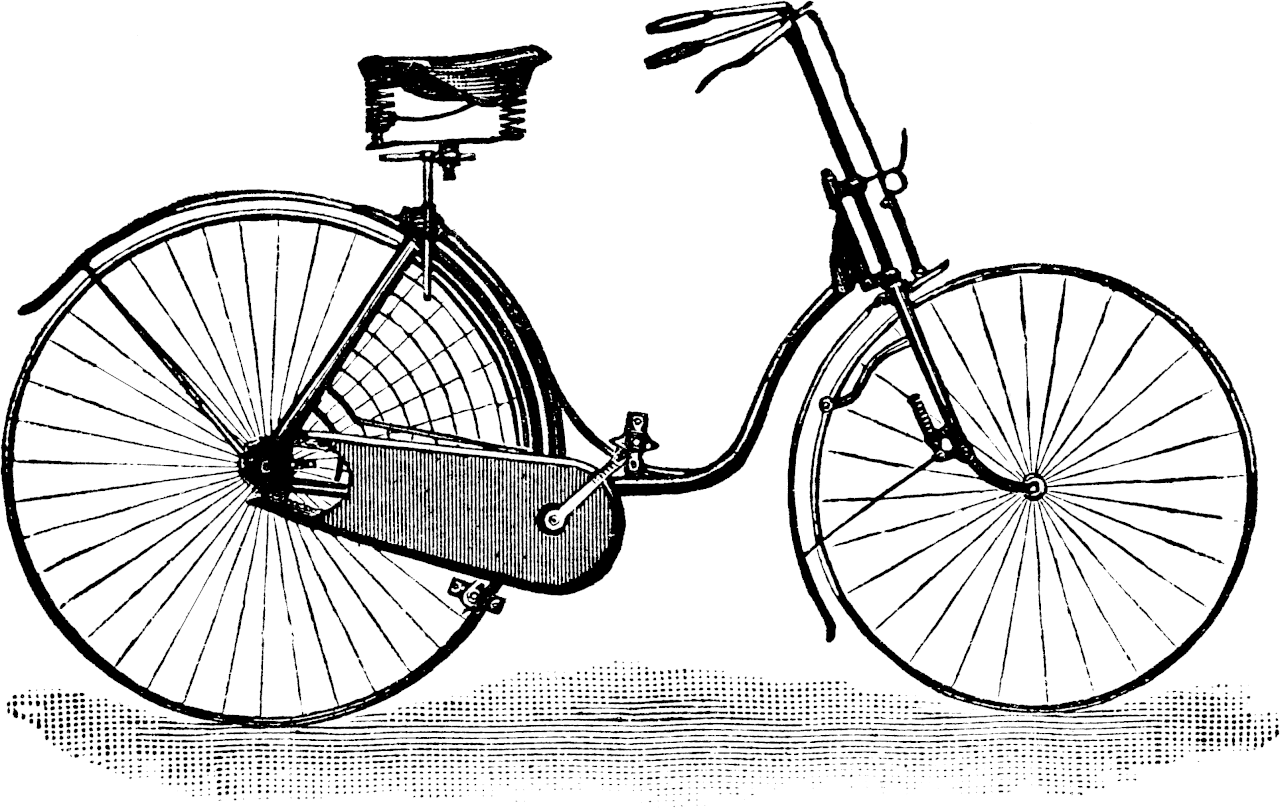
ladies' safety bicycle (1889) | public domain
In 1902, William F. Fonvielle (1869-1903), a prolific writer, self-published The Taint of the Bicycle, a genre-bending book about the evils of bicycles, especially for Christians. The Taint of the Bicycle first appeared as a series of articles in the Star of Zion (which was founded in 1876 by the African Methodist Episcopal Zion Church and is our oldest continuing newspaper).[1] In the book’s preface, Fonvielle wrote, “These contributions attracted so very much attention at the time of their publication, and so great has been the demand for them since, that the author has consented to place them in book form.”

photographic portrait of William F. Fonvielle from The Taint of the Bicycle (c1902_
The Taint of the Bicycle is a critical text for study because it is the only book from the turn of the twentieth century, that I know of, that expounds on the incompatibility of religion and bicycling. Moreover, in multiple ways, it is an early text that dramatically tethers Christianity and technologies. First, Fonvielle chose writing as a technology for his own pleasure. It seems fair to say that, as a prolific writer, Fonveille reveled in employing journalism and fiction to moralize about and play around the edges of popular culture. Second, Fonvielle’s book demonstrates that popular fiction, specifically melodrama, could be forms of and spaces for Christian exploration and exposition. Fonvielle drew upon his readers’ familiarity with melodrama’s complex affordances of exaggeration (of the differences between good and evil), excess (the too muchness of “sharp plot twists and vigorous emotionalism”), with a sprinkling of ecology (the celestial, fauna and flora).[2] Finally, Fonvielle shows us that Christian texts were vibrant spaces for discussions about popular technologies.[3]

cover of William F. Fonvielle’s The Taint of the Bicycle (1902)
My primary goal for this project was to make The Taint of the Bicycle easier for the public, researchers and scholars to use. I would love for more people to work with this rare text. The Taint of the Bicycle is rare not only because of its genre-bending focus on bicycles, but also because there are very few extant copies. According to WorldCat, there are only two institutions that have copies of the book: Livingstone College and the Schomburg Center for Research in Black Culture. To that end:
-
I paid for a high-resolution digital copy of the Schomburg Center’s copy of the book.
-
I narrated all seven chapters of the book, as well as the title page, the dedication and the preface.
-
I offer the text as a generative genealogy for current scholarly work on religion and technologies.
-
I offer ‘techno-Christian melodrama’ as a usable concept, which I define as a genre in which technologies and Christianity are constitutive of the melodramatic drive of a text. I’d love for folks to find other examples of ‘techno-Christian melodrama’ in popular fiction, film, poems, theater, television and social media.
william f. fonvielle.
Fonvielle was born on 11 June 1869 in Goldsboro, North Carolina. His writing life began at least as early as college. At Livingstone College, Fonvielle was managing editor of the school’s new monthly periodical, The Living-Stone. He also wrote a column for The Living-Stone titled, “Things of the Hour” which “bristled with pertinent comments.”[4] Fonvielle also wrote the lyrics for the school song, “My Livingstone,” which was composed by Victoria Richardson, a faculty member and librarian.[5] During the summer of 1893, between his junior and senior years, Fonvielle traveled throughout the “deep south” on a mission to observe white people and to see how they sought to institutionalize and normalize white terror. He detailed his experience in the A.M.E. Zion Quarterly Review (a scholarly journal founded in 1890).[6] During college and after graduation, his poems were published in popular secular newspapers, including the New York Age, the Richmond Planet and the Seattle Republican.[7] His final publication, Reminiscences of College Days (1904), an institutional memoir, was published posthumously. Fonveille died on 11 September 1903 in Goldsboro, NC.[8]
the taint of the bicycle.
taint (noun): a contaminant; the presence of a minor and unwanted element
The Taint of the Bicycle, a 24-page book with seven chapters, began as a series of articles in the Star of Zion in 1900 under the newspaper’s popular column, “Majors and Minors.” The series of the same name was delineated in four parts in March and April. Although I have not been able to find any reader responses to the series in the letters to the editor section, we can trace its popularity, in part, by its movement within the pages of the newspaper. The first part appeared on page three; the second part appeared on page two; the third on page four; and the final part, where he switches from journalism to melodrama, was placed in the newspaper’s prime spot: the first two columns of the front page (and continued onto the back page due to its long length).
In the book, Fonvielle deployed melodrama in the final four chapters to show the incompatibility of Christianity and bicycles. (He used a journalistic style in the first three chapters.) This incompatibility hinges primarily on his binary concepts of gender. For Fonvielle, women are prescribed to be the moral pallbearers of Christianity and heterosocial matrimony. And men are prescribed to be the leaders and providers in heterosocial matrimony. Fonvielle believed that bicycles were incompatible with Christianity primarily because they took women outside of the home for non-family pleasure and into the “insubstantial bubble of Popularity.” Bicycles opened up the dangers of and possibilities for cross-gender mingling, interactions with non-Christians and new bodily desires, movements and sensations. His dedication hinted at the former prescription.

preface to William F. Fonvielle’s The Taint of the Bicycle (1902)
We are introduced to Sadie Southwell, the main character, in the fourth chapter. Southwell was the darling of her family because of her beauty and intelligence. She graduated as the college valedictorian of an unnamed seminary, met a male pastor and they got married. They moved to a locale far from her family and friends to be near the church he would lead. They were happy together…for a while. But then she succumbed to the bicycle. After her husband bought her a bicycle, “she learned to ride, and joined bicycle parties of different sizes, shapes, and sexes. A bicycle club was formed, she joined that, and the summer was one long day of wheeling and pleasure” (pp. 19-20). Then an unspoken tragedy occurred, about which Fonvielle is vague.
He wrote,
It was a lovely day, as nearly perfect as a day in May can be.
The young wife returned home alone; not riding, but walking,
leading her bicycle. Bursting into the hall wild-eyed, nervous,
pale with ashen lips, she left her bicycle in the hall and sought
her husband. Alarmed at her appearance, he questioned her.
Then falling into a chair, bursting into tears, between sobs and
much incoherent speech, she made a confession--told him all.
Overcome with what he had just learned, the good man sat
blinded in his stony grief. Then raising his arms above his head,
there issued a cry from his lips, not unlike that of some wild beast,
wounded at bay, still defending the cub which the hunter is seeking to
despoil her of. That is all. (p. 21)
Did Southwell have consensual sex with a woman or a man or a combination of
some sort? Did a man rape her?
Within a year, Southwell died. Her husband followed a year later. All that was left was their daughter.
And the child, the little girl, the image of the pretty mother, with
the bright smile and the violet eyes, now an orphan sitting in the
hall playing with the ribbons which flutter from the handle bars
of the bicycle, does not know, she may never know till
the Resurrection Day—the great Judgement morn, that both of
her fond parents were victims of the BICYCLE. (p. 24)
That’s how Fonvielle ended the book. Melodrama, indeed.
listen to the taint of the bicycle.
techno-christian melodrama.
I’m drawn to ‘techno-Christian melodrama’ as a concept because it helps to think about the ways that Fonvielle, as a writer and a Christian/a Christian writer, played with technologies (writing and bicycles), Christianity, and melodrama as forms of pleasure and policing. At the same time, he created spaces—through the articles and the book—for readers to also play with technologies, Christianity, and melodrama. Fonvielle reinforces for readers that Christianity was a space for creativity, play, genre-bending, as well as enclosure, guilt and shame.
Pauline Hopkins, a contemporary of Fonvielle’s, is well-known for her melodramatic fiction that was serialized in magazines and published as novels. Contending Forces was published in 1900, the same year that Fonvielle’s series appeared in the Star of Zion. Interestingly, Contending Forces includes a small section on heterosexual coupling and bicycling. For Hopkins, however, it was a moment of romance and not tragedy. In my larger work on bicycling and blackness in the late 19th century U.S., one of my chapters focuses on the ways in which bicycles figured in late 19th century literature.[9] If you know of other works (novels, poems, essays, plays and more) at the turn of the twentieth century that feature bicycles, please reach out to me at maryamcquirter.com or on bluesky @dustjacketjones.
Fonvielle’s turn toward melodrama prefigures current Christian melodrama in books, film, television, theater and social media. Indeed, Fonvielle’s work could provide an early genealogy for current research and scholarship on Christianity, technology and popular culture. Here I am thinking of Erika Gault’s work on Christianity, hip hop and social media; Kristen Tamara Wright’s work on melodrama and abjection in theater; and the dozens of writers who began producing the genre of Christian fiction in the late 1990s.[10]
final ask.
I was originally drawn to Fonvielle’s The Taint of the Bicycle because it’s a turn of the twentieth century book solely about bicycles. Before receiving a Crossroads Project fellowship, I became interested in it as an object of study for the burgeoning field of black book studies. I was compelled by Elizabeth McHenry’s insistence that we study the history of small publishers, printing presses, self-published authors and unpublished works at least as much as we study well-known authors. During the fellowship, as I have reread and reread the book, I see how many tentacles it has: Christianity, technology, melodrama, publishing, bicycles, fiction, college publications, southern studies, ecology, gender, sexuality, book studies and paratext. I would love to have folks discuss this text from these different vantage points and more. If you are interested in joining a group conversation about The Taint of the Bicycle, please reach out to me at maryamcquirter.com or bluesky @dustjacketjones.
gratitude.
Big thx to Hasan Crockett, Josh Hadro, Laura Johnson, Maira Liriano, Troy Russell, Kimber Thomas and Joel Omanye Thompson for their assistance with the project. Also, a special thank you to Judith Weisenfeld for the consistent encouragement, guidance and support throughout the fellowship.
notes.
[1] My project is grounded in black studies. Therefore, you can feel free to assume that all of the pronouns, people, places, institutions, etc. are grounded in blackness, unless indicated otherwise.
[2] “In addition to having Black women at their center, these shows are characterized by sharp plot twists and vigorous emotionalism, in essence, melodrama.” Kristen Tamara Wright, “Elastic Melodramas: Abjection and Self-Authorship in African-American Theater,” (Ph.D. Dissertation: Cornell University, 2020), 15. https://ecommons.cornell.edu/server/api/core/bitstreams/adb42105-7b26-4990-977d-f37c139e64f2/content
[3] Here, I am drawing from Judith Weisenfeld, in Hollywood Be Thy Name: African American Religion in American Film, 1929-1949 (University of California Press, 2006), who asserts that films can constitute religious texts.
[4] Rev. William Henry Davenport, “Prof. W. F. Fonvielle,” Star of Zion, 8 October 1903, p. 5. https://newspapers.digitalnc.org/lccn/sf88092969/1903-10-08/ed-1/seq-5/
[5] “Tulip Trees Memorialize Livingstone Alumnus, Staffer,” New Pittsburgh Courier 13 April 1974, p. 11. The Poets and Dreamers Association planted tulip trees in their garden for Fonvielle and Richardson.
[6] “The South As I Saw It,” A.M.E. Zion Church Quarterly 4 (January 1894): 149-58.
[7] “Maid of Sulu,” was reprinted in the Seattle Republican 6 March 1903, p. 4 and originally published in the New York Age. “No Matter What You Say,” Richmond Planet 27 January 1894, p. 1.
[8] He is buried in Elmwood Cemetery in Goldsboro.
[9] Marya McQuirter, Technochoreographies: Reading Bicycles, Reading Blackness, in progress.
[10] Erika Gault, Networking the Black Church: Digital Black Christians and Hip Hop (New York University Press, 2022). Chandra Sparks Splond, “Meet Some of the Founding Authors of Black Christian Fiction,” Black Fiction Addiction, 7 October 2022; Wright, “Elastic Melodramas.”
cite this project.
Projects featured on this site are the intellectual property of the Fellows who created them and may not be reproduced without their permission.
Please cite the creator if you use their work in support of your own.
Citation: McQuirter, Marya. “William F. Fonvielle, The Taint of the Bicycle and Techno-Christian Melodrama." SPIRIT HOUSE: A Crossroads Project. July 2026. Date Accessed. https://www.crossroads-spirithouse.org/mcquirter

Marya McQuirter is an independent curator, researcher and writer based in Washington, DC. Marya’s work is grounded in black studies. She has developed and collaborated on a number of DH projects, including the dc1968 project, which commemorates the 50th anniversary of 1968 in DC. In 2020, she used university research funds to produce, print and distribute for free an art catalog, 1968 in deep color. Her most recent article, “yes. still. movement.” in liquid blackness, is available as an open access publication. Her current book project is Technochoreographies: Reading Bicycles, Reading Blackness, in which she insists that we can learn about blackness anew through an examination of the different ways we experimented with bicycles in the late 19th century.
_edited.jpg)