




shantel george.
casting the obi on new ground
cohort. 2025-26
project. Casting the Obi on New Ground: the Obi (Kola) in Africana Religions
location. Brazil; Yorubaland
medium. exhibit
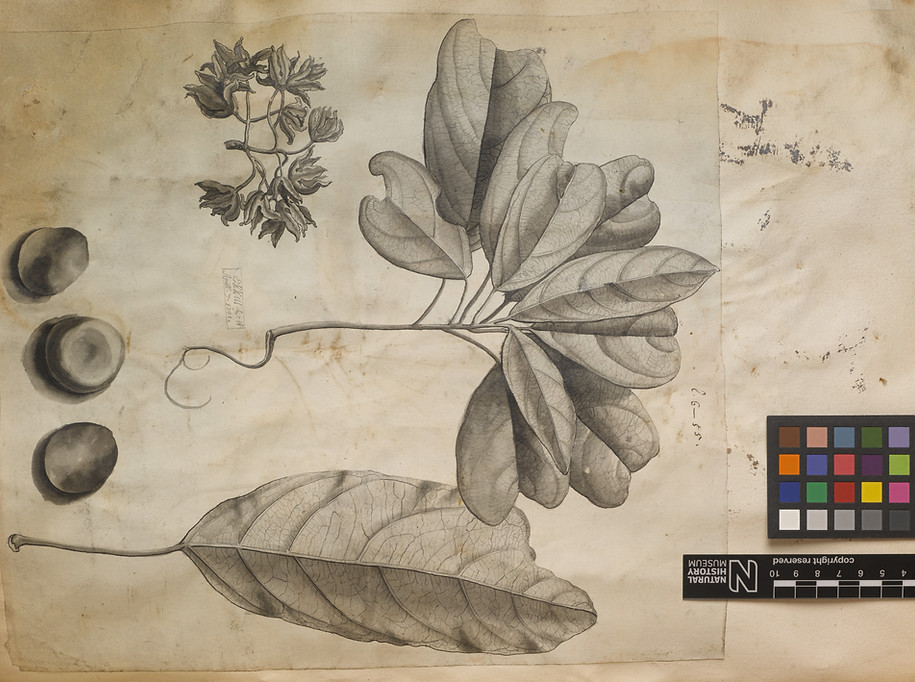
Natural History Museum. 2026. Sterculia ntida Vent (from Collection specimens) [Photograph]. Natural History Museum. Licensed under CC-BY-4.0 https://data.nhm.ac.uk/object/b86edb3e-2f76-469c-82ea-349f2f95b67f
Mãe Aline Bangbose is a prominent priestess of the Candomblé tradition in Salvador, Bahia. Mãe Aline, recounted that her grandmother, Irena Sowzer Dos Santos, planted the obi tree (origin: Yoruba; the preferred term for kola in Brazil) in the grounds of her terreiro, Ilê Axé Odô Obá Obitikô, around forty to fifty years ago. Ilê Axé Odô Obá Obitikô is one of the oldest terreiros in Brazil. Grandmother Irena taught Mãe Aline Bangbose about the obi, how to read with it, and how to cast it. The obi is used to communicate with the orixás (deities), for example, before food sacrifice, obi is used to enquire whether the sacrifice has been performed correctly, or if there is a message to be conveyed by the orixás. Once the obi is cast—thrown on the ground—the way it falls is read to determine the orixás’ response. In Yorubaland, a similar process can be discerned. The kola nut is split into four lobes and cupped while the diviner asks the question for which they require a response. The diviner then casts the lobes on the ground or onto a divining board and interprets the message based on how the lobes fall, before relaying the message to the client. A favourable outcome is indicated if the kola lobes fall with their inner sides facing up, if three lobes have their inner sides up, or if there is an equal number of lobes turned either way (Fadipe, 1970). Centuries after their enslavement in the Americas, African descended peoples across the Americas cast kola on new ground, continuing and recreating their Yoruba-inspired religions.
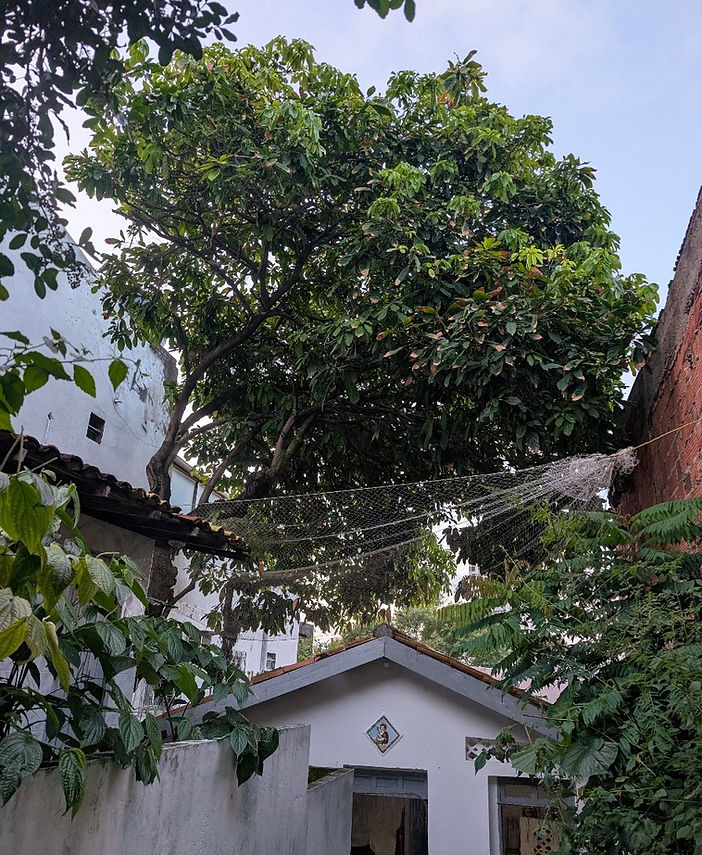
An obi tree in Ilê Axé Odô Obá Obitikô, Salvador, Bahia|photograph taken by author (2025)
Perhaps the visually striking position of the obi tree at Mãe Aline’s terreiro reflects the central place of obi in Candomblé practice. The tree appears to grow out of the terreiro, and ripe obi frequently fall on the roof of the terreiro, breaking its tiles, and so a large net is used to catch the obi and protect the roof (Figure 1). The terreiro was built in 1882 by its founder, Maria Júlia Martins Andrade, daughter of Bamboxê Obitikô, the three times great-grandfather of Mãe Aline Bangbose. Bamboxê Obitikô was born in Lagos, Nigeria around 1820. Arriving in Brazil as an enslaved person, he later secured his freedom, establishing religious houses in Bahia, Casa Branca, and Barroquinha, and travelling regularly between Lagos and Bahia, bringing materials, such as obi, for use in Candomblé rituals (Castillo, 2016).
Mãe Aline Bangbose was unsure how obi came to Salvador but proposed that one of her grandmother’s cousins may have conveyed it from Africa; one of these seeds was eventually planted by her grandmother in the terreiro. Within the kola nuts that Bangbose’s grandmother’s obi tree yielded is a story of global curative practices supported by the South Atlantic transfer of obi, showing that Candomblé adherents were producers, consumers, and distributors of global commodities.
what are kola nuts?
The kola nut is the fruit of the African kola tree. In the fifteenth century, Europeans adopted the name from the Temne (a West Atlantic speaking group) who referred to the fruit as kͻla. As a result, the word for kola in several European languages (Portuguese: cola, English: kola, and French: kola) indicates the legacy of West Atlantic speakers, the first producers and traders (Brooks, 1980). The colour of kola varies from white to red. There are over forty species of kola although two are more popular: cola nitida and cola acuminata. C. nitida has between 1.0 to 4 per cent caffeine and is native to forest zones of Sierra Leone, Côte d’Ivoire, and Ghana. Each nut contains two cotyledons. C. acuminata contains between 1.5 to 3.6 per cent caffeine and is indigenous to the rainforests of eastern West Africa, from Nigeria to Gabon. This variety of seed has three to five, sometimes six, cotyledons. Kola is highly relational, employed widely in welcoming guests, offered to visitors as a symbol of hospitality, friendship, and trust, and is a critical item in births, marriages, funerals, divination, rituals, and medicinal traditions. As a result, West Africans have a long history in the production and consumption of kola. Long distance trading networks were established in the c. nitida variety. In the late nineteenth century, European and North American pharmacists and drink manufacturers produced kola-infused goods, notably Coca-Cola syrup (Lovejoy, 1971, 1980a, 1980b; Agiri, 1972; Abaka, 2004; Adebayo and O. I. Oladele, 2012; Okoye, 2024).
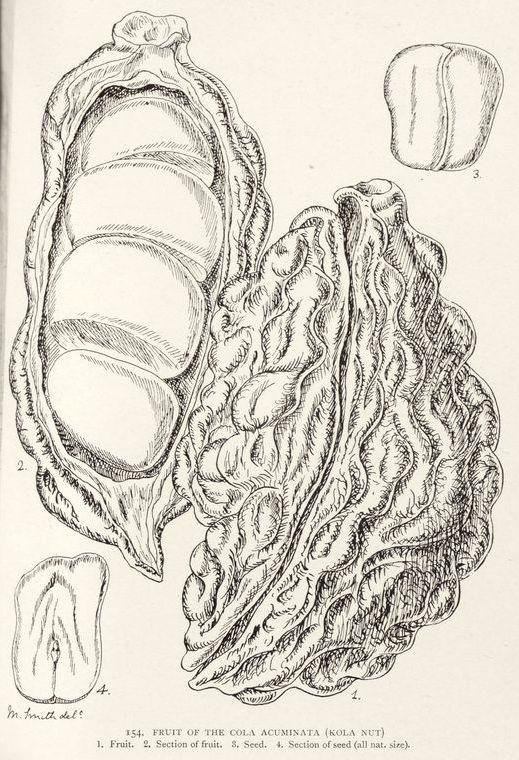
"Fruit of the cola acuminata (kola nut)." Schomburg Center for Research in Black Culture, Jean Blackwell Hutson Research and Reference Division, The New York Public Library. The New York Public Library Digital Collections. 1906.
project goals.
Using interviews with religious healers, missionary records, and objects, this project reframes our understanding of the African kola nut by showing how kola fashioned religious practices across several sites in the Black Atlantic, an overlooked aspect in traditional histories of kola. This work also foregrounds Black consumption practices to challenge a common thread in commodity studies: the production of commodities by African labour in the Americas or Africa, driven by changing consumption habits in Europe and North America. By placing religious expression at the heart of kola’s life cycle—its production, consumption, and distribution—this project examines how kola was imbued with memories of the African past and realities of the present, offering African-descended peoples avenues for religious expression and renewal.
how the African kola nut arrived in the americas.
Hans Sloane, a British physician, naturalist, and enslaver, indicated that kola was naturalised in Jamaica from at least the seventeenth century. In the 1680s, he documented a seven-year-old kola nut tree, describing that it was “rais’d from Seed…brought in a Guinea ship from that Country,” planted on an estate in St. Catherine, Jamaica (Sloane, 1707). Other documentation points to the slave ship as the conveyor of kola. Early sixteenth to eighteenth-century European accounts often praised kola’s ability to improve the taste of water or palm wine and quench thirst, and these attributes might have rendered kola valuable on slave ships, helping to relieve thirst as well as hunger during long voyages and enhancing the taste of stale water (Barbot, 1732; Pigafetta, 1881; Carney and Rosomoff, 2011). After the arrival of these slave ships, kola nuts eventually took root on new ground, shaping medicinal and religious practices in the Americas (Carney and Rosomoff, 2011).
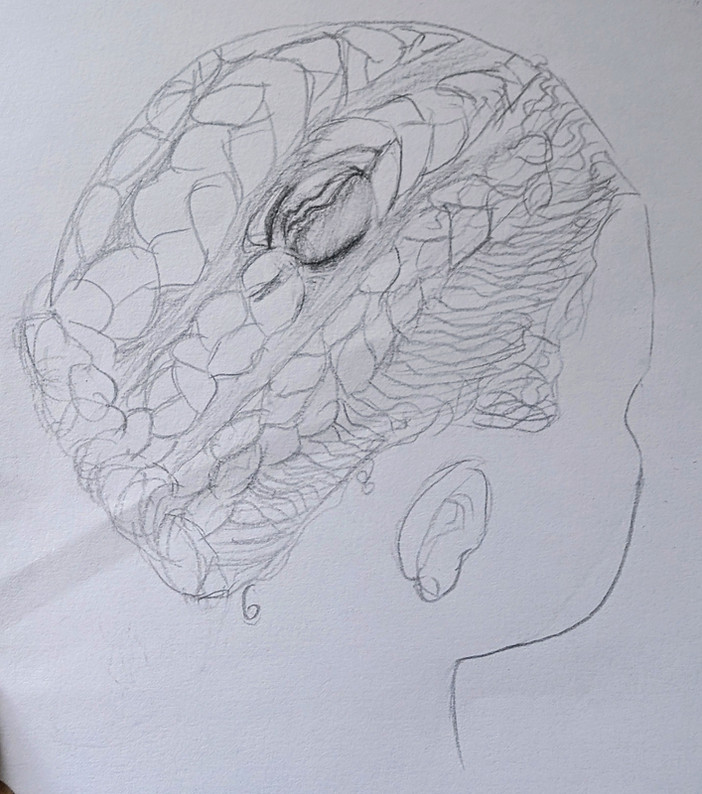
Sketch of kola braided in hair. Illustration by Shantel George (2025)
In Brazilian oral traditions, enslaved ancestors are remembered to have smuggled kola nuts across the Atlantic in their hair, on their clothing, or in a pouch. Survivors of a traumatic capture and deprived of most personal items, it is highly unlikely that prized items would have survived the acute traumatic and dislocating experience of transatlantic enslavement (Voeks, 1997).
Pai Paulo (Candomblé Ketu) recounted an intriguing story told to him by an elder in Salvador:
Women brought obi in their mouths from Africa to Brazil; the saliva from their mouths provided the moisture needed to make the obi sprout so it could be planted.
This enduring memory held by Afro-Brazilians challenges the notion of Europeans as primary distributors of global commodities, and places emphasis on the consumption practices of African descendants.
cite this project.
Projects featured on this site are the intellectual property of the Fellows who created them and may not be reproduced without their permission.
Please cite the creator if you use their work in support of your own.
Citation: George, Shantel. “Casting the Obi on New Ground: the Obi (Kola) in Africana Religions." SPIRIT HOUSE: A Crossroads Project. July 2026. Date Accessed. https://www.crossroads-spirithouse.org/george.

Shantel George is a Lecturer in History at the University of Glasgow, specialising in trans-Atlantic slavery and emancipation, with a focus on the British Caribbean. She earned her PhD from SOAS, University of London, in 2017. Her first book, “The Yoruba are on A Rock”: Recaptured Africans and the Orisas of Grenada,will be published by Cambridge University Press. Shantel is the Principal Investigator for an AHRC-funded impact project that deepens and transforms public understandings of the Orisa and Spiritual Baptist religions in Grenada.She is currently working on a book on the global history of the African kola nut, emphasising its interlocking histories of healing and well-being across several sites from 1500 to the present. This work has been supported by fellowships from The John Carter Brown Library (2022) and Gilder Lehrman Center for the Study of Slavery, Resistance, and Abolition (2023). Shantel’s published work appears in Atlantic Studies and several edited book collections.
_edited.jpg)