


leonard c. mckinnis, ii.
the messenger's residence
cohort. 2024-25
project. The Messenger’s Residence: Nation-building in the Nation of Islam
location. Chicago, IL
medium. visual arts
The Messenger’s Residence documentary takes viewers inside the historic home and sacred space of the Honorable Elijah Muhammad. Each episode, focused on the home and Elijah Muhammad’s background, introduces the home as a sacred space of Black religiosity. It focuses our attention on the ways in which homes become sites of identity construction, spiritual practices, and nation building. This documentary is the first glimpse into the personal dwelling and organizing center of the Honorable Elijah Muhammad and the Nation of Islam, and the series provides an original perspective on the Nation of Islam.
Episode One: “Unveiling Sacred Spaces”
Episode Two: “Preserving Black Religious Sites: The Elijah Muhammad Home”
Episode Three: “Uncovering the Roots of the Honorable Elijah Muhammad: A Walk through South Georgia.”
Episode Four: “A Walking Tour of the Muhammad Residence.”
Episode Five: “Muhammad's Kitchen: Food, Diet, and the Body Among Nation of Islam Believers.”


project narrative.
In the summer of 2023, I was invited by Sajdah Muhammad, Nation of Islam (NOI) archivist, to visit the former residence of the Nation of Islam’s long-time and most consequential leader, the Honorable Elijah Muhammad (1897-1975). Sajdah is overseeing the preservation of Elijah Muhammad’s residence and its transition to a House Museum. The offer to visit the home was well received. Having been raised in Chicago where the Nation of Islam is headquartered, the Black religion was not foreign to me, but rather was part and parcel of my religious imagination that was shaped in Black Chicago. From the well-groomed and handsomely dressed men who lined the streets of Chicago’s southeast side selling bean pies and current issues of The Final Call, to observing NOI believers flank the streets of south Cottage Grove avenue where Mosque Maryam, the national mosque of the NOI, is located, the NOI has been as present to me as the Black Church and the many denominations that comprise that institution.
Such religious diversity in many ways shapes the context of Black Chicago and has been the case since southern Blacks migrated to the North in large numbers in the early twentieth century. In this sense, my interest in the study of Black religions – more specifically the Nation of Islam – was not merely born out of intellectual curiosity, but also from a sense to more fully appreciate the landscape and city that provided such a tapestry of Black religions in the middle of the metropolis. The opportunity to explore the former residence of the Honorable Elijah Muhammad provided an occasion to connect with the religious scene of my childhood beyond traditional sites of worship. It was an opportunity to observe religious sites and practices as part of the ordinary life of some of Chicago’s Black Muslims, situated in a residential community that some people call home, and others, holy land.

“The Cracked Atom," Front Yard of the Honorable Elijah Muhammad Residence | Photo Credit: Wendy Sajdah Muhammad

The Honorable Elijah Muhammad saluting the Fruit of Islam (FOI) from the front porch of his home | Photo Credit: Wendy Sajdah Muhammad
As I parked my vehicle on the corner of 48th and Woodlawn in Chicago’s historic Kenwood neighborhood, it immediately dawned on me that I was encircled by a network of homes that were significant to the study of Black life in America. Just steps from the Elijah Muhammad home are the home of former President Barack Obama and the former residence of Muhammad Ali, and blocks away is the former abode of Civil Rights leader Rev. Jesse Jackson, among the residences of other persons who have made significant contributions to Black culture. I emphasize these homes as a way of shedding light on the community and geographic space in which the Eliah Muhammad home is located. This neighborhood is not historic merely because of the Frank Loyd Wright architecture or the wealth accumulation present, but rather, its historicity is, in part, related to persons who took residence there, creating an incubator of Black life connected to a sense of freedom and community building. The Elijah Muhammad residence offers the occasion to examine the relationship between personal dwellings, religion in the city, and the ways in which the ordinary becomes sacred. This was made evident to me as I prepared to enter the residence for the first time.

“The Palace” | Photo Credit: Wendy Sajdah Muhammad
As I walked toward the Muhammad residence, I was immediately halted by the striking beauty of “the palace,” the moniker for the home of Nation of Islam’s current leader and national representative of the Honorable Elijah Muhammad, Louis Farrakhan (b.1933), which sits to the immediate right of the Muhammad residence. The Farrakhan abode was built on land purchased from American baritone singer Lou Rawls (1933-2006) by Elijah Muhammad in 1972. Its architecture is exquisite. Elijah Muhammad commissioned Egyptian architects to design the North African-themed residence as a way of bringing North African architecture to the south side of Chicago. The red clay roofed 9,000-square-foot home sits on the corner lot and is surrounded by a black iron fence with a perfectly manicured lawn. Fruit of Islam (FOI), the NOI’s paramilitary arm, keeps watch over the Farrakhan home in both parked vehicles and on foot. Strolling past the Farrakhan residence toward the Elijah Muhammad home, members of the FOI approached me with the traditional Islamic greeting, “As Salaam Alaikum.” The gentleman continued, “Dr. McKinnis?” to which I responded, “yes, that’s me.” “Sister Sajdah is expecting you,” noted the gentleman. I continued my short walk toward the Muhammad residence until I approached the gate which surrounded the home.

Residence of the Honorable Elijah Muhammad (1960) | Photo Courtesy of Nation of Islam Archivist, Wendy Sajdah Muhammad
Crossing the threshold from the pavement onto the Muhammad estate, I was arrested by a sense of solemnity and peace that engulfed the dwelling's yard. Standing in the driveway as I made my way toward the porch to enter the home, Sajdah, observant of my body frozen in place, inquired, “Hey Leonard, what’s going on?” I responded and informed Sajdah that the sense of peace was very evident in this space. She replied and simply said, “that was your initiation. If you didn’t feel anything we would know you were not supposed to be here.” This short project overview does not permit the space to interrogate Sajdah’s commentary, but I offer this account as a way of contextualizing both my location as a participant observer in Nation of Islam research, and the community’s way of deciphering whom they permit to “get close” to their religious world and way of life. Sajdah’s reaction to my sensory experience as an “initiation” was therefore not divorced from history. Rather, NOI believers have long desired to protect their religious sites from the outside gaze of those who they deem to misrepresent and undermine their religious heritage. For Sajdah, my presence on the grounds of the Muhammad dwelling and having what, for believers, is a religious experience, was an indication that I was not there to engage her belief system voyeuristically, but to learn about her way of life through narrative and an encounter with a Nation of Islam sacred space. We will return to this concept of sacred space, but a brief history of the Muhammad residence seems apropos.

Restoration of the Residence of the Honorable Elijah Muhamad | Photo Credit: Wendy Sajdah Muhammad
Built in 1902 for William French Burrows (1854-1925) and his wife Louisa Libby (1858-1940), heir to the Libby Food brand, the 9,728-square-foot primary Muhammad residence and 2,000-square-foot coach house, were acquired by Elijah Muhammad through a cash sale in 1952 and functioned as the national headquarters of the Nation of Islam until 1975. As the central headquarters of the Nation, it was inside the Hyde Park habitation that Elijah Muhammad built the Nation of Islam and ran its operations, with the home serving as the symbol of the Nation’s growth and its reach in Chicagoland and beyond. That the Woodlawn habitation was the center of operations for the Nation of Islam as it matured into one of the most significant and consequential Black diasporic religions in the United States, illustrates one of the more profound ways in which Black religions utilized homes and other clandestine spaces for the shaping and building of other worlds outside the watchful eye of white surveillance. Akin to many Black churches that were organized in a home, or repurposed space (i.e., storefronts), the Nation of Islam transformed a dwelling in the middle of the Black metropolis into a well-organized infrastructure that permitted the group to expand its influence while shaping the internal organization of the Black religion. In this sense, for believers in the Nation of Islam, the Elijah Muhammad residence sits on holy ground, and the residence itself is a sacred space.

"The Honorable Elijah Muhammad at Home” | Photo Credit: Wendy Sajdah Muhammad
While sacred spaces are traditionally understood as houses of worship or other venues with visible signs of religious activity that separate these spaces from ordinary spaces, for Nation of Islam believers the Elijah Muhammad residence is a sacred space that narrates a story about Elijah Muhammad, Messenger of Allah, and his longing to build a new way of life and religion for people of African descent. Indeed, Sajdah Muhammad recounts a conversation with Minister Louis Farrakhan in which he offered the following upon hearing the Muhammad residence referred to as a sacred space: “You are right to call it sacred because it became sacred when a God decided to move in.” Farrakhan’s declaration of the Woodlawn dwelling as a sacred space offers insight into both the NOI’s theology and the Black religion’s sense of religiosity and spirituality beyond the Mosque. That is, for NOI followers the Honorable Elijah Muhammad is the Exalted Christ, or divine messenger, of Nation of Islam founder W. Fard Muhammad, (1877-1930 (disappearance)) God in person. The Messenger’s residence on Woodlawn Street in Chicago is therefore a sacred space that housed, and houses, Allah’s divine messenger.

Letter from Elijah Muhammad to Dr. Martin Luther King, Jr. (1966) | Courtesy, Nation of Islam archivist, Wendy Sajdah Muhammad
Elijah Muhammad not only built the Nation of Islam from his residence, but also used it as a space to organize with other Black religious, civil, and political leaders on matters impacting Black life in America. Muhammad hosted an array of guests such as Muhammad Ali, Julian Bond, Martin Luther King, Jr. and Coretta Scott King, Wilma Rudolph, and the 1968 delegation of the Loyal National Democratic Party, whose delegates he funded to be seated at at the Democratic National Convention in Chicago, after the Georgia Democratic Party handpicked white segregationists to represent the party at the convention. In this respect, the Elijah Muhammad residence is a site of Black political activity as much as it is a place of religiosity. Given the NOI’s posture toward the material world, it is not shocking that Elijah Muhammad, who otherwise encouraged his followers to not participate in the American political system, agreed to fund the faction of the Democratic Party that pushed for social and economic change.
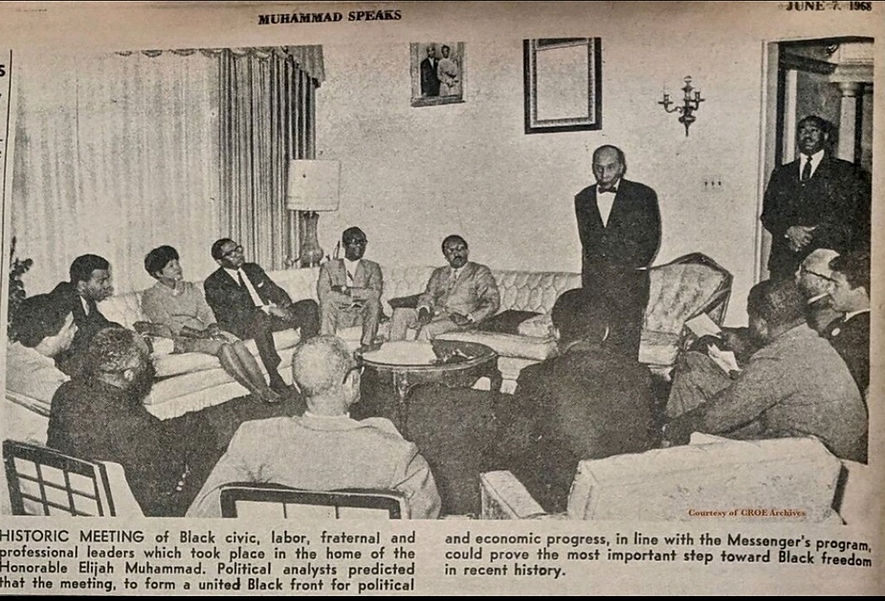
Elijah Muhammad hosts meeting in home with Black civil, labor, fraternal, and professional leaders | Courtesy: Nation of Islam archivist Wendy Sajdah Muhammad
cite this project.
Projects featured on this site are the intellectual property of the Fellows who created them and may not be reproduced without their permission.
Please cite the creator if you use their work in support of your own.
Citation: McKinnis ii, Leonard. "The Messenger’s Residence: Nation-building in the Nation of Islam." SPIRIT HOUSE: A Crossroads Project. August 2025. Date Accessed. https://www.crossroads-spirithouse.org/mckinnis.

Leonard C. McKinnis, II is Associate Professor of Religion and Black Studies at the University of Illinois at Urbana-Champaign. Dr. McKinnis is a scholar of Black Religions. His work has been supported by the Louisville Institute, the American Academy of Religion, and Mellon Faculty Fellowships. In 2023 he was named the Sankofa Scholar at Emory University in the Candler School of Theology. Dr. McKinnis’ research sits at the intersection of new religious movements, religion and identity, lived religion, and ethnographic approaches to the study of religion. His first book, The Black Coptic Church: Race, Religion, and Imagination in a New Religion, was published in 2023 with New York University (NYU) Press in their Race, Religion, and Ethnicity Series. He is currently working on a book tentatively titled, Everyday Muslim: Religion and the Construction of Black Identity in the Nation of Islam. This ethnographic work explores the relationship between religious performance, identity, and world making in the Nation of Islam. He is the interim Executive Director of the Society for the Study of Black Religion.
_edited.jpg)