




sheriden booker.
d’zaklèr é dolo
cohort. 2025-26
project. D’zaklèr é Dolo: A Lineage of Lightning and Water
location. Louisiana
medium. short story

Theodore Müller. Vue Générale de la Nouvelle-Orléans. c. 1850. Lithograph. Mabel Brady Garvan Collection, Yale University Art Gallery (Object 46394; Accession No. 1946.9.1888). Image provided under the Yale University Art Gallery Open Access Policy.
Artist's Intervention: The original image has been modified with the digital overlay of a lightning bolt outlined with black ink.
the spectacle.
“Bonjou, Madamm Toledano! Byinvini enkò a mò kour,” (“Good day, Ms. Toledano! Welcome to my court again”) Recorder Joseph Genois sang out, as the bailiff pressed a Bible into Betsey's hand. “Do you swear to tell the truth and nothing but the truth, ki pou Bondjè èdé vou?” (“So help you God?”)
“Byin sir, Misyé Joseph,” (“Of course, Mr. Joseph,”) Betsey stated with just a tinge of familiar defiance, enough to make clear who she was in relation to him, in spite of his formal position and office.
Maintaining a proud countenance, she chuckled to herself as she surveyed the room in anticipation of the theatrics about to unfold. Several dozen people had filled the foyer, balcony, and courthouse steps, all to catch the latest episode of The Voudous Go To Court Again. Indeed, Betsey and her sisters’ courthouse appearances had become more popular of late than Père Antoine’s Catholic masses had been next door at St. Louis’s Cathedral when she was a child. The hour of the Voudous had arrived. However, now that their names were on the lips of everyone in the Vieux Carré and all the Uptown newspapers, how would they use their influence to restore balance? Fame was a dangerous spirit. Once summoned, who could truly command its course?
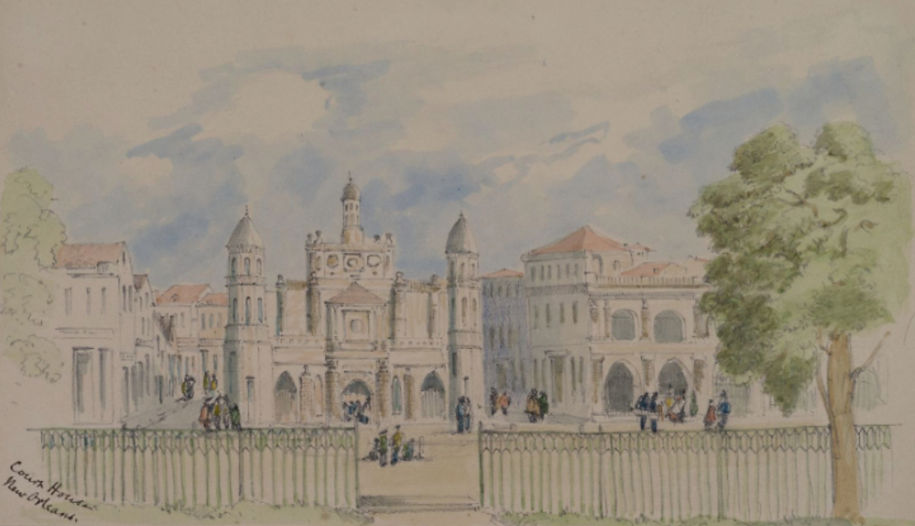
Artist unknown. Courthouse and Church, Place d'Armes, New Orleans. c. 1845. Watercolor. The Historic New Orleans Collection, via Louisiana Digital Library.
“Would you like to conduct business in English today, Madamm Toledano?" Joseph continued, looking at her over the rim of his glasses, testing ever so slightly to see if he could get a rise out of her. She paused to assess his challenge and reposition her strategy, replying confidently,"Yes, I would.” Unlike many black women her age on this side of town, Betsey felt quite comfortable communicating in English. She had grown up between the Old Ursuline Plantation and the rough docks where the Kaintucks[1] unloaded their flatboats. Long before most of her generation learned English, she had listened to merchants, sailors, and speculators pouring into the city, cursing over cargo and lusting after opportunity.
At the time, her father was a stevedore at the Toledano warehouse and whenever business was afoot, he'd wave her off and tell her to go hush and stand inside. Though she had been born free and he enslaved, she respected his word and rarely disobeyed or talked back. Instead, she’d make herself invisible hiding behind bails of cotton, sucking on stalks of sugarcane, watching the world go by through the slatted walls. Years of studying the movement of mice and men in this manner had taught her plenty about the American temperament. So she felt no particular concern about the English-speaking journalists swarming the interior perimeter of the court room. If they wanted a spectacle for the Picayune or the Daily Delta, she was more than willing to give them one. But she was certain her testimony would fly right over their heads, just like lightning.

Photograph by Susan Middleton. © 1994 J. Paul Getty Trust. Courtesy of the Getty Conservation Institute. Note: Hevioso and Sogbo are not distinct deities, but rather different names and manifestations of the same supreme Vodun spirit associated with thunder, lightning, and justice. While Hevioso refers specifically to the deity venerated at the lakeside village of Hevi, Sogbo is understood as the overarching ruler of the entire pantheon of sky and thunder Vodun.

(Poterie du culte vodun Dan) Maker unknown. Fon culture, Benin, c. 1900. Earthenware vessel. Musée Africain de Lyon, France. Photograph by Ji Elle (2016). CC BY-SA 4.0, accessed via Wikimedia Commons. Note: Dan is the primordial cosmic rainbow serpent in Fon cosmology, while Dangbe is the earthly manifestation of that same spirit.
the root.
As a priestess of Sogbo in the royal house of Abomey, as her mother and her mother's mother had been too, Betsey was certain she could never adequately explain such things to the uninitiated eye of in jij amérikin (an American judge), or even a Creole one who may occasionally turn to Voudou when life necessitated it.
The policemen believed they had confiscated a few pots, some stones, a necklace, and a saint's statue. And the newspapers would likely repeat the same.
Yet standing before the court, Betsey knew that what sat in police custody amounted to 238 years of devotion born from an unbroken lineage of hands and names called upon to mend broken worlds whenever things fell apart. This kind of devotion transcended continents and oceans. It survived kingdoms and changes in government. It rallied against oblivion and erasure, outliving the ambitions of men.
Betsey's understanding of the world rested upon this certainty. And despite what those gathered in the courtroom might have thought, she had not come to reclaim a collection of objects today. She had come to retrieve her lineage.

This photograph and the following three are of Voudou priests and community members gathering in Glidji, Togo for the annual Ekpe Ekpe Festival where they enter the forest to pick a stone that will forecast the health and well-being of the community for the year. https://kwekudee-tripdownmemorylane.blogspot.com/2012/09/Ekpe-ekpe-voodoo-festival-roots-of.html

https://kwekudee-tripdownmemorylane.blogspot.com/2012/09/Ekpe-ekpe-voodoo-festival-roots-of.html
A pot could break.
A necklace could be lost.
A statue could burn.
But lineage was neither something one could replace nor purchase. And yet that seemed to be the very thing they were hell bent on taking from women like her. Fortunately for Betsey, however, her grandmother, Agbolete—this ram is a worthy sacrifice to the god of thunder and lightning—had spent a lifetime resisting erasure through storytelling. She spoke often of secret women's gatherings held beneath the moonlight in the swamps beyond the city walls, and of the grand balls Mina men held each year in Pointe Coupée to crown a new king.[2] She spoke of the power of lightning and how its presence had been summoned when it came time to revolt—first in '91 and then again in '95.[3]

Photographer currently unidentified. Reproduced from the Kwekudee blog, "Ekpe Ekpe Voodoo Festival: Roots of Voodoo in Africa and the New World," pending confirmation of the original photographer and copyright holder.

Photographer currently unidentified. Reproduced from the Kwekudee blog, "Ekpe Ekpe Voodoo Festival: Roots of Voodoo in Africa and the New World," pending confirmation of the original photographer and copyright holder.
Yet Agbolete never spoke openly about the circumstances that brought her from Abomey to Louisiana. There were silences in her stories. Things that remained untouched even after decades. Certain betrayals and details of palace intrigue that stayed buried, certain wounds that remained unhealed and unnamed. They lingered in the spaces between words as they sailed down the bayous toward the lakefront, dressed in gleaming white to make offerings to the Mother of All Waters, just as their ancestors had done.
But instead of pressing her grandmother for answers, Betsey was content to watch her sail. She knew enough.
She knew there had been darker moments in the hull of a ship. And that Sogbo had crossed those waters with her grandmother, holding her firmly when the only escape from the abyss was to fly away in one’s mind. And she knew that something stronger than fear had carried Agbolete through the years that followed. She was certain of this. For the day her grandmother placed the beaded cowrie-shell necklace over her shoulder, beckoning her to carry Sogbo on her head, was the day Betsey caught lightning for the first time.

(Queen Mother of the African Diaspora, Benin) Photograph by Maya. Courtesy of HRM Queen Mother Sêmévo Dr. Dòwòti Désir. Reproduced with permission of the subject.

Photograph by Susan Middleton. © 1994 J. Paul Getty Trust. Courtesy of the Getty Conservation Institute. Note: This bas-relief, located in the zinkpoho (formerly the Hall of Thrones) of the Royal Palace of Abomey, depicts King Guezo as the Vodun deity Dan Ayido Houedo. As Piqué and Rainer observe, "By comparing himself to a god, Guezo projected an aura of timeless power; this image can be interpreted to signify that the kingdom of Dahomey was so vast that it was universally known."
Placing offerings on the water, her grandmother would continue with stories. Sweet cakes and flowers amidst stories about Abomey, Glidji and Oyo. Arada, Ouidah, and Popo. Stories of kings and foolish men. Stories of women whose patience was greater than the kingdoms they sustained. But the one Betsey loved the most concerned Agaja, the Greatest of Black Kings.
And Agbolete loved that story too.
She delighted in recounting how King Agaja—her grandfather, Betsey's great-great-grandfather—while attempting to negotiate the containment of the slave trade, had dictated a letter to a yôvô scribe held at court, who was to deliver it to King George I of England.[4, 5] After an exhausting exchange, translating back and forth—Fongbe to English, English to Fongbe, with some Portuguese and Yoruba thrown in—the young yôvô scribe began reading back the king’s words: “We think it strange that women are somehow allowed so much power in England, as we hear they are even to reign over men.”
Agbolete’s grandmother, Hwanjile—utterly incredulous that this was what her husband had meant or would
even concern himself with in the midst of war—had sucked her teeth so long and hard that it sounded as
though Dan, the primordial serpent of wisdom, had coiled his tail around the royal courtyard rattling the
earth itself. After all, was it not the women who birthed the leopard, the Kpodjito who advised the king?[6]
Aren’t I sitting here before you now?
Every time her story reached that point, Agbolete would lean forward demonstrating for her audience the
sound of Hwanjile’s disdain and all the children would laugh. But even as a little girl, Betsey understood that
stories were not just stories. They were blueprints for the house that we live in and the future ones we plan to
build.
Some stories were told by the water, and others while chopping vegetables in the servant’s yard of the
Ursuline plantation. Betsey could still see her grandmother seated beneath a sprawling oak draped in Spanish
moss, slicing okra with practiced hands, stained blue as the deepest ocean from years spent cultivating indigo.

Harold Rudolph. Bayou Landscape. 1879. Photograph of painting courtesy of Neal Auction Company, New Orleans, Louisiana (Lot 390, February 3, 2023 Auction), via Invaluable.
"Okra cries slimy tears, ti shèr,"(little dear, sweetheart; shèr is literally something that is precious, expensive) she would say.
"Don't be like okra. To komprenn, twa?"(Do you understand?)
Then, having set aside several pods, she would thread them together and hang them, along with a fan of
palmetto fronds, across the door sill to mark the entrance to her home.
Protection against tears yet to come.
Protection against the sorrows of childbirth.
Protection against grief.
Some women inherited land, and yet others inherited jewelry. But Betsey inherited stories and from that she would mold her own kind of lineage. The newspapers would later call her stout, obese, intelligent, disorderly, articulate. Dangerous. She would read every word, certain that none could define her. For the day she caught lightning for the first time, was the day she understood that lineage was not a metaphor but a living substance. It was the accumulation of everything lived and learned from time immemorial. It was the things we elected to remember, and the material we selected to build with. From that day onward, she carried herself differently. As she moved through the world, she learned early that those with money could purchase newspapers, elections, judges, and laws with astonishing ease. Living on Conti Street, only steps from the St. Louis Exchange, she possessed a front-row seat to one of the greatest theaters of wealth in North America. Planters, merchants, brokers, politicians, and speculators drifted through its halls, smoking fine cigars and sipping cognac, all while boisterously making bids on sundry items such as furniture, machinery, human beings, and art. They arrived speaking French, Spanish, and English, and departed speaking the universal language of profit. They called themselves powerful, but Betsey only found them remarkably fragile.

William Henry Brooke (artist), J. M. Starling (engraver). Sale of Estates, Pictures and Slaves in the Rotunda, New Orleans. 1842. Engraving. Schomburg Center for Research in Black Culture, Manuscripts, Archives and Rare Books Division, The New York Public Library. Digital image accessed via The New York Public Library Digital Collections.
Note: This engraving most likely depicts an auction held beneath the dome of either the St. Louis Hotel or the St. Charles Hotel in New Orleans, both of which operated as prominent commercial exchanges where enslaved people, land, and other commodities were sold throughout the year.
A drop in cotton prices.
A failed investment.
A bruised ego.
A beautiful woman.
Any one of these could puncture their pride, resulting in a duel in the field behind Tremé. As her
grandmother often used to say, pride was the most widely available ingredient of character, and yet the most
expensive one to preserve. And in this, Betsey found nothing to envy.
She owned no plantation.
No bank.
No newspaper.
No voting rights.
No political office.
What she possessed instead was something far older and more valuable. Because those who knew knew, to be
a priestess in an order as venerable as the Voudous was an honor bestowed! Ay Kandjo! Most people who
passed her never understood this nor what they were looking at and nor did they need to.
They saw in fenm de koulœr lib (free woman of color)
A Voudou.
The Dauphine.
A curiosity.
A nurse.
An inconvenience.
A headline.
Some money.
A woman so free
A nymph of the pave
In pèbon! (prostitute)
Tchsssss, can you believe?
What they did not see though was Abomey, nor the women who had carried Sogbo before her. Nor did they
see the generations of hands who had survived long enough to place their pot upon her. And that, more than
anything else, was why she found herself standing in court that day. Not because of the stones, nor the statue,
although they were important. And not because of the police, although their ignorance and abuses were
enraging. She stood there because lineage, like water, had a tendency to outlive the structures built to contain
it, and lightning a tendency to set it all ablaze.

Artist's Intervention: the original image has been digitally overlaid by the artist/author of this project with a snapshot of the 1845 newspaper article in which Betsey Toledano first appears as having been arrested for operating a “bad house” on Douane between Bourgogne and Dauphine.

Artist unknown. 1850. Watercolor. The Historic New Orleans Collection, via Louisiana Digital Library.
dangerous meditations.
And yet there was something else. Genois's preemptive request to conduct the proceedings in a foreign language had deeply bothered Betsey, and she wondered to herself whether lezamérikin-yé (the Americans) were applying a new kind of pressure from their bankhouse perches Uptown. But the law was clear and uncomplicated with regard to the matter of language. They might translate everything afterward, stack it away in English ledgers, call it progress in the form of records, but she still had every legal right to testify in her mother tongue, especially when appearing before a municipal judge who was Creole. The true source of her irritation, then, was the inconvenient and unacknowledged fact that she and Genois were both amphibious creatures maneuvering in and out of other worlds—worlds that had become increasingly difficult to articulate as real.
Added to this, Betsey could not help but notice Joseph's discomfort with her eagerness to meet his challenge. She realized he had goaded her over the rim of his spectacles, without entirely expecting her to say yes to his question. But she did, and so now, here she stood before his bench with her arms akimbo and her feet firmly planted against the worn cypress wood—the bowed floorline making her appear slightly sway-legged, leaning toward the Recorder's bench as if daring the room itself to object. Joseph was both embarrassed and amused. And now he was the one chuckling to himself, because he knew that defiant look all too well. In fact, he was certain that at that very moment a fruit seller was standing in the Place d'Armes out front in much the same posture, commanding attention through nothing more than confidence and presence.
It occurred to Betsey, then, that perhaps this was precisely what he had hoped to avoid. The truth of the matter. Not because he believed she was incapable of speaking English; he knew better than that. But because the familiarity in their exchanges offered a glimmer of what they could not say. Had she refused, had she insisted upon speaking Kouri-Vini, it would have been easier to distance himself and to position her as an artifact—a quaint remnant of an older New Orleans slowly receding before the advance of the American century.[7] After all, was this not what they were already saying? That New Orleans needed to clean its act up, if it wanted to attract investors. That no bank or insurance company in New York or London would underwrite a city where beaux nègres were allowed to beat drums in the marketplace, Voudou queens to sing praises at the water's edge, and pompous cavaliers to drink cognac for breakfast, lunch and dinner.[8] It would have been much easier to treat her case as a fleeting curiosity than it would have been to explore the inside of hypocrisy.
And so, he was surprised she had accepted the challenge because he had not quite anticipated her disloyal commitment to the whole charade. When she answered in English, and with such confidence no less, he now found himself in the awkward position of having to explain this incident to colleagues at City Hall. Soothe their concerns about this wild but articulate black woman claiming she could command lightning, rain and fire, all with a necklace bequeathed by her African grandmother. And he would have to reassure those Anglo politicians who had secured the Whig vote for his reelection. Convince the bankers with deep pockets that this city—sewn from a collage of tapestries—was somehow still governable, still inviting, still lucrative.
This fluent, non-verbal repartee between Joseph and Betsey was somewhat deceptive, however. Joseph’s brother Charles had served as mayor of New Orleans, and while their father had been an immigrant, albeit successful, Venetian merchant, their mother was a scion of the aristocratic de Morant line, whose patriarch had laid down roots in Louisiana over 100 years prior. Carrying forth this venerable legacy, Joseph himself occupied one of the most influential administrative posts in the city, to which he had been reelected three times, beating out the other Democratic candidate, Clement Ramos.

Louis Nicolas Adolphe Rinck. Portrait of a Creole Gentleman (sitter unknown). 1841. Oil painting. CC0 image via Wikimedia Commons.
Artist's Intervention: The original image has been digitally overlaid by the artist/author of this project with a snapshot of Joseph Genois’ 1866 will, in which he acknowledges (Marie) Josephine Genois as his natural daughter in the weeks before his death. In the document, Genois bequeaths to her “everything that the law permits me to dispose of in her favor.” This inheritance may have been limited by Louisiana’s Napoleonic-influenced succession laws, under which children born outside of legal marriage faced restrictions on inheritance rights. Genois designated his nephew, Philippe Avigno, as universal legatee and executor of his estate.
1841.
He could vote.
He could hold office.
He could shape policy.
He was white.
He was a man.
Betsey could do and be none of those things. Yet for more than twenty years they had lived and worked within a few blocks of one another, their lives intersecting in ways that would have scandalized even the nosiest Uptown
journalist. But alas, this is what happens in cities built upon water. They had a peculiar way of forcing people together, especially during times of crisis.
Just last year, when the Sauvé Crevasse had burst seventeen miles upriver, the Mississippi had bypassed the riverfront levees, spilling through the back swamps to inundate more than half the city.[9] Streets vanished beneath muddy water. Chickens floated past church steeples. Furniture drifted through intersections. Families took refuge on second-story galleries, and the poor built makeshift huts and tents on high ridges. While some people bought steamboat tickets to tour the rushing waters at the site of the breach, Joseph climbed into a boat, rowing through the flooded back end of town toward Congo Square, distributing bread and fresh water, helping to organize the construction of a makeshift levee along the Carondolet Canal. Betsey remembered seeing him row down the street with surprising ease. He appeared as comfortable navigating floodwaters as municipal politics, so much so that his Venetian ancestors would have been proud. Betsey, with a hint of Ganvié in her blood herself, took to the converted waterways too, tending to displaced residents along with several of her sisters.[10] They moved from house to house to house, dressing wounds, preparing remedies, and distributing supplies to those in need. For two and half months, those who stayed worked side by side, the flood having washed away many things, if only temporarily. The city was too small, too porous, and too vulnerable for the neat boundaries and maps legislators constantly attempted to impose upon it. Water had little interest in ethnicity, race, municipal boundaries, property lines, or political factions. And every few years it returned to remind New Orleans that it had built its certainties atop a swamp.

Alfred R. Waud. Canal Street, Flooded During the New Orleans Flood of 1871. 1871. Wood engraving published in Every Saturday, July 8, 1871. Public-domain image via Wikimedia Commons.
Note: The artist/author of this project selected this image for its visual detail. A similar painting by Elizabeth Lamoisse specifically depicts the New Orleans Flood of 1849 and was later reproduced and referenced as a lithograph or sketch. Like Waud’s engraving, Lamoisse’s work presents New Orleans as a veritable Venice, with Canal Street submerged and residents traveling by boat.
And yet as soon as each crisis had passed, the divisions would return. Joseph resumed conducting municipal business with bankers and merchants in the coffeehouses along Exchange Alley. He effortlessly passed holding cells of human captives awaiting sale in the squeezed passageways between buildings. In the winter, he resumed attending balls, auctions, and civic functions at the St. Louis Exchange, making some purchases of his own. And Betsey passed through those same streets on her way to market, occasionally crossing paths with him in doorways or at intersections where they traded brief nods of recognition. When they were younger they might have stopped to exchange pleasantries. But such things had become more complicated. Each year produced new laws regulating the transfer of wealth, inheritance, and legal status. Public interactions acquired political meanings. Relationships that had once existed in uneasy but fluid proximity now carried risks. Even the ability of enslaved people to purchase their own freedom, as Betsey’s mother had once done, had been eliminated under the new American order. Every week free people of color left for Haiti and Mexico, to join family members who had found peace and freedom abroad. And all of this had only intensified the aristocratic tendency among old guard families who had yet to accept that the ancien régime had died with the Revolution and that both France and Spain had long since abandoned Louisiana.[11] Joseph would never risk his family name lightly. One could say, these were the fireproof bricks out of which he had chosen to build his lineage.
Yet no amount of legislation could untangle lives woven together over generations. The clearest example was the cabaret on Royal and St. Philip, operated by Marie Rose Voltaire, a free woman of color whose perfectly seasoned courtbouillon could draw politicians, merchants, sailors, and neighborhood gossips through the door on any night of the week. If the Cabildo represented the levee conducting the official flow of power, Marie Rose's establishment was the place where the water found its way around. One of the sharpest businesswomen in the Quarter, she also happened to be, not incidentally, Betsey's goddaughter.
Over the years, Joseph had grown particularly fond of the place. So fond, in fact, that his and his associates’ frequent appearances prompted Marie Rose's husband, Mathurin Rivaros, to emerge on occasion from the carpenter's shop in the rear. A tall, muscular grif with straight black hair and cinnamon skin, Mathurin had
a handsome stature and protective presence that, without saying a word, conveyed love and respect for Marie—traits that would eventually bring him tragic ruin, a testament to the deadly undercurrents of water.[12]
Yet, within those walls, municipal boundaries also softened. Business forecasts were discussed. Political rumors circulated over glasses of claret. Information traveled through the room with greater efficiency than many government offices. Years earlier, when Betsey and an enslaved woman named Caroline had appeared before Joseph's court on charges of operating a “disorderly house”, Marie Rose had quietly intervened, securing forgiveness for Betsey's fifty-dollar fine and a reduction in Caroline's corporal punishment. Later, when Joseph faced difficult decisions involving investments, elections, and political alliances, he accepted more than one private consultation with Betsey in a back room of the cabaret.

Henri Rivière (attributed). Le théâtre des ombres au cabaret du Chat Noir. 1887. Lithograph. Licensed via Alamy Limited (Image ID: 3DY043J; SPCOLLECTION).
Note: Although this image depicts Belle Époque Paris, the artist/author of this project uses it as a visual reference for the atmosphere and social mixing that characterized certain cabaret spaces in nineteenth-century New Orleans. Many working-class cabarets in the French Quarter, particularly those near the docks, were cited and fined for serving liquor to enslaved people who frequented these venues during their off hours. Increasingly during the 1840s and 1850s, such interracial and intercaste socializing was restricted by reactionary local officials and vigilantes.
The arrangement suited everyone—at least at first. Boom times produced opportunities, but they also produced competition, and men like Joseph needed every advantage they could find. His dealings with Voudou had brought him a measure of stability, and in private he often credited his reelections in ‘46, ‘48, and ‘50 to the readings and spiritual guidance that Betsey had offered.
What fascinated Betsey, however, was not Joseph's participation in these exchanges but the contradictions they revealed. As Recorder and President of the First Municipality Council, he spent much of his professional life enforcing regulations designed to control the movement of people, property, and power. Standing before him that day, her own case dealt with unlawful assembly, for she had deigned to gather free and enslaved, black and white for a women’s ceremony in her home. Yet his own life routinely crossed those very same boundaries his municipal regulations sought to maintain. He remained, at heart, a Creole man—the son of a Venetian merchant and a French Creole mother, born in a Spanish colony where both water and people resisted containment with a vengeance.
At fifty-three, widowed and without a single legitimate heir, Joseph resided in a townhouse on Orleans Street
where he was the only white person in the household. His longtime companion, Nenette Pouplon, was a free
woman of color of Saint-Domingan extraction by way of Cuba and a good friend of Betsey's whom she often
saw at worship ceremonies held every Friday at the Laveau’s. Everyone in their social circle knew that Nenette, her daughter, her grandson, the Lartigues, their children, and a collection of enslaved domestic servants, two of whom were rumored to be Nenette’s cousins, all lived under the same roof with the President of the First Municipal Council. And so yes, as she stood there in court to retrieve her lineage, Betsey wondered whether Joseph reflected upon the meaning of unlawful assembly when he sat down for supper with his family. Or if he thought about legacy when he visited his black daughter, Marie Joséphine, whom he had sent to live with his brother Charles and his wife Eulalie a few blocks away. Or better yet, if he contemplated Voudou and the blessings of health and longevity, when he held Nenette at night in their mahogany wood bed.
This was why his question about English had troubled her so deeply. Not because it was offensive, not because it presumed her ignorance. But because it drove right to the farcical heart of their shared reality. He knew exactly who she was, just as she knew exactly who he was. Yet, they stood on opposite sides of a courtroom bench
performing roles demanded by a legal order neither had created but both understood better than most.
And being a priestess of Sogbo—justice and truth embodied—it irritated Betsey to no end that he felt content
to wake each morning committed to preserving a system so diametrically opposed to the most intimate corners of his life, while simultaneously stripping lineage from her own.
How many silences did it require?
How many compromises?
How many carefully rehearsed performances?
She suspected Joseph asked himself these same questions in the quiet hours of the night. But a man who survived by mediating opposing worlds could never afford to answer them honestly. And that, Betsey thought, was the true definition of dangerous, like a wet metal rod waiting to be struck by lightning.
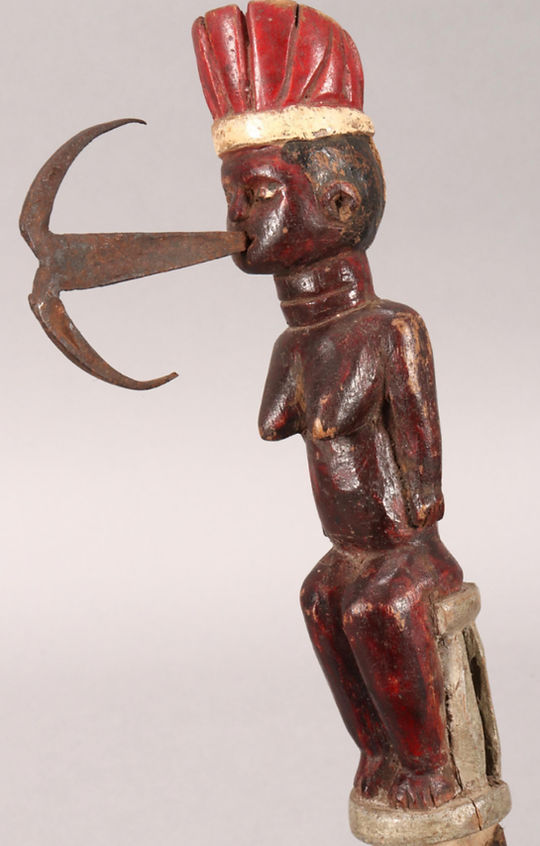
Hevioso Staff. Maker unknown. Fon culture, Benin. Digital image courtesy of Aalders Auctions, Stanmore, Australia (Lot 526, December 3, 2023 Auction), via Invaluable.
author's note: in search of betsey.
In July 1850, Betsey Toledano, a fenm de couleur libre (free woman of color), was arrested in New Orleans’s French Quarter and charged with unlawful assembly. Her offense was the act of having gathered free women of color, enslaved women, and white women in her home for a Voudou ceremony. This was not the first time she was arrested, nor was it the second.
Betsey survives the archives only in fragments. Like so many African-descended women of the nineteenth century, she appears most clearly only during those precise moments the state attempts to discipline or regulate her. Yet one of those fragments is extraordinary. Appearing before Joseph Genois’s First Municipal Court following her July arrest, she reportedly declared that it was an honor “to be a priestess in an order as venerable as the Voudous,” that she had every right to practice her religion, and that she had inherited her tradition from her African grandmother. This courthouse scene and that statement became the seed for this story.
Rather than treat the fragmented archival record—and the silences that accompany it—as an ending, I have approached them as an invitation. Who was this woman who appeared before an antebellum Southern court with such extraordinary confidence? What kind of world produced someone capable of making such a declaration in a court of law at a moment when the legal and political rights of free people of color were steadily being dismantled? And what did she mean when she grounded her authority not just in the laws of Louisiana, but in the inheritance of an African grandmother and in the power to communicate with lightning and water?
If Betsey’s testimony is taken seriously, we are compelled to ask where that grandmother came from, what political worlds she inhabited before Louisiana, what traditions she carried across the Atlantic, and how these informed her engagement with the land, people, and laws of the Mississippi River Delta. Following those questions carries us to the kingdoms and coastal cities of West Africa, where women exercised forms of political and religious authority that have rarely been placed in conversation with the history of Voudou in Louisiana. By allowing West African political worlds to illuminate nineteenth-century Louisiana, New Orleans itself and women like Betsey begin to look different.
The result is a work that is neither biography nor conventional history, but an experiment in historical imagination rooted as firmly as possible in the documentary record. Agbolete, Betsey’s grandmother, and her father, the stevedore, are both historical extrapolations as I have yet to locate Betsey’s baptismal certificate or other evidence of her exact parentage. However, every other major character in this story was a real person I’ve encountered in the archive. Most lived where I say they lived. Many knew one another, moved through the same streets, and inhabited the same social world as indicated in notarial documents, contemporary newspapers, municipal records, census schedules, city directories, and other surviving sources that preserve fragments of their lives. Yet the archive rarely grants us access to their inner lives. We may know where they lived, whom they lived with, where they worshiped, traded, litigated, and socialized—but rarely what they thought, what they felt, or what passed between them in private.
Inspired by what Saidiya Hartman has called critical fabulation, I draw upon archival evidence, historical context, and informed imagination to reconstruct Betsey’s social world and to imagine how she might have experienced her arrest and the events that ensued. While the dialogue, interior reflections, and certain scenes are fictionalized, they remain grounded in research on mid-nineteenth-century New Orleans, primary documents related to family and community genealogy, and the history of the broader Afro-Atlantic world. Throughout the story, I use the spelling Voudou when referring to the religion as it was described in nineteenth-century Louisiana sources and newspapers. In footnotes, I also use the contemporary West African spelling Vodun when referring to the related religious traditions of present-day Benin and Togo.
Additionally, all Louisiana Creole (Kouri-Vini) dialogue follows the orthographic conventions developed by Landry, St. Laurent, and Gisclair. I capitalize “Creole” in recognition of it being a specific language and ethnic identity in Louisiana. Likewise, I employ ”Afro-Creole” and “Black Creole” with a capital letter when referring to a specific sub-culture and social milieu within Creole culture that developed in relation to Louisiana’s colonial racial codes and legal traditions, which were distinct from those emerging out of an Anglo-American legal context. Lastly, I use lower-case “black”, when using the term as an appearance descriptor as opposed to an ethnic identity.
This project draws on my years of teaching and studying African traditional religions throughout the Americas and West Africa. Those experiences have reinforced my belief that practitioners of these traditions are too often remembered through the fears, fantasies, and prejudices of those who sought to regulate, suppress, commercialize, and/or weaponize their religious cultures, rather than through their own understandings of themselves. Likewise, the adherents and leaders of these traditions are rarely imagined as politically informed actors whose religious lives have shaped their ethical engagement with broader struggles over civil rights, community, authority, and survival.
One final note concerns Betsey’s name which has become quite controversial of late within the field of Louisiana Creole art historical studies after Lucia Olubunmi Momoh’s #NotBetsy campaign and master’s thesis publicly exposed how François (née Franz) Fleischbein’s 1837 painting of a free woman of color had been altered by a white conservator and titled “Betsy” (with no “e”) based on the erroneous assumption that the sitter must have been Fleischbein’s enslaved house servant Betsy. In the short story that I relate here, I spell Betsey with an “-sey” because this was how I found the name of the Voudou priestess Betsey written in both English and dual French-English language newspapers and police ledgers. However, I have also seen her name spelled “Betzi Tolédano”, indicating the existence of competing orthographic traditions amidst Louisiana’s mid-nineteenth century multicultural, multi-linguistic environment.
Either way, Betsey is not a typical Louisiana Creole name, but Toledano is (particularly in New Orleans), and so the question becomes: how did she end up with this unique combination of names, and what might it indicate about her background and possible origins? In a separate article, I will elaborate on my interaction with the archives, the politics of certain spelling choices and naming traditions, what they tell us about the world that both #NotBetsy and Betsey inhabited as fenm de couleur libre, and their implications for future writing and research on Louisiana Voudou.
D’Zaklèr é Dolo represents the opening movement of a larger multidisciplinary project combining historical research, visual archives, music, and eventually interactive digital humanities content. It beckons us to look again at Antebellum Louisiana, not through the eyes of the officials who sought to regulate Black religious life, but through those of a woman who refused to surrender the inheritance entrusted to her. This story is my first sketch of a social landscape shaped by lineage and memory, by competing forms of inheritance, by contradictions and silences, by floods and migrations, and by women who spoke with conviction and spiritual authority even as the communities and traditions that birthed their existence and outlook were being transformed. As new evidence emerges and this project continues to grow, some details may change, deepen, or take unexpected turns—as is only fitting for a story concerned with lightning and water.
For now, this is Betsey’s world as I have come to understand it. I hope the ancestors are honored.

Louis Nicolas Adolphe Rinck. Woman in Tignon (sitter unknown). 1844. Oil painting. William E. Groves Collection, Paul and Lulu Hilliard University Art Museum, University of Louisiana at Lafayette. Gift of Mr. and Mrs. W. E. Groves. Accession No. 1962.01.04. Photograph of painting by Robin Miller. CC0 1.0 Universal image via Wikimedia Commons.
selected bibliography.
Bay, Edna G. Wives of the Leopard: Gender, Politics, and Culture in the Kingdom of Dahomey. University of Virginia Press, 1998.
Hall, Gwendolyn Midlo. Africans in Colonial Louisiana: The Development of Afro-Creole Culture in the Eighteenth Century. Louisiana State University Press, 1992.
Hartman, Saidiya. "Venus in Two Acts." Small Axe, vol. 12, no. 2, 2008, pp. 1–14.
Johnson, Jessica Marie. Wicked Flesh: Black Women, Intimacy, and Freedom in the Atlantic World. University of Pennsylvania Press, 2020.
Long, Carolyn Morrow. A New Orleans Voudou Priestess: The Legend and Reality of Marie Laveau. Gainesville: University Press of Florida, 2006.
notes.
[1] Kaintuck was a historic and regional American slang term used primarily to describe a native or resident of Kentucky, often characterized as a rural or rustic frontiersman. The term was also used to describe boatmen from the Ohio River Valley who floated commercial goods down the Mississippi River to trading hubs like New Orleans and Natchez. After selling their goods, these “Kaintucks" would famously walk hundreds of miles back home along the Natchez Trace. The term itself derives from various Indigenous names for the Kentucky region. Depending on the specific Nation, it is rooted in words meaning "at the head of the river" (Shawnee: Kain-tuck-ee), "meadow land” (Kanienʼkehá꞉ka [Mohawk]: Kentake), or "land of tomorrow" (Wyandotte [Wandat]: Kah-ten-tah-teh).
[2] Mina was a colonial term used to designate people hailing from the region between the Volta River in what is today Eastern Ghana eastward through Togo to present-day Benin, the country. This is an area that is today considered the heartland of Vodun worship in West Africa. Ethnic designations under the Mina designation typically included the Aja and Ewe peoples who were genealogically and politically related to the Fon of Dahomey. In the diaspora, the Mina term was used often in the Caribbean and Brazil. Other related ethnic designations included the Arada, as in the kingdom of Arada which was captured by Dahomey in 1724. Their name and ethnicity are reflected in the Rada rites of Haitian Vodou and the Arara religion of Cuba.
[3] In July of 1791, a group of Mina slaves revolted on the estate of the Widow Provillar in New Roads, Point Coupee Parish led by Cesar, an enslaved man from Jamaica; Jacó, an enslaved Mina man; and Juan Luis (Jean Louis), another Mina man, who was known for organizing regular balls there for Mina men. When their plot was discovered by the Spanish colonial authorities, 17 were brought to trial in New Orleans, where the authorities called in local Mina-translators for the trial. As Gwendolyn Midlo Hall pointed out in her groundbreaking book Africans in Colonial Louisiana (1992), this conspiracy revealed an existing network of Mina-speaking slaves along the Mississippi River corridor who were not yet fluent in Louisiana Creole. Given the ceremonial and regular periodicity of their gathering in Point Coupée for a men’s “ball”and their maintenance of strong Mina-ethnic affiliation, I am suggesting it is highly likely that Vodun/Voudou was involved in the planning of this conspiracy as it was in Haiti in August of that same year. In 1795, a group of enslaved people along with three collaborating white men again revolted in Point Coupee. This time 23 were hung, their corpses decapitated, and their heads posted along the Mississippi River Road. Thirty one enslaved rebels were sentenced to flogging and hard labor, and all three white men were deported, with two being sentenced to six years of forced labor in Havana.
[4] Yôvô is a word in the Fongbe language that translates to "foreigner," "white person," or “someone with light skin." It is used as a common, everyday term to refer to any visitor or traveler from the West, regardless of their specific racial background. The term is not necessarily meant as an insult.
[5] In 1726, King Agaja of Dahomey wrote a letter to King George I of England and had it delivered via a European trader who was being held at his court. It took five years for the letter to finally be delivered to authorities in London, at which time it was examined by the Board of Trade and deemed to be a forgery. Some Africanist historians, however, have debated the validity of those forgery claims, and have urged scholars to at least consider the letter as evidence of trade negotiations and attempted communication between Dahomey and England, as King Agaja sent one of his men back to Europe with an employee of the Royal African Company. The original copy of the letter has now been lost to history, but copies of it exist in the archived transcripts of the House of Commons of the United Kingdom Parliament and in various newspapers that reprinted it in parts.
[6] The Kpodjito was the female counterpart, reign mate, or "Woman King" who co-ruled with the King of Dahomey. Frequently of commoner or enslaved origin, the Kpodijto represented a balance of monarchical and commoner authority, and held immense political and religious authority, including the power to negotiate and form coalitions that determined royal succession and influenced the ascension of new kings.
[7] Kouri-Vini is what is typically referred to as Louisiana Creole in English. It is an endangered, French- based Creole language native to Louisiana that developed during the 18th century as a result of contact among enslaved West Africans, French colonists, and Indigenous peoples. In order to distinguish it from Louisiana French as well as distinct languages spoken in the Caribbean such as Haitian, Guadaloupan, or Martinican Creole, language activists are now encouraging the community to refer to the language as Kouri-Vini (KV), a term coined by Creole speakers on the Bayou Teche in Louisiana. It is derived from the way the phrase "I went, you came" (Mo kouri, to vini) is spoken in the language, distinguishing it from standard French (J'ai été, J'ai venu). For more on the history of Kouri-Vini’s official recognition, please see https://www.mylhcv.com/kouri-vini-whats-name/
[8] Translation from Standard French: “Handsome Blacks”; this was in fact, what the early French colonists called initial shipments of Africans arriving directly from Africa to Louisiana in the early 18th century, particularly when they arrived healthy after the long Transatlantic voyage. “Beaux Nègres, grand, bien fait”—handsome, big, and well-made—were in such high demand, members of the Superior Council in the 1720’s and 30’s traded and swapped them amongst themselves and gave some to their friends. See Midlo Hall, Africans in Colonial Louisiana (1992, 67).
[9] Sauvé Crevasse was a Mississippi River levee failure that started 17 miles upriver from the city of New Orleans on May 3rd, 1849 at Pierre Sauvé’s plantation. Initially, the residents of New Orleans had hoped that the water which had bypassed the riverfront levee defenses would find another channel for draining into Lake Pontchartrain in its 17 mile run downriver, but it did not. Instead, it ran right through the swamps and by May 17th entered through the back of the city, flooding a good portion of New Orleans. It took two and a half months for engineers to both repair the breach in the levee up at Sauvé’s and drain the water that had already gotten into the city. The flood displaced 12,000 people, many of whom built huts or pitched tents on the Metairie Ridge to escape the water. It also precipitated a yellow fever outbreak and starvation, as many people did not have fresh food and water for the duration. A Picayune reporter perched on the top of the St. Charles Hotel during the flood said that New Orleans “look[ed] like Venice”.
[10] Ganvié is a lake village in Benin, Africa on Lake Nokoué, near Cotonou. The village was created in the sixteenth or seventeenth centuries by the Tofinu people who took to the lake to avoid Fon warriors and slave raiders. The Ganvie villagers are often referred to as "water men" and the area, the "Venice of Africa.”
[11] The ancien regime literally means “the old regime” in French and refers to the monarchical, political and social system of pre-1789 Revolutionary France. Society in France under the ancien régime was characterized by an absolute monarchy and defined by a rigid social hierarchy and a strict three-estate system: First Estate: the clergy (Catholic church leaders); Second Estate: the nobility (aristocrats and royals); and the Third Estate: commoners (peasants, merchants, and professionals).
[12] Grif (KV)/Griffe (Standard French) is a historical racial classification used predominantly in the Americas—especially in Louisiana and the Caribbean—that refers to someone of mixed African and European descent, typically an offspring of an African person and a mulatto. In Louisiana, however, the term was also heavily used to refer to someone of mixed African and Native American ancestry. These classifications did not follow exact blood quantum, but referred to how someone appeared. In archival documents, Mathurin Rivaros was labeled as “mulatrê” (mulatto) sometimes and as “griffe” on other occasions.
gratitude.
This project was funded by a Fellows Grant from The Crossroads Project, a collaborative research initiative directed by Judith Weisenfeld, Anthea Butler, and Lerone Martin and supported by the Henry Luce Foundation and Princeton University. Ongoing research for this project has also been supported by a Monroe Fellowship from Tulane University and a Community Solidarity Fellowship from the Guilbeau Center for Public History, University of Louisiana, Lafayette. Special thank you to Ms. Beryl F. Hunter at the New Orleans Notarial Archives for helping me not only to access documents but to imagine how our ancestors might have experienced Antebellum New Orleans spatially and somatically. Dr. Nathan Rabalais for initial French translations of archival documents. Queen Mother Sêmévo Dr. Dòwòti Désir for feedback on the final draft of this story.
fair use.
The historical images reproduced throughout this work are included to support scholarly interpretation, historical education, and public understanding of the people, places, and religious traditions discussed in the accompanying text. Every effort has been made to identify rights holders, provide accurate attribution, and obtain permission where required.
Some images are reproduced under open-access or public-domain policies established by the holding institution. Others are included pursuant to the principles of fair use under Section 107 of the United States Copyright Act for purposes of scholarship, research, criticism, commentary, and education. Such images are reproduced in a non-commercial context and are presented solely to illustrate the historical subjects discussed in this work. Copyright in these images remains with their respective rights holders where applicable.
If you are a rights holder and believe that any image has been reproduced in error or without appropriate authorization, please contact the author so that the matter may be promptly addressed in future editions.
cite this project.
Projects featured on this site are the intellectual property of the Fellows who created them and may not be reproduced without their permission.
Please cite the creator if you use their work in support of your own.
Citation: Booker, Sheriden M. “D’Zaklér é Dolo: (A Lineage of Lightning and Fire)." SPIRIT HOUSE: A Crossroads Project. July 2026. Date Accessed. https://www.crossroads-spirithouse.org/booker

Sheriden M. Booker, Ph.D. is an interdisciplinary artist, storyteller, and scholar whose work explores Black womanhood, and evolving questions of place, lineage, belonging, diaspora and indigeneity in the Afro-Atlantic world. Working across historical fiction, archival research, music, digital humanities, and community-engaged performance, she delves into the nuanced political genealogies and emotional geographies of overlooked women's histories. “D'Zaklèr é Dolo (A Lineage of Lightning and Water)” is the first installment of 238 Years of Devotion, an evolving multidisciplinary project tracing the historical and spiritual lineages of Black Creole religious life and women’s leadership in Louisiana. Combining archival research with imaginative storytelling in the spirit of critical fabulation, the next installment of this project will expand into music and an interactive digital humanities exhibition.
“D'Zaklèr é Dolo” is also the second vignette in Kat Fenm, an ongoing cycle of stories about remarkable, defiant women from the semi-mythical land of Di Pa Ça—a place where they have been told for generations, "Don't say that," yet say it anyway. Conceived as a Louisiana Afro-Creole conversation with Nina Simone's Four Women, the series reimagines Black women's contributions to the religious, cultural, and political life of the Gulf South while honoring the enduring legacies of African women across the Atlantic world.
Sheriden teaches in the Department of Black Studies at The City College of New York and divides her time between Louisiana and New York.
_edited.jpg)